A wire of density kg cm is stretched between two clamps 1 m apart. The resulting strain in the wire is . The lowest frequency of the transverse vibrations in the wire (Young's modulus of wire Nm), (to the nearest integer) is ___________.
Every Waves question JEE Main has set, grouped by the idea it tests rather than the order of the syllabus. 169 questions across 6 distinct ideas. Free to read, answer key on every one.
Questions
169
Distinct ideas
6
Share of marks
2.2%
Difficulty
MEDIUM
A chapter is not one subject — it is a handful of procedures the examiner reuses. These are the ones Waves questions actually test.
101–120 OF 169 · NEWEST FIRST
A wire of density kg cm is stretched between two clamps 1 m apart. The resulting strain in the wire is . The lowest frequency of the transverse vibrations in the wire (Young's modulus of wire Nm), (to the nearest integer) is ___________.
A heavy ball of mass is suspended from the ceiling of a car by a light string of mass (). When the car is at rest, the speed of transverse waves in the string is 60 ms. When the car has acceleration , the wave-speed increases to 60.5 ms. The value of , in terms of gravitational acceleration , is closest to:
A stationary source emits sound waves of frequency 500 Hz. Two observers moving along a line passing through the source detect sound to be of frequencies 480 Hz and 530 Hz. Their respective speeds are, in m s,
(Given speed of sound = 300 m/s)
16, 14
12, 16
12, 18
8, 18
A train moves towards a stationary observer with speed 34 m/s. The train sounds a whistle and its frequency registered by the observer is . If the speed of the train is reduced to 17 m/s, the frequency registered is . If speed of sound is 340 m/s, then the ratio is:
21/20
20/19
19/18
18/17
A travelling harmonic wave is represented by the equation , where x and y are in meter and t is in seconds. Which of the following is a correct statement about the wave?
The wave is propagating along the positive x-axis with speed 25 m s
The wave is propagating along the positive x-axis with speed 100 m s
The wave is propagating along the negative x-axis with speed 25 m s
The wave is propagating along the negative x-axis with speed 100 m s
A submarine A travelling at 18 km hr is being chased along the line of its velocity by another submarine B travelling at 27 km hr. B sends a sonar signal of 500 Hz to detect A and receives a reflected sound of frequency v. The value of v is close to (Speed of sound in water 1500 m s)
504 Hz
499 Hz
502 Hz
507 Hz
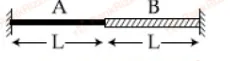
A wire of length 2L, is made by joining two wires A and B of same length but different radii r and 2r and made of the same material. It is vibrating at a frequency such that the joint of the two wires forms a node. If the number of antinodes in wire A is p and that in B is q then ratio p:q is:

3 : 5
4 : 9
1 : 4
1 : 2
Equation of travelling wave on a stretched string of linear density 5 g/m is where distance and time are measured in SI units. The tension in the string is:
10 N
7.5 N
12.5 N
5 N
A musician using an open flute of length 50 cm produces second harmonic sound waves. A person runs towards the musician from another end of a hall at a speed of 10 km h. If the wave speed is 330 m s, the frequency heard by the running person shall be close to:
333 Hz
500 Hz
666 Hz
753 Hz
A string of length 1 m and mass 5 g is fixed at both ends. The tension in the string is 8.0 N. The string is set into vibration using an external vibrator of frequency 100 Hz. The separation between successive nodes on the string is close to:
20.0 cm
10.0 cm
16.6 cm
33.3 cm
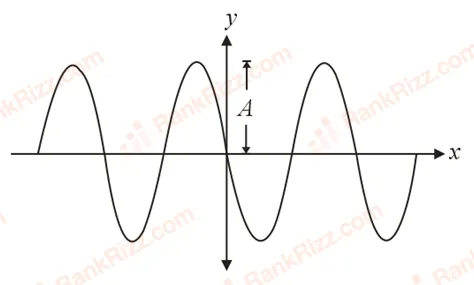
A progressive wave travelling along the positive x-direction is represented by . Its snapshot at t = 0 is given in the figure.
For this wave, the phase is:
0
A resonance tube is old and has a jagged end. It is still used in the laboratory to determine the velocity of sound in air. A tuning fork of frequency 512 Hz produces first resonance when the tube is filled with water to a mark 11 cm below a reference mark, near the open end of the tube. The experiment is repeated with another fork of frequency 256 Hz which produces first resonance when water reaches a mark 27 cm below the reference mark. The velocity of sound in air, obtained in the experiment, is close to
335 m s
341 m s
322 m s
328 m s
Two cars A and B are moving away from each other in opposite directions. Both the cars are moving with speed of 20 m s with respect to the ground. If an observer in car A detects a frequency 2000 Hz of the sound coming from car B, what is the natural frequency of the sound source in car B? (speed of sound in air = 340 m s)
2150 Hz
2300 Hz
2250 Hz
2060 Hz
A string is clamped at both the ends and it is vibrating in its 4th harmonic. The equation of the stationary wave is . The length of the string is: (All quantities are in SI units.)
20 m
60 m
40 m
80 m
A string 2.0 m long and fixed at its ends is driven by a 240 Hz vibrator. The string vibrates in its third harmonic mode. The speed of the wave and its fundamental frequency is:
320 m s, 120 Hz
320 m s, 80 Hz
180 m s, 80 Hz
180 m s, 120 Hz
A small speaker delivers 2 W of audio output. At what distance from the speaker will one detect 120 dB intensity sound? [Given reference intensity of sound as W/m]
40 cm
20 cm
10 cm
30 cm
The pressure wave, N m, corresponds to the sound produced by a vibrating blade on a day when atmospheric temperature is 0°C. On some other day when temperature is T, the speed of sound produced by the same blade and at the same frequency is found to be 336 m s. Approximate value of T is:
12°C
15°C
4°C
11°C
A closed organ pipe has a fundamental frequency of 1.5 kHz. The number of overtones that can be distinctly heard by a person with this organ pipe will be (Assume that the highest frequency a person can hear is 20,000 Hz).
7
4
6
5
Two sources of sound S and S produce sound waves of same frequency 660 Hz. A listener is moving from source S towards S with a constant speed u m/s and he hears 10 beats/s. The velocity of sound is 330 m/s. Then, u equals:
10.0 m/s
2.5 m/s
5.5 m/s
15.0 m/s
A source of sound S is moving with a velocity of 50 m s towards a stationary observer. The observer measures the frequency of the source as 1000 Hz. What will be the apparent frequency of the source when it is moving away from the observer after crossing him? (Take velocity of sound in air is 350 m s)
750 Hz
857 Hz
1143 Hz
807 Hz
OTHER PHYSICS CHAPTERS