RankRizzStart free

Thermal Properties of Matter — JEE Main Previous Year Questions

Every Thermal Properties of Matter question JEE Main has set, grouped by the idea it tests rather than the order of the syllabus. 116 questions across 6 distinct ideas. Free to read, answer key on every one.

Questions

116

Distinct ideas

6

Share of marks

1.6%

Difficulty

MEDIUM

The ideas inside Thermal Properties of Matter

A chapter is not one subject — it is a handful of procedures the examiner reuses. These are the ones Thermal Properties of Matter questions actually test.

01Temperature scales and thermal expansionset 26×
02Calorimetry and specific heat capacityset 23×
03Change of state and latent heatset 20×
04Heat conduction and thermal resistanceset 23×
05Thermal radiation: Stefan's law, Wien's law and Kirchhoff's lawset 6×
06Newton's law of coolingset 18×

Every Thermal Properties of Matter question

81–100 OF 116 · NEWEST FIRST

JEE MAIN 2019 · 08 APR S1Change of state and latent heatTRANSCRIBED

A thermally insulated vessel contains 150 g of water at 0°C. Then the air from the vessel is pumped out adiabatically. A fraction of water turns into ice and the rest evaporates at 0°C itself. The mass of evaporated water will be closest to: (Latent heat of vaporization of water = J kg and Latent heat of Fusion of water = J kg)

  1. A

    35 g

  2. B

    20 g

  3. C

    130 g

  4. D

    150 g

JEE MAIN 2019 · 09 JAN S1Heat conduction and thermal resistanceTRANSCRIBED

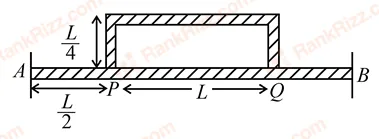
Temperature difference of 120C is maintained between two ends of a uniform rod of length . Another bent rod , of same cross-section as and length , is connected across (See figure). In steady state, temperature difference between and will be close to:

  1. A

    45C

  2. B

    35C

  3. C

    60C

  4. D

    75C

JEE MAIN 2019 · 11 JAN S2Calorimetry and specific heat capacityTRANSCRIBED

When 100 g of a liquid A at is added to 50 g of a liquid B at temperature , the temperature of the mixture becomes . The temperature of the mixture, if 100 g of liquid A at is added to 50 g of liquid B at , will be:

  1. A

  2. B

  3. C

  4. D

JEE MAIN 2019 · 08 APR S1Newton's law of coolingTRANSCRIBED

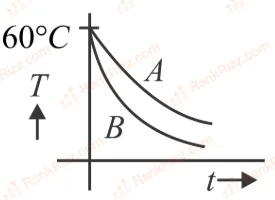
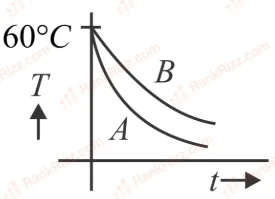
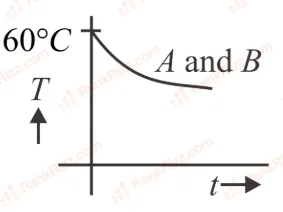
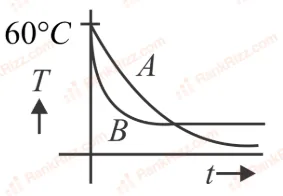
Two identical beakers A and B contain equal volumes of two different liquids at 60°C each and left to cool down. Liquid in A has density of kg m and specific heat of 2000 J kgK while the liquid in B has density kg m and specific heat of 4000 J kgK. Which of the following best describes their temperature versus time graph schematically? (assume the emissivity of both the beakers to be the same)

  1. A
    image
  2. B
    image
  3. C
    image
  4. D
    image
JEE MAIN 2019 · 11 JAN S2Calorimetry and specific heat capacityTRANSCRIBED

A metal ball of mass 0.1 kg is heated upto and dropped into a vessel of heat capacity and containing 0.5 kg water. The initial temperature of water and vessel is . What is the approximate percentage increment in the temperature of the water? [Specific Heat Capacities of water and metal are, respectively, and ]

  1. A

    15%

  2. B

    30%

  3. C

    25%

  4. D

    20%

JEE MAIN 2019 · 09 APR S2Calorimetry and specific heat capacityTRANSCRIBED

A massless spring (k = 800 N/m), attached with a mass (500 g) is completely immersed in 1 kg of water. The spring is stretched by 2 cm and released so that it starts vibrating. What would be the order of magnitude of the change in the temperature of water when the vibrations stop completely? (Assume that the water container and spring receive negligible heat and specific heat of mass = 400 J/kg K, water = 4184 J/kg K)

  1. A

    K

  2. B

    K

  3. C

    K

  4. D

    K

JEE MAIN 2018 · 08 APR OFFLINECalorimetry and specific heat capacityTRANSCRIBED

The mass of a hydrogen molecule is kg. If hydrogen molecules strike, per second, a fixed wall of the area 2 cm at an angle of 45 to the normal, and rebound elastically with a speed of m s, then the pressure on the wall is nearly:

  1. A

    N m

  2. B

    N m

  3. C

    N m

  4. D

    N m

JEE MAIN 2018 · 15 APR S2Newton's law of coolingTRANSCRIBED

A body takes 10 minutes to cool from 60C to 50C. The temperature of surroundings is constant at 25C. Then, the temperature of the body after next 10 minutes will be approximately

  1. A

    43C

  2. B

    47C

  3. C

    41C

  4. D

    45C

JEE MAIN 2018 · 08 APR OFFLINECalorimetry and specific heat capacityTRANSCRIBED

Two moles of an ideal monoatomic gas occupies a volume V at 27C. The gas expands adiabatically to a volume 2V. Calculate (a) the final temperature of the gas and (b) change in its internal energy.

  1. A

    (a) 195 K (b) 2.7 kJ

  2. B

    (a) 189 K (b) 2.7 kJ

  3. C

    (a) 195 K (b) -2.7 kJ

  4. D

    (a) 189 K (b) -2.7 kJ

JEE MAIN 2017 · 02 APR OFFLINECalorimetry and specific heat capacityTRANSCRIBED

A copper ball of mass 100 g is at a temperature . It is dropped in a copper calorimeter of mass 100 g, filled with 170 g of water at room temperature. Subsequently, the temperature of the system is found to be 75°C. is given by:
(Given: room temperature = 30°C, specific heat of copper = 0.1 cal g °C)

  1. A

    825°C

  2. B

    800°C

  3. C

    885°C

  4. D

    1250°C

JEE MAIN 2017 · 08 APR ONLINECalorimetry and specific heat capacityTRANSCRIBED

In an experiment, a sphere of aluminium of mass 0.20 kg is heated up to 150°C. Immediately, it is put into water of volume 150 cc at 27°C kept in a calorimeter of water equivalent to 0.025 kg. The final temperature of the system is 40°C. The specific heat of the aluminium is (take 4.2 Joule = 1 calorie):

  1. A

    434 J kg °C

  2. B

    378 J kg °C

  3. C

    315 J kg °C

  4. D

    476 J kg °C

JEE MAIN 2016 · 03 APR OFFLINETemperature scales and thermal expansionTRANSCRIBED

A pendulum clock loses 12 s a day if the temperature is 40°C and gains 4 s a day if the temperature is 20°C. The temperature at which the clock will show correct time, and the co-efficient of linear expansion () of the metal of the pendulum shaft are respectively:

  1. A

    30°C; /°C

  2. B

    55°C; /°C

  3. C

    25°C; /°C

  4. D

    60°C; /°C

JEE MAIN 2016 · 09 APR ONLINETemperature scales and thermal expansionTRANSCRIBED

A simple pendulum made of a bob of mass m and a metallic wire of a negligible mass has a time period of 2 s at . If the temperature of the wire is increased, and the corresponding change in its time period is plotted against its temperature, the resulting graph is a line of slope . If the coefficient of linear expansion of metal is , then the value of is

  1. A

  2. B

  3. C

  4. D

JEE MAIN 2016 · 09 APR ONLINECalorimetry and specific heat capacityTRANSCRIBED

200 g water is heated from 40°C to 60°C. Ignoring the slight expansion of water, the change in its internal energy is close to (Given specific heat of water = 4184 J kg K):

  1. A

    167.4 kJ

  2. B

    8.4 kJ

  3. C

    4.2 kJ

  4. D

    16.7 kJ

JEE MAIN 2015 · 11 APR ONLINEChange of state and latent heatTRANSCRIBED

An experiment takes 10 min to raise the temperature of water in a container from 0C to 100C and another 55 min to convert it totally into steam by a heater supplying heat at a uniform rate. Neglecting the specific heat of the container and taking specific heat of the water to be 1 cal (gC), the heat of vaporization according to this experiment will come out to be:

  1. A

    530 cal g

  2. B

    550 cal g

  3. C

    540 cal g

  4. D

    560 cal g

JEE MAIN 2014 · 09 APR ONLINECalorimetry and specific heat capacityTRANSCRIBED

Water of volume 2 L in a closed container is heated with a coil of 1 kW. While water is heated, the container loses energy at a rate of 160 J/s. In how much time will the temperature of water rise from 27°C to 77°C? (Specific heat of water is 4.2 kJ/kg and that of the container is negligible).

  1. A

    8 min 20 s

  2. B

    7 min

  3. C

    14 min

  4. D

    6 min 2 s

JEE MAIN 2014 · 11 APR ONLINENewton's law of coolingTRANSCRIBED

A hot body, obeying Newton's law of cooling is cooling down from its peak value 80°C to an ambient temperature of 30°C. It takes 5 minutes in cooling down from 80°C to 40°C. How much time will it take to cool down from 62°C to 32°C? (Given ln 2 = 0.693, ln 5 = 1.609)

  1. A

    3.75 minutes

  2. B

    8.6 minutes

  3. C

    9.6 minutes

  4. D

    6.5 minutes

JEE MAIN 2014 · 12 APR ONLINENewton's law of coolingTRANSCRIBED

Hot water cools from 60°C to 50°C in the first 10 minutes and to 42°C in the next 10 minutes. The temperature of the surroundings is:

  1. A

    25°C

  2. B

    10°C

  3. C

    15°C

  4. D

    20°C

JEE MAIN 2014 · 19 APR ONLINEThermal radiation: Stefan's law, Wien's law and Kirchhoff's lawTRANSCRIBED

A black coloured solid sphere of radius R and mass M is inside a cavity with vacuum inside. The walls of the cavity are maintained at temperature . The initial temperature of the sphere is . If the specific heat of the material of the sphere varies as per unit mass with the temperature T of the sphere, where is a constant, then the time taken for the sphere to cool down to temperature will be ( is Stefan Boltzmann constant)

  1. A

  2. B

  3. C

  4. D

JEE MAIN 2014 · 06 APR OFFLINEHeat conduction and thermal resistanceTRANSCRIBED

Three rods of Copper, Brass and Steel are welded together to form a Y-shaped structure. Area of cross-section of each rod is 4 cm. End of copper rod is maintained at 100 °C. Where as ends of brass and steel are kept at 0 °C. Lengths of the copper, brass and steel rods are 46, 13 and 12 cms respectively. The rods are thermally insulated from surroundings except at ends. Thermal conductivities of copper, brass and steel are 0.92, 0.26 and 0.12 CGS units respectively. Rate of heat flow through copper rod is:

  1. A

    1.2 Cal/s

  2. B

    2.4 Cal/s

  3. C

    4.8 Cal/s

  4. D

    6.0 Cal/s