When the temperature of a metal wire is increased from 0C to 10C, its length increases by 0.02%. The percentage change in its mass density will be closed to:
- A
0.06
- B
2.3
- C
0.008
- D
0.8
Every Thermal Properties of Matter question JEE Main has set, grouped by the idea it tests rather than the order of the syllabus. 116 questions across 6 distinct ideas. Free to read, answer key on every one.
Questions
116
Distinct ideas
6
Share of marks
1.6%
Difficulty
MEDIUM
A chapter is not one subject — it is a handful of procedures the examiner reuses. These are the ones Thermal Properties of Matter questions actually test.
61–80 OF 116 · NEWEST FIRST
When the temperature of a metal wire is increased from 0C to 10C, its length increases by 0.02%. The percentage change in its mass density will be closed to:
0.06
2.3
0.008
0.8
Two different wires having lengths and and respective temperature coefficient of linear expansion and , are joined end-to-end. Then the effective temperature coefficient of linear expansion is:
A metallic sphere cools from 50°C to 40°C in 300 s. If atmospheric temperature around is 20°C, then the sphere's temperature after the next 5 minutes will be close to:
31°C
33°C
28°C
35°C
The specific heat of water = 4200 J kg K and the latent heat of ice = J kg. 100 grams of ice at 0°C is placed in 200 g of water at 25°C. The amount of ice that will melt as the temperature of water reaches 0°C is close to (in grams)
61.7
63.8
69.3
64.6
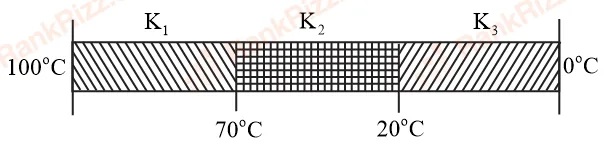
Three rods of identical cross-section and length are made of three different materials of thermal conductivity , and , respectively. They are joined together at their ends to make a long rod (see figure). One end of the long rod is maintained at and the other at (see figure). If the joints of the rod are at and in steady state and there is no loss of energy from the surface of the rod, the correct relationship between , and is:

;
K_1 < K_2 < K_3
;
K_1 > K_2 > K_3
A calorimeter of water equivalent 20 g contains 180 g of water at 25°C. 'm' grams of steam at 100°C is mixed in it till the temperature of the mixture is 31°C. The value of 'm' is close to (Latent heat of water = 540 cal g, specific heat of water = 1 cal g°C)
2
4
3.2
2.6
A bullet of mass , travelling with a speed of , strikes a fixed wooden target. One half of its kinetic energy is converted into heat in the wood. The rise of temperature of the bullet if the specific heat of its material is () close to:
A non-isotropic solid metal cube has coefficients of linear expansion as: /C along the x-axis and /C along the y and the z-axis. If the coefficient of volume expansion of the solid is /C then the value of C is
M grams of steam at 100C is mixed with 200g of ice at its melting point in a thermally insulated container. If it produces liquid water at 40C [heat of vaporization of water is 540 cal/g and heat of fusion of ice is 80 cal/g], the value of M is
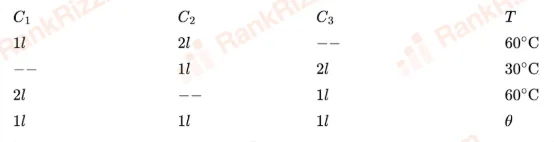
Three containers , and have water at different temperatures. The table below shows the final temperature T when different amounts of water (given in liters) are taken from each container and mixed (assume no loss of heat during the process)
The value of (in C to the nearest integer) is__________
A bakelite beaker has volume capacity of 500 cc at 30°C. When it is partially filled with volume (at 30°C) of mercury, it is found that the unfilled volume of the beaker remains constant as temperature is varied. If °C, where is the coefficient of volume expansion, then (in cc) is close to...
Two rods A and B of identical dimensions are at temperature . If A is heated upto and B upto , then the new lengths are the same. If the ratio of the coefficients of linear expansion of A and B is 4 : 3, then the value of T is
A cylinder of radius R is surrounded by a cylindrical shell of inner radius R and outer radius 2R. The thermal conductivity of the material of the inner cylinder is and that of the outer cylinder is . Assuming no loss of heat, the effective thermal conductivity of the system for heat flowing along the length of the cylinder is:
Ice at is added to 50 g of water at . When the temperature of the mixture reaches , it is found that 20 g of ice is still unmelted. The amount of ice added to the water was close to (Specific heat of water = 4.2 J/g/°C, Specific heat of Ice = 2.1 J/g/°C, Heat of fusion of water at = 334 J/g)
50 g
100 g
60 g
40 g
A thermometer graduated according to a linear scale reads a value when in contact with boiling water, and when in contact with ice. What is the temperature of an object in °C, if this thermometer in the contact with the object reads ?
25
60
40
35
When M gram of ice at -10°C (specific heat = 0.5 cal g °C) is added to M gram of water at 50°C, finally no ice is left and the water is at 0°C. The value of latent heat of ice, in cal g is:
A heat source at K is connected to another heat reservoir at K by a copper slab which is 1 m thick. Given that the thermal conductivity of copper is 0.1 W K m, the energy flux through it in the steady-state is:
65 W m
120 W m
90 W m
200 W m
An unknown metal of mass 192 g heated to a temperature of 100C was immersed into a brass calorimeter of mass 128 g containing 240 g of water at a temperature of 8.4C. Calculate the specific heat of the unknown metal if water temperature stabilizes at 21.5C. (Specific heat of brass is 394 J kgK)
916 J kg K
458 J kg K
654 J kg K
1232 J kg K
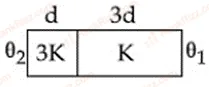
Two materials having coefficients of thermal conductivity 3K and K and thickness d and 3d respectively, are joined to form a slab as shown in the figure. The temperatures of the outer surfaces are and respectively, (\theta_2 > \theta_1). The temperature at the interface is:

1 kg of water, at 20°C is heated in an electric kettle whose heating element has a mean (temperature averaged) resistance of 20 Ω. The rms voltage in the mains is 200 V. Ignoring heat loss from the kettle, time taken for water to evaporate fully is close to
[Specific heat of water = 4200 J kg °C Latent heat of water = 2260 kJ kg]
3 min
16 min
22 min
10 min
OTHER PHYSICS CHAPTERS