JEE MAIN 2025 · 24 JAN S2Energy in simple harmonic motionTRANSCRIBED
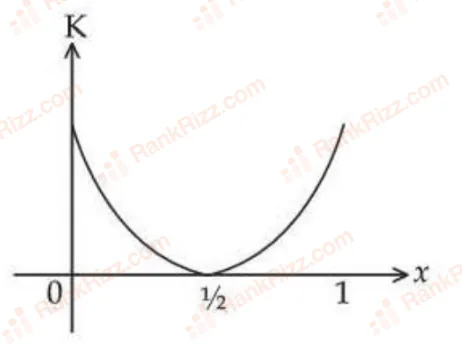
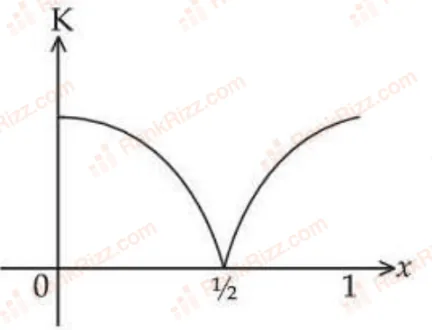
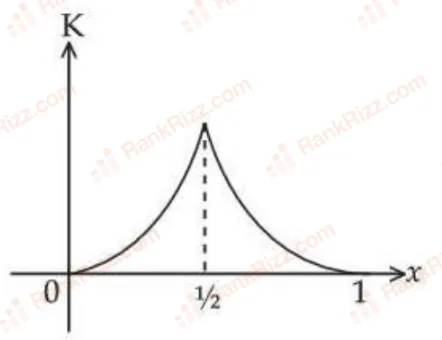
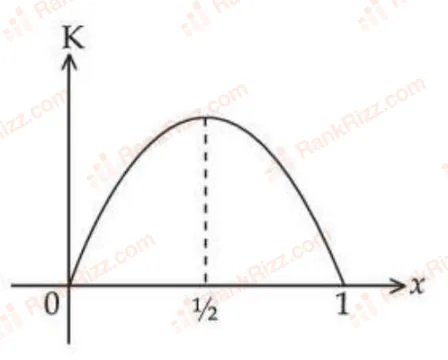
A particle oscillates along the -axis according to the law, where . The kinetic energy of the particle as a function of is correctly represented by the graph
- A
- B
- C
- D
Every Oscillations question JEE Main has set, grouped by the idea it tests rather than the order of the syllabus. 182 questions across 7 distinct ideas. Free to read, answer key on every one.
Questions
182
Distinct ideas
7
Share of marks
2.8%
Difficulty
MEDIUM
A chapter is not one subject — it is a handful of procedures the examiner reuses. These are the ones Oscillations questions actually test.
21–40 OF 182 · NEWEST FIRST
A particle oscillates along the -axis according to the law, where . The kinetic energy of the particle as a function of is correctly represented by the graph
Given below are two statements. One is labelled as Assertion (A) and the other is labelled as Reason (R). Assertion (A) : A simple pendulum is taken to a planet of mass and radius, 4 times and 2 times, respectively, than the Earth. The time period of the pendulum remains same on earth and the planet. Reason (R): The mass of the pendulum remains unchanged at Earth and the other planet. In the light of the above statements, choose the correct answer from the options given below :
(A)is false but (R) is true
(A) is true but (R) is false
Both (A) and (R) are true but (R) is the correct explanation of (A)
Both (A) and (R) are true but (R) is NOT the correct explanation of (A)
A light hollow cube of side length 10 cm and mass 10 g , is floating in water. It is pushed down and released to execute simple harmonic oscillations. The time period of oscillations is , where the value of y is (Acceleration due to gravity, , density of water
6
2
4
1
Two simple pendulums having lengths and with negligible string mass undergo angular displacements and , from their mean positions, respectively. If the angular accelerations of both pendulums are same, then which expression is correct?
Given below are two statements : one is labelled as Assertion (A) and the other is labelled as Reason (R). Assertion (A) : Time period of a simple pendulum is longer at the top of a mountain than that at the base of the mountain. Reason (R): Time period of a simple pendulum decreases with increasing value of acceleration due to gravity and vice-versa. In the light of the above statements, choose the most appropriate answer from the options given below :
Both (A) and (R) are true and (R) is the correct explanation of (A)
(A) is true but (R) is false
(A) is false but (R) is true
Both (A) and (R) are true but (R) is not the correct explanation of (A)
A simple pendulum doing small oscillations at a place R height above earth surface has time period of . would be its time period if it is brought to a point which is at a height from earth surface. Choose the correct relation :
In simple harmonic motion, the total mechanical energy of given system is . If mass of oscillating particle is doubled then the new energy of the system for same amplitude is
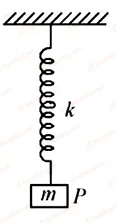
A mass is suspended from a spring of negligible mass and the system oscillates with a frequency . The frequency of oscillations if a mass is suspended from the same spring is . The value of is ______.
A particle executes simple harmonic motion with an amplitude of cm. At the mean position, velocity of the particle is . The distance of the particle from the mean position when its speed becomes is cm, where ______.
When the displacement of a simple harmonic oscillator is one third of its amplitude, the ratio of total energy to the kinetic energy is , where _______.
A simple harmonic oscillator has an amplitude and time period second. Assuming the oscillation starts from its mean position, the time required by it to travel from to will be s, where ______.
A particle performs simple harmonic motion with amplitude . Its speed is increased to three times at an instant when its displacement is . The new amplitude of motion is . The value of is _____.
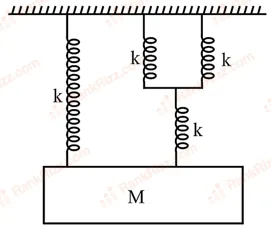
The time period of simple harmonic motion of mass in the given figure is , where the value of is
The displacement of a particle executing SHM is given by m. The time period of motion is s. The velocity of the particle at is _____ m/s.
A particle is doing simple harmonic motion of amplitude and time period . The maximum velocity of the particle is _______ cm/s.
An object of mass 0.2 kg executes simple harmonic motion along x axis with frequency of Hz. At the position m the object has kinetic energy 0.5 J and potential energy 0.4 J. The amplitude of oscillation is _____ cm.
The position, velocity and acceleration of a particle executing simple harmonic motion are found to have magnitudes of m, ms and ms at a certain instant. The amplitude of the motion is m, where is ________
A particle of mass executes simple harmonic motion under force . The time period of oscillation is s. The value of is ______ (Given )
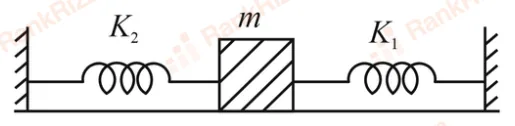
A mass is attached to two springs as shown in figure. The spring constants of two springs are and . For the frictionless surface, the time period of oscillation of mass is
is the time period of simple pendulum on the earth's surface. If time period becomes when taken to a height (equal to earth's radius) above the earth's surface. Then, the value of will be:
4
2
OTHER PHYSICS CHAPTERS