RankRizz

Biot-Savart law: straight wires and moving charges — JEE Main Previous Year Questions

Every JEE Main question on Biot-Savart law: straight wires and moving charges, one of the ideas inside Moving Charges & Magnetism: 75 questions from 2007–2026, 46 of them in the last five years. Newest first, answer key on every one. Free to read.

Questions

75

Years asked

16

Since

2007

Of the chapter

30%

Every Biot-Savart law: straight wires and moving charges question

61–75 OF 75 · NEWEST FIRST

JEE MAIN 2019 · 08 APR S2Biot-Savart law: straight wires and moving chargesTRANSCRIBED

Two very long, straight, and insulated wires are kept at 90° angle from each other in xy-plane as shown in figure. These wires carry currents of equal magnitude I, whose direction are shown in the figure. The net magnetic field at point P will be:
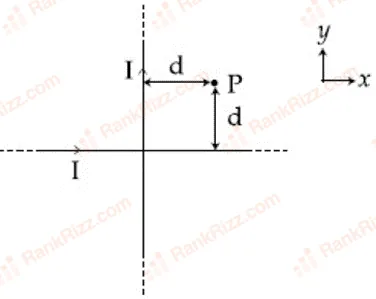
Figure for JEE Main 2019 Physics question on Biot-Savart law: straight wires and moving charges
  1. A

    −μ0I2πd(x^+y^)-\frac{\mu_0 I}{2\pi d}(\hat{x} + \hat{y})

  2. B

    +μ0Iπdz^\frac{+\mu_0 I}{\pi d}\hat{z}

  3. C

    μ0I2πd(x^+y^)\frac{\mu_0 I}{2\pi d}(\hat{x} + \hat{y})

  4. D

    Zero

JEE MAIN 2019 · 12 APR S1Biot-Savart law: straight wires and moving chargesTRANSCRIBED

A thin ring of 10 cm radius carries a uniformly distributed charge. The ring rotates at a constant angular speed of 40π40\pi rad s−1^{-1} about its axis, perpendicular to its plane. If the magnetic field at its centre is 3.8×10−93.8 \times 10^{-9} T, then the charge carried by the ring is close to μ0=4π×10−7\mu_0 = 4\pi \times 10^{-7} N/A2^2.

  1. A

    4×10−54 \times 10^{-5} C

  2. B

    3×10−53 \times 10^{-5} C

  3. C

    2×10−62 \times 10^{-6} C

  4. D

    7×10−67 \times 10^{-6} C

JEE MAIN 2019 · 09 JAN S1Biot-Savart law: straight wires and moving chargesTRANSCRIBED

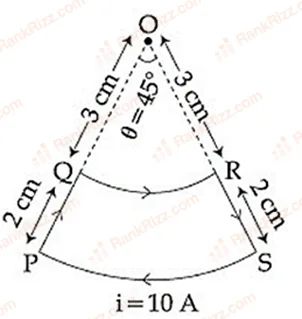
A current loop, having two circular arcs joined by two radial lines is shown in the figure. It carries a current of 10 A. The magnetic field at point O will be close to:

Figure for JEE Main 2019 Physics question on Biot-Savart law: straight wires and moving charges
  1. A

    1.5×10−71.5 \times 10^{-7} T

  2. B

    1.0×10−71.0 \times 10^{-7} T

  3. C

    1.5×10−51.5 \times 10^{-5} T

  4. D

    1.0×10−51.0 \times 10^{-5} T

JEE MAIN 2019 · 10 APR S2Biot-Savart law: straight wires and moving chargesTRANSCRIBED

The magnitude of the magnetic field at the centre of an equilateral triangular loop of side 1 m which is carrying a current of 10 A is:
[Take μ0=4π×10−7\mu_0 = 4\pi \times 10^{-7} N A−2^{-2}]

  1. A

    3 μT

  2. B

    1 μT

  3. C

    18 μT

  4. D

    9 μT

JEE MAIN 2018 · 15 APR S1Biot-Savart law: straight wires and moving chargesTRANSCRIBED

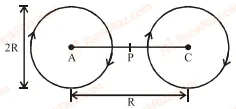
A Helmholtz coil has pair of loops, each with N turns and radius R. They are placed coaxially at distance R and the same current I flows through the loops in the same direction. The magnitude of magnetic field at P, midway between the centres A and C, is given by (Refer to figure):
Figure for JEE Main 2018 Physics question on Biot-Savart law: straight wires and moving charges

  1. A

    4Nμ0I53/2R\frac{4N\mu_0 I}{5^{3/2}R}

  2. B

    8Nμ0I53/2R\frac{8N\mu_0 I}{5^{3/2}R}

  3. C

    4Nμ0I51/2R\frac{4N\mu_0 I}{5^{1/2}R}

  4. D

    8Nμ0I51/2R\frac{8N\mu_0 I}{5^{1/2}R}

JEE MAIN 2018 · 15 APR S2Biot-Savart law: straight wires and moving chargesTRANSCRIBED

A current of 1 A is flowing on the sides of an equilateral triangle of side 4.5×10−24.5 \times 10^{-2} m. The magnetic field at the centre of the triangle will be:

  1. A

    4×10−54 \times 10^{-5} Wb/m2^2

  2. B

    Zero

  3. C

    2×10−52 \times 10^{-5} Wb/m2^2

  4. D

    8×10−58 \times 10^{-5} Wb/m2^2

JEE MAIN 2016 · 03 APR OFFLINEBiot-Savart law: straight wires and moving chargesTRANSCRIBED

Two identical wires A and B, each of length ll, carry the same current II. Wire A is bent into a circle of radius R and wire B is bent to form a square of side aa. If BAB_A and BBB_B are the values of magnetic field at the centres of the circle and square respectively, then the ratio BABB\frac{B_A}{B_B} is

  1. A

    π216\frac{\pi^2}{16}

  2. B

    π282\frac{\pi^2}{8\sqrt{2}}

  3. C

    π28\frac{\pi^2}{8}

  4. D

    π2162\frac{\pi^2}{16\sqrt{2}}

JEE MAIN 2014 · 12 APR ONLINEBiot-Savart law: straight wires and moving chargesTRANSCRIBED

Consider two thin identical conducting wires covered with very thin insulating material. One of the wires is bent into a loop and produces magnetic field B1_1, at its centre when a current I passes through it. The ratio B1_1 : B2_2 is:

  1. A

    1:1

  2. B

    1 : 3

  3. C

    1 : 9

  4. D

    9 : 1

JEE MAIN 2013 · 22 APR ONLINEBiot-Savart law: straight wires and moving chargesTRANSCRIBED

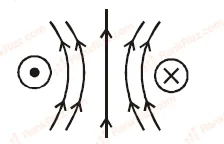
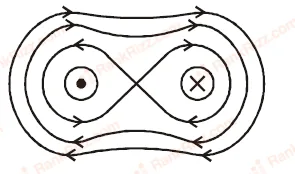
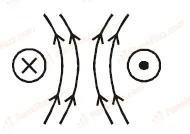
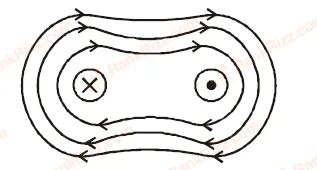
Choose the correct sketch of the magnetic field lines of a circular current loop shown by the dot and the cross ⊗\otimes.

  1. A
    Figure for JEE Main 2013 Physics question on Biot-Savart law: straight wires and moving charges
  2. B
    Figure for JEE Main 2013 Physics question on Biot-Savart law: straight wires and moving charges
  3. C
    Figure for JEE Main 2013 Physics question on Biot-Savart law: straight wires and moving charges
  4. D
    Figure for JEE Main 2013 Physics question on Biot-Savart law: straight wires and moving charges
JEE MAIN 2013 · 09 APR ONLINEBiot-Savart law: straight wires and moving chargesTRANSCRIBED

An electric current is flowing through a circular coil of radius R. The ratio of the magnetic field at the centre of the coil and that at a distance 22R2\sqrt{2}R from the centre of the coil and on its axis is :

  1. A

    222\sqrt{2}

  2. B

    27

  3. C

    36

  4. D

    8

JEE MAIN 2013 · 22 APR ONLINEBiot-Savart law: straight wires and moving chargesTRANSCRIBED

A current ii is flowing in a straight conductor of length LL. The magnetic induction at a point on its axis at a distance L4\frac{L}{4} from its centre will be :

  1. A

    Zero

  2. B

    μ0i2πL\frac{\mu_0 i}{2\pi L}

  3. C

    μ0i2L\frac{\mu_0 i}{\sqrt{2}L}

  4. D

    4μ0i5πL\frac{4\mu_0 i}{\sqrt{5}\pi L}

JEE MAIN 2011Biot-Savart law: straight wires and moving chargesTRANSCRIBED

A current II flows in an infinitely long wire with cross section in the form of a semicircular ring of radius RR. The magnitude of the magnetic induction along its axis is:

  1. A

    μ0I2π2R\dfrac{\mu_0 I}{2 \pi^2 R}

  2. B

    μ0I2πR\dfrac{\mu_0 I}{2 \pi R}

  3. C

    μ0I4π2R\dfrac{\mu_0 I}{4 \pi^2 R}

  4. D

    μ0Iπ2R\dfrac{\mu_0 I}{\pi^2 R}

JEE MAIN 2010Biot-Savart law: straight wires and moving chargesTRANSCRIBED

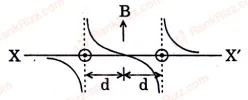
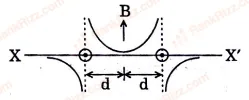
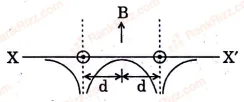
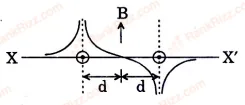
Two long parallel wires are at a distance 2d2d apart. They carry steady equal current flowing out of the plane of the paper as shown. The variation of the magnetic field along the line XX′XX' is given by

  1. A
    Figure for JEE Main 2010 Physics question on Biot-Savart law: straight wires and moving charges
  2. B
    Figure for JEE Main 2010 Physics question on Biot-Savart law: straight wires and moving charges
  3. C
    Figure for JEE Main 2010 Physics question on Biot-Savart law: straight wires and moving charges
  4. D
    Figure for JEE Main 2010 Physics question on Biot-Savart law: straight wires and moving charges
JEE MAIN 2008Biot-Savart law: straight wires and moving chargesTRANSCRIBED

A horizontal overhead power line is at a height of 4 m from the ground and carries a current of 100 A from east to west. The magnetic field directly below it on the ground is (μ0=4π×10−7 T m A−1)(\mu_0 = 4\pi \times 10^{-7}\ T\ m\ A^{-1})

  1. A

    2.5×10−72.5 \times 10^{-7} T southward

  2. B

    5×10−65 \times 10^{-6} T northward

  3. C

    5×10−65 \times 10^{-6} T southward

  4. D

    2.5×10−72.5 \times 10^{-7} T northward

JEE MAIN 2007Biot-Savart law: straight wires and moving chargesTRANSCRIBED

Two identical conducting wires AOB and COD are placed at right angles to each other. The wire AOB carries an electric current I1I_1 and COD carries a current I2I_2. The magnetic field on a point lying at a distance 'dd' from O, in a direction perpendicular to the plane of the wires AOB and COD, will be given by

  1. A

    μ02π(I1+I2d)1/2\frac{\mu_0}{2\pi} \left(\frac{I_1 + I_2}{d}\right)^{1/2}

  2. B

    μ02πd(I12+I22)1/2\frac{\mu_0}{2\pi d} (I_1^2 + I_2^2)^{1/2}

  3. C

    μ02πd(I1+I2)\frac{\mu_0}{2\pi d} (I_1 + I_2)

  4. D

    μ02πd(I12+I22)\frac{\mu_0}{2\pi d} (I_1^2 + I_2^2)