JEE Main 2021 Physics question — Motion on inclined planes and wedges
A block of mass slides on the wooden wedge, which in turn slides backward on the horizontal surface. The acceleration of the block with respect to the wedge is:
Given kg, kg
Assume all the surfaces shown in the figure to be frictionless.
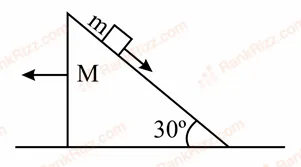
SOLUTION
We need to find the acceleration of the block of mass with respect to the wooden wedge of mass .
1. Define the Variables and Coordinate System
From the schematic , we have:
- Mass of the block,
- Mass of the wedge,
- Angle of inclination,
Let the horizontal acceleration of the wedge moving backward (to the left) be . Let the acceleration of the block relative to the wedge down the incline be .
2. Set Up Equations of Motion Using Pseudo Force
Let's observe the block from the non-inertial reference frame of the accelerating wedge. In this frame, a horizontal pseudo force of magnitude acts on the block towards the right.
- Forces acting on the block parallel to the incline:
The component of gravity pulling the block down is . The component of the pseudo force pushing it up the incline is .
- Forces acting on the block perpendicular to the incline:
The normal force exerted by the wedge on the block is balanced by the components of gravity and the pseudo force:
3. Equation of Motion for the Wedge
Now, observing the wedge from the ground (inertial frame), the horizontal forces acting on it are due to the normal reaction from the block. The horizontal component of this normal force drives the wedge to the left:
Substitute from Equation 2 into Equation 3:
4. Substitute the Given Values
Substitute , , , and into the expression for :
Now, substitute back into Equation 1 to find the relative acceleration :
Conclusion
The acceleration of the block with respect to the wedge is , which corresponds to Option D.
Tagged Motion on inclined planes and wedges. Machine-assigned, so read it as a strong shortlist rather than a verdict.