RankRizzStart free

Gravitation — JEE Main Previous Year Questions

Every Gravitation question JEE Main has set, grouped by the idea it tests rather than the order of the syllabus. 205 questions across 7 distinct ideas. Free to read, answer key on every one.

Questions

205

Distinct ideas

7

Share of marks

2%

Difficulty

MEDIUM

The ideas inside Gravitation

A chapter is not one subject — it is a handful of procedures the examiner reuses. These are the ones Gravitation questions actually test.

01Newton's law of gravitation and superpositionset 2×
02Acceleration due to gravity and its variationset 56×
03Gravitational field and potential of rings, shells and spheresset 11×
04Gravitational potential energy of systemsset 25×
05Escape speedset 36×
06Satellites: orbital speed, period, energy and geostationary orbitsset 30×
07Kepler's laws and planetary motionset 45×

Every Gravitation question

141–160 OF 205 · NEWEST FIRST

JEE MAIN 2020 · 09 JAN S1Satellites: orbital speed, period, energy and geostationary orbitsTRANSCRIBED

A body A of mass is moving in a circular orbit of radius about a planet. Another body B of mass collides with A with a velocity which is half the instantaneous velocity of A. The collision is completely inelastic. Then, the combined body:

  1. A

    continues to move in a circular orbit

  2. B

    Escapes from the Planet's Gravitational field

  3. C

    Falls vertically downwards towards the planet

  4. D

    starts moving in an elliptical orbit around the planet
JEE MAIN 2020 · 05 SEP S1Acceleration due to gravity and its variationTRANSCRIBED

The value of the acceleration due to gravity is at a height ( = radius of the earth) from the surface of the earth. It is again equal to at a depth below the surface the earth. The ratio equals:

  1. A

  2. B

  3. C

  4. D

JEE MAIN 2020 · 07 JAN S2Acceleration due to gravity and its variationTRANSCRIBED

A box weighs 196 N on a spring balance at the north pole. Its weight recorded on the same balance if it is shifted to the equator is close to (Take g = 10 ms at the north pole and the radius of the earth = 6400 km):

  1. A

    195.66 N

  2. B

    194.32 N

  3. C

    194.66 N

  4. D

    195.32 N

JEE MAIN 2020 · 04 SEP S1Gravitational field and potential of rings, shells and spheresTRANSCRIBED

On the -axis and at a distance from the origin, the gravitational field due to a mass distribution is given by in the -direction. The magnitude of the gravitational potential on the -axis at a distance , taking its value to be zero at infinity is:

  1. A

  2. B

  3. C

  4. D

JEE MAIN 2020 · 08 JAN S1Acceleration due to gravity and its variationTRANSCRIBED

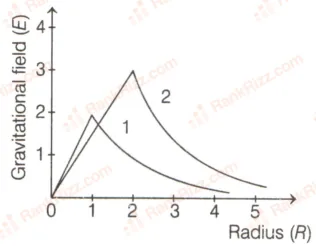
Consider two solid spheres of radii m, m and masses and , respectively. The gravitational field due to sphere (1) and (2) are shown. The value of is:

  1. A

  2. B

  3. C

  4. D

JEE MAIN 2020 · 06 SEP S2Gravitational potential energy of systemsTRANSCRIBED

Two planets have masses M and 16M and their radii are and , respectively. The separation between the centres of the planets is . A body of mass is fired from the surface of the larger planet towards the smaller planet along the line joining their centres. For the body to be able to reach at the surface of smaller planet, the minimum firing speed needed is:

  1. A

  2. B

  3. C

  4. D

JEE MAIN 2020 · 03 SEP S2Acceleration due to gravity and its variationTRANSCRIBED

The mass density of a planet of radius R varies with the distance r from its centre as . Then the gravitational field is maximum at:

  1. A

  2. B

  3. C

  4. D

JEE MAIN 2020 · 06 SEP S1Kepler's laws and planetary motionTRANSCRIBED

A satellite is in an elliptical orbit around a planet . It is observed that the velocity of the satellite when it is farthest from the planet is 6 times less than that when it is closest to the planet. The ratio of distances between the satellite and the planet at closest and farthest points is:

  1. A

    1 : 6

  2. B

    1 : 3

  3. C

    1 : 2

  4. D

    3 : 4

JEE MAIN 2020 · 09 JAN S2Satellites: orbital speed, period, energy and geostationary orbitsTRANSCRIBED

Planet has mass and radius . Planet has half the mass and half the radius of Planet . If the escape velocities from the Planets and are and , respectively, then . The value of is:

  1. A

    4

  2. B

    1

  3. C

    2

  4. D

    3

JEE MAIN 2020 · 04 SEP S2Satellites: orbital speed, period, energy and geostationary orbitsTRANSCRIBED

A body is moving in a low circular orbit about a planet of mass M and radius R. The radius of the orbit can be taken to be R itself. Then the ratio of the speed of this body in the orbit to the escape velocity from the planet is:

  1. A

  2. B

  3. C

  4. D

JEE MAIN 2020 · 02 SEP S1Satellites: orbital speed, period, energy and geostationary orbitsTRANSCRIBED

The mass density of a spherical galaxy varies as over a large distance from its center. In that region, a small star is in a circular orbit of radius R. Then the period of revolution, T depends on R as:

  1. A

  2. B

  3. C

  4. D

JEE MAIN 2020 · 08 JAN S2Escape speedTRANSCRIBED

An asteroid is moving directly towards the centre of the earth. When at a distance of 10R (R is the radius of the earth) from the centre of the earth, it has a speed of 12 km s. Neglecting the effect of earth's atmosphere, what will be the speed of the asteroid when it hits the surface of the earth (escape velocity from the earth is 11.2 km s)? Give your answer to the nearest integer in km s

JEE MAIN 2019 · 10 APR S1Acceleration due to gravity and its variationTRANSCRIBED

The value of acceleration due to gravity at Earth's surface is 9.8 m s. The altitude above its surface at which the acceleration due to gravity decreases to 4.9 m s, is close to: (Radius of earth = m)

  1. A

    m

  2. B

    m

  3. C

    m

  4. D

    m

JEE MAIN 2019 · 12 JAN S1Satellites: orbital speed, period, energy and geostationary orbitsTRANSCRIBED

A satellite of mass M is in a circular orbit of radius R about the center of the earth. A meteorite of the same mass, falling towards the earth, collides with the satellite completely inelastic. The speeds of the satellite and the meteorite are the same, just before the collision. The subsequent motion of the combined body will be:

  1. A

    In an elliptical orbit

  2. B

    Such that it escapes to infinity

  3. C

    In a circular orbit of a different radius

  4. D

    In the same circular orbit of radius R

JEE MAIN 2019 · 08 APR S1Kepler's laws and planetary motionTRANSCRIBED

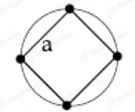
Four identical particles of mass M are located at the corners of a square of side 'a'. What should be their speed if each of them revolves under the influence of other's gravitational field in a circular orbit circumscribing the square?

  1. A

  2. B

  3. C

  4. D

JEE MAIN 2019 · 11 JAN S1Satellites: orbital speed, period, energy and geostationary orbitsTRANSCRIBED

A satellite is revolving in a circular orbit at a height h from the earth surface, such that where R is the radius of the earth. Assuming that the effect of earth's atmosphere can be neglected the minimum increase in the speed required so that the satellite could escape from the gravitational field of earth is

  1. A

  2. B

  3. C

  4. D

JEE MAIN 2019 · 09 JAN S2Escape speedTRANSCRIBED

The energy required to take a satellite to a height above the Earth surface (radius of Earth km) is , and the kinetic energy required for the satellite to be in a circular orbit at this height is . The value of for which and are equal, is:

  1. A

    km

  2. B

    km

  3. C

    km

  4. D

    km

JEE MAIN 2019 · 12 JAN S1Kepler's laws and planetary motionTRANSCRIBED

A straight rod of length L extends from to . The gravitational force it exerts on a point mass 'm' at , if the mass per unit length of the rod is , is given by:

  1. A

  2. B

  3. C

  4. D

JEE MAIN 2019 · 12 APR S2Acceleration due to gravity and its variationTRANSCRIBED

The ratio of the weights of a body on Earth's surface to that on the surface of a planet is 9:4. The mass of the planet is th of that of the Earth. If R is the radius of the Earth, what is the radius of the planet? (Take the planets to have the same mass density)

  1. A

  2. B

  3. C

  4. D

JEE MAIN 2019 · 09 JAN S1Kepler's laws and planetary motionTRANSCRIBED

If the angular momentum of a planet of mass , moving around the Sun in a circular orbit is , about the center of the Sun, its areal velocity is:

  1. A

  2. B

  3. C

  4. D