JEE MAIN 2021 · 31 AUG S2Acceleration due to gravity and its variationTRANSCRIBED
If be the radius of Earth, then the ratio between the acceleration due to gravity at a depth below and a height above the earth surface is: (Given: )
- A
- B
- C
- D
Every Gravitation question JEE Main has set, grouped by the idea it tests rather than the order of the syllabus. 205 questions across 7 distinct ideas. Free to read, answer key on every one.
Questions
205
Distinct ideas
7
Share of marks
2%
Difficulty
MEDIUM
A chapter is not one subject — it is a handful of procedures the examiner reuses. These are the ones Gravitation questions actually test.
121–140 OF 205 · NEWEST FIRST
If be the radius of Earth, then the ratio between the acceleration due to gravity at a depth below and a height above the earth surface is: (Given: )
A body is projected vertically upwards from the surface of earth with a velocity sufficient enough to carry it to infinity. The time taken by it to reach height is ___ s.
Consider a planet in some solar system that has a mass double the mass of earth and density equal to the average density of the earth. If the weight of an object on earth is , the weight of the same object on that planet will be:
The angular momentum of a planet of mass moving around the sun in an elliptical orbit is . The magnitude of the areal velocity of the planet is :
The planet Mars has two moons, if one of them has a period 7 hours, 30 minutes and an orbital radius of km. Find the mass of Mars.
kg
kg
kg
kg
A satellite is launched into a circular orbit of radius around earth, while a second satellite is launched into a circular orbit of radius 1.02 . The percentage difference in the time periods of the two satellites is:
1.5
2.0
0.7
3.0
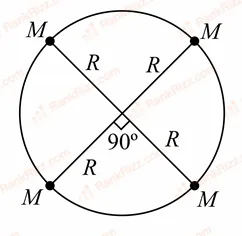
Four particles each of mass , move along a circle of radius under the action of their mutual gravitational attraction as shown in figure. The speed of each particle is:
A mass of 50 kg is placed at the center of a uniform spherical shell of mass 100 kg and radius 50 m. If the gravitational potential at a point, 25 m from the center is kg m. The value of is:
+2
-20
-4
-60
Consider a binary star system of star A and star B with masses and revolving in a circular orbit of radii and , respectively. If and are the time period of star A and star B, respectively, then:
T_A > T_B (if m_A > m_B)
T_A > T_B (if r_A > r_B)
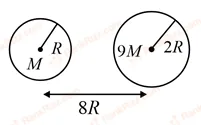
Suppose two planets (spherical in shape) of radii and , but mass and respectively have a centre to centre separation as shown in the figure. A satellite of mass is projected from the surface of the planet of mass directly towards the centre of the second planet. The minimum speed required for the satellite to reach the surface of the second planet is , then the value of is
[Given: The two planets are fixed in their position]
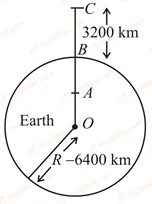
In the reported figure of earth, the value of acceleration due to gravity is same at point A and C but it is smaller than that of its value at point B (surface of the earth). The value of will be . The value of is ______
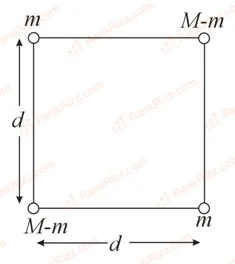
A body of mass splits into four masses , which are rearranged to form a square as shown in the figure. The ratio of for which, the gravitational potential energy of the system becomes maximum is . The value of is _________.
The initial velocity required to project a body vertically upward from the surface of the earth to reach a height of , where is the radius of the earth, may be described in terms of escape velocity such that . The value of will be
The radius in kilometer to which the present radius of earth ( km) to be compressed so that the escape velocity is increased 10 times is ________.
If one wants to remove all the mass of the earth to infinity in order to break it up completely. The amount of energy that needs to be supplied will be where is ________. (Round off to the Nearest Integer)
( is the mass of earth, is the radius of earth, is the gravitational constant)
Two satellites revolve around a planet in coplanar circular orbits in anticlockwise direction. Their period of revolutions are 1 hour and 8 hours respectively. The radius of the orbit of nearer satellite is km. The angular speed of the farther satellite as observed from the nearer satellite at the instant when both the satellites are closest is rad h, where is _________.
A satellite is moving in a low nearly circular orbit around the earth. Its radius is roughly equal to that of the earth's radius . By firing rockets attached to it, its speed is instantaneously increased in the direction of its motion so that it becomes times larger. Due to this the farthest distance from the centre of the earth that the satellite reaches is . Value of is:
The height 'h' at which the weight of a body will be the same as that at the same depth 'h' from the surface of the earth is (Radius of the earth is R and effect of the rotation of the earth is neglected):
The acceleration due to gravity on the earth's surface at the poles is and angular velocity of the earth about the axis passing through the pole is . An object is weighed at the equator and at a height above the poles by using a spring balance. If the weights are found to be same, then is: (, where is the radius of the earth)
A satellite of mass is launched vertically upwards with an initial speed from the surface of the earth. After it reaches height ( = radius of the earth), it ejects a rocket of mass so that subsequently the satellite moves in a circular orbit. The kinetic energy of the rocket is ( is the gravitational constant; is the mass of the earth):
OTHER PHYSICS CHAPTERS