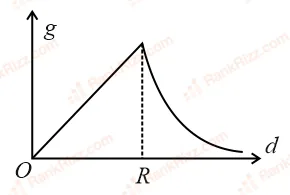
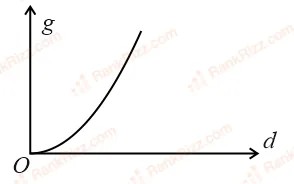
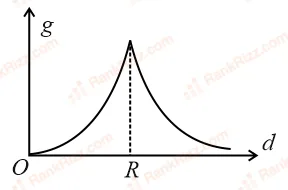
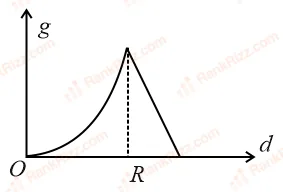
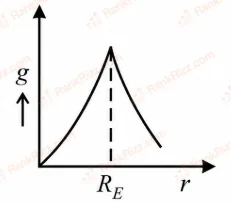
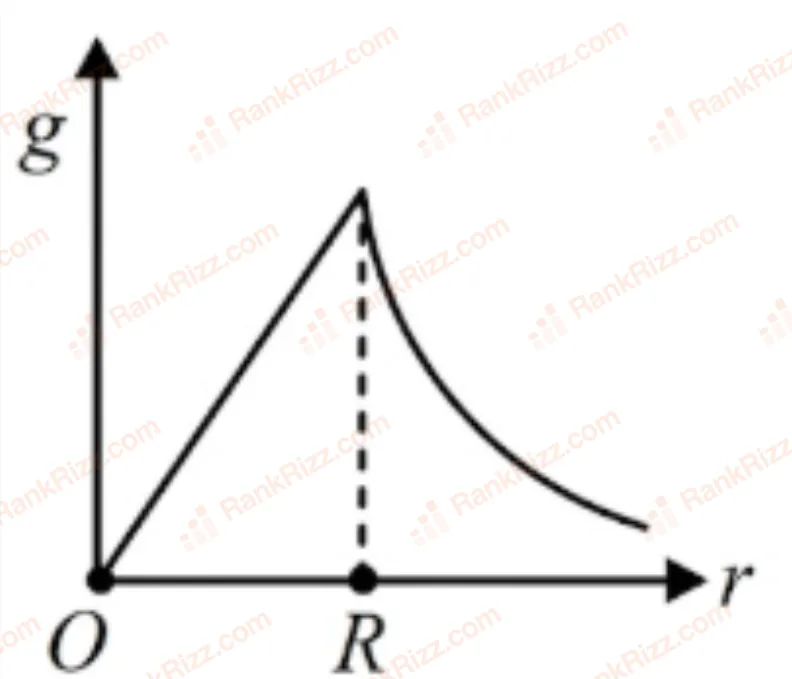
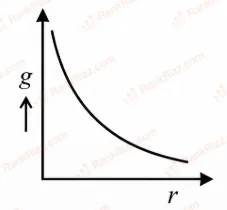
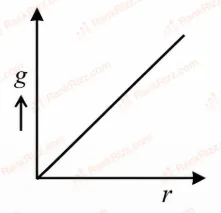
The height 'h' at which the weight of a body will be the same as that at the same depth 'h' from the surface of the earth is (Radius of the earth is R and effect of the rotation of the earth is neglected):
- A
- B
- C
- D
Every JEE Main question on Acceleration due to gravity and its variation, one of the ideas inside Gravitation: 56 questions from 2005–2026, 34 of them in the last five years. Newest first, answer key on every one. Free to read.
Questions
56
Years asked
13
Since
2005
Of the chapter
27%
41–56 OF 56 · NEWEST FIRST
The height 'h' at which the weight of a body will be the same as that at the same depth 'h' from the surface of the earth is (Radius of the earth is R and effect of the rotation of the earth is neglected):
The acceleration due to gravity on the earth's surface at the poles is and angular velocity of the earth about the axis passing through the pole is . An object is weighed at the equator and at a height above the poles by using a spring balance. If the weights are found to be same, then is: (, where is the radius of the earth)
The value of the acceleration due to gravity is at a height ( = radius of the earth) from the surface of the earth. It is again equal to at a depth below the surface the earth. The ratio equals:
A box weighs 196 N on a spring balance at the north pole. Its weight recorded on the same balance if it is shifted to the equator is close to (Take g = 10 ms at the north pole and the radius of the earth = 6400 km):
195.66 N
194.32 N
194.66 N
195.32 N
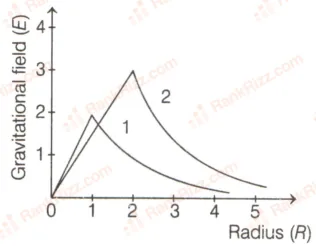
Consider two solid spheres of radii m, m and masses and , respectively. The gravitational field due to sphere (1) and (2) are shown. The value of is:

The mass density of a planet of radius R varies with the distance r from its centre as . Then the gravitational field is maximum at:
The value of acceleration due to gravity at Earth's surface is 9.8 m s. The altitude above its surface at which the acceleration due to gravity decreases to 4.9 m s, is close to: (Radius of earth = m)
m
m
m
m
The ratio of the weights of a body on Earth's surface to that on the surface of a planet is 9:4. The mass of the planet is th of that of the Earth. If R is the radius of the Earth, what is the radius of the planet? (Take the planets to have the same mass density)
Suppose that the angular velocity of rotation of the Earth is increased. Then, as a consequence:
weight of the object, everywhere on the earth, will decrease.
weight of the object, everywhere on the earth, will increase.
except at poles, weight of the object on the earth, will decrease.
there will be no change in weight anywhere on the earth.
The variation of acceleration due to gravity with distance from the centre of the earth is best represented by ( = Earth's radius):


If the Earth has no rotational motion, the weight of a person on the equator is . Determine the speed with which the earth would have to rotate about its axis so that the person at the equator will weigh . The radius of the Earth is 6400 km and m s.
rad s
rad s
rad s
rad s
Which graph correctly presents the variation of acceleration due to gravity with the distance from the centre of the earth (radius of the earth = )?


Assuming the earth to be a sphere of uniform density, the acceleration due to gravity inside the earth at a distance of from the centre is proportional to
The height at which the acceleration due to gravity becomes (where g the acceleration due to gravity on the surface of the earth) in terms of , the radius of the earth is
Average density of the earth
does not depend on
is a complex function of
is directly proportional to
is inversely proportional to
The change in the value of at a height '' above the surface of the earth is the same as at a depth '' below the surface of earth. When both '' and '' are much smaller than the radius of earth, then which one of the following is correct?