A red LED emits light at 0.1 watt uniformly around it. The amplitude of the electric field of the light at a distance of 1 m from the diode is:
- A
7.75 V m
- B
1.73 V m
- C
2.45 V m
- D
5.48 V m
Every Electromagnetic Waves question JEE Main has set, grouped by the idea it tests rather than the order of the syllabus. 182 questions across 3 distinct ideas. Free to read, answer key on every one.
Questions
182
Distinct ideas
3
Share of marks
3.4%
Difficulty
EASY
A chapter is not one subject — it is a handful of procedures the examiner reuses. These are the ones Electromagnetic Waves questions actually test.
161–180 OF 182 · NEWEST FIRST
A red LED emits light at 0.1 watt uniformly around it. The amplitude of the electric field of the light at a distance of 1 m from the diode is:
7.75 V m
1.73 V m
2.45 V m
5.48 V m
For plane electromagnetic waves propagating in the -direction, which one of the following combinations gives the correct possible direction for and field respectively?
and
and
and
and
During the propagation of electromagnetic wave in a particular medium:
Electric energy density is double of the magnetic energy density
Electric energy density is half of the magnetic energy density
Electric energy density is equal to the magnetic energy density
Both electric and magnetic energy densities are zero
Match List I (Wavelength range of electromagnetic spectrum) with List II (Method of production of these waves) and select the correct option from the options given below the lists.
List I: List II:
(a) 700 nm to 1 mm (i) Vibration of atoms and molecules
(b) 1 nm to 400 nm (ii) Inner shell electrons in atoms moving from one energy level to a lower level
(c) < 10 nm (iii) Radioactive decay of the nucleus
(d) 1 mm to 0.1 m (iv) Magnetron valve
(a)-(iii), (b)-(iv), (c)-(i), (d)-(ii)
(a)-(i), (b)-(ii), (c)-(iii), (d)-(iv)
(a)-(iv), (b)-(iii), (c)-(ii), (d)-(i)
(a)-(ii), (b)-(iii), (c)-(iv), (d)-(i)
If microwaves, X-rays, infrared, gamma rays, ultraviolet, radio waves and visible parts of the electromagnetic spectrum are denoted respectively by M, X, I, G, U, R and V the following is the arrangement in ascending order of the wavelength:
I, M, R, U, V, X and G
R, M, I, V, U, X and G
M, R, V, X, U, G and I
G, X, U, V, I, M and R
Match List - I (Electromagnetic wave type) with List - II (Its association/application) and select the correct option from the choices given below the lists:
List - I: List - II:
(a) Infrared waves (i) To treat muscular strain
(b) Radio waves (ii) For broadcasting
(c) X-rays (iii) To detect fracture of bones
(d) Ultraviolet rays (iv) Absorbed by the ozone layer of the atmosphere
(a)-(iv), (b)-(iii), (c)-(ii), (d)-(i)
(a)-(i), (b)-(ii), (c)-(iv), (d)-(iii)
(a)-(iii), (b)-(ii), (c)-(i), (d)-(iv)
(a)-(i), (b)-(ii), (c)-(iii), (d)-(iv)
An electromagnetic wave of frequency hertz is propagating along z-axis. The amplitude of electric field is 4 V/m. If C/N-m, then average energy density of electric field will be:
J/m
J/m
J/m
J/m
A lamp emits monochromatic green light uniformly in all directions. The lamp is 3% efficient in converting electrical power to electromagnetic waves and consumes 100 W of power. The amplitude of the electric field associated with the electromagnetic radiation at a distance of 5 m from the lamp will be nearly:
1.34 V/m
2.68 V/m
4.02 V/m
5.36 V/m
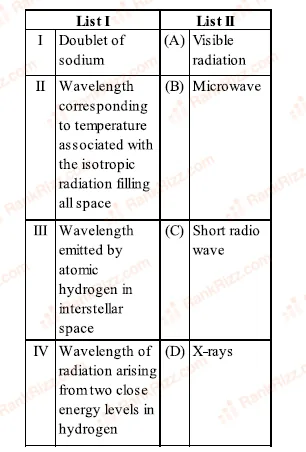
Match the List-I (Phenomenon associated with electromagnetic radiation) with List-II (Part of electromagnetic spectrum) and select the correct code from the choices given below this lists:

(I)-(A), (II)-(B), (III)-(B), (IV)-(C)
(I)-(A), (II)-(B), (III)-(C), (IV)-(C)
(I)-(D), (II)-(C), (III)-(A), (IV)-(B)
(I)-(B), (II)-(A), (III)-(D), (IV)-(A)
A parallel plate capacitor of area 60 cm and separation 3 mm is charged initially to 90C. If the medium between the plate gets slightly conducting and the plate loses the charge initially at the rate of C/s, then what is the magnetic field between the plates?
T
T
T
Zero
The magnetic field in a travelling electromagnetic wave has a peak value of 20 nT. The peak value of electric field strength is :
9 V m
12 V m
3 V m
6 V m
Select the correct statement from the following :
Electromagnetic waves cannot travel in vacuum.
Electromagnetic waves are longitudinal waves.
Electromagnetic waves are produced by charges moving with uniform velocity.
Electromagnetic waves carry both energy and momentum as they propagate through space.
Photons of an electromagnetic radiation has an energy 11 keV each. To which region of electromagnetic spectrum does it belong?
X-ray region
Ultra violet region
Infrared region
Visible region
A plane electromagnetic wave in a non-magnetic dielectric medium is given by with distance being in meter and time in seconds. The dielectric constant of the medium is :
2.4
5.8
8.2
4.8
This question has Statement-1 and Statement-2. Of the four choices given after the Statements, choose the one that best describes the two Statements.
Statement-1: Out of radio waves and microwaves, the radio waves undergo more diffraction.
Statement-2: Radio waves have greater frequency compared to microwaves.
Statement-1 is true, Statement-2 is true and Statement-2 is the correct explanation of Statement-1
Statement-1 is false, Statement-2 is true.
Statement-1 is true, Statement-2 is false.
Statement-1 is true, Statement-2 is true but Statement-2 is not the correct explanation of Statement-1
An electromagnetic wave in vacuum has the electric and magnetic fields and , which are always perpendicular to each other. The direction of polarization is given by and that of wave propagation by . Then :
and
and
and
and
A radio transmitter transmits at 830 kHz. At a certain distance from the transmitter magnetic field has amplitude T. The electric field and the wavelength are respectively
0.014 N/C, 36 m
0.14 N/C, 36 m
0.14 N/C, 360 m
0.014 N/C, 360 m
The frequency of -rays; -rays and ultraviolet rays are respectively , and then
a < b; b > c
a > b; b > c
a < b < c
An electromagnetic wave with frequency and wavelength travels in the direction. Its magnetic field is along -axis. The vector equation for the associated electric field (of amplitude ) is
If a source of power kW produces photons/second, the radiation belong to a part of the spectrum called
X-rays
ultraviolet rays
microwaves
-rays
OTHER PHYSICS CHAPTERS