JEE MAIN 2022 · 26 JUL S2Properties of EM waves: fields, energy, intensity and momentumTRANSCRIBED
The oscillating magnetic field in a plane electromagnetic wave is given by . The amplitude of electric field will be
- A
- B
- C
- D
Every Electromagnetic Waves question JEE Main has set, grouped by the idea it tests rather than the order of the syllabus. 182 questions across 3 distinct ideas. Free to read, answer key on every one.
Questions
182
Distinct ideas
3
Share of marks
3.4%
Difficulty
EASY
A chapter is not one subject — it is a handful of procedures the examiner reuses. These are the ones Electromagnetic Waves questions actually test.
81–100 OF 182 · NEWEST FIRST
The oscillating magnetic field in a plane electromagnetic wave is given by . The amplitude of electric field will be
A beam of light travelling along -axis is described by the electric field . The ratio of electric force to magnetic force on a charge moving along -axis with a speed of will be: [Given speed of light ]
Identify the correct statements from the following descriptions of various properties of electromagnetic waves.
A. In a plane electromagnetic wave electric field and magnetic field must be perpendicular to each other and direction of propagation of wave should be along electric field or magnetic field.
B. The energy in electromagnetic wave is divided equally between electric and magnetic fields.
C. Both electric field and magnetic field are parallel to each other and perpendicular to the direction of propagation of wave.
D. The electric field, magnetic field and direction of propagation of wave must be perpendicular to each other.
E. The ratio of amplitude of magnetic field to the amplitude of electric field is equal to speed of light.
Choose the most appropriate answer from the options given below:
D only
B and D only
B, C and E only
A, B and E only
As shown in the figure, after passing through the medium 1, the speed of light in medium 2 will be: (Given m s)
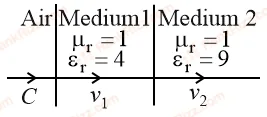
m s
m s
m s
m s
Sun light falls normally on a surface of area 36 cm and exerts an average force of N within a time period of 20 minutes. Considering a case of complete absorption, the energy flux of incident light is
W cm
W cm
6.0 W cm
0.06 W cm
Match List-I with List-II
| List-I | List-II |
|---|---|
| (a) UV rays | (i) Diagnostic tool in medicine |
| (b) X-rays | (ii) Water purification |
| (c) Microwave | (iii) Communication, Radar |
| (d) Infrared wave | (iv) Improving visibility in foggy days |
Choose the correct answer from the options given below :
(a)-(iii), (b)-(ii), (c)-(i), (d)-(iv)
(a)-(ii), (b)-(i), (c)-(iii), (d)-(iv)
(a)-(ii), (b)-(iv), (c)-(iii), (d)-(i)
(a)-(iii), (b)-(i), (c)-(ii), (d)-(iv)
A wave of frequency GHz, strikes a particle of size of , then this phenomenon is called as
Diffraction
Scattering
Reflection
Refraction
Match List - I with List - II
| List-I | List-II |
|---|---|
| (a) Ultraviolet rays | (i) Study crystal structure |
| (b) Microwaves | (ii) Greenhouse effect |
| (c) Infrared waves | (iii) Sterilizing surgical instrument |
| (d) X-rays | (iv) Radar system |
(a)-(iii), (b)(iv), (c)-(ii), (d)-(i)
(a)-(iii), (b)(i), (c)-(ii), (d)-(iv)
(a)-(iv), (b)(iii), (c)-(ii), (d)-(i)
(a)-(iii), (b)(iv), (c)-(i), (d)-(ii)
Given below are two statements :
Statement I: A time varying electric field is a source of changing magnetic field and vice-versa. Thus a disturbance in electric or magnetic field creates EM waves.
Statement II: In a material medium, the EM wave travels with speed .
In the light of the above statements, choose the correct answer from the options given below.
Both statement I and statement II are true
Both statement I and statement II are false
Statement I is correct but statement II is false
Statement I is incorrect but statement II is true
Light wave travelling in air along -direction is given by . Then, the peak value of magnetic field of wave will be (Given )
A plane electromagnetic wave travels in a medium of relative permeability and relative permittivity . If magnitude of magnetic intensity is A m at a point, what will be the approximate magnitude of electric field intensity at that point?
(Given : Permeability of free space N A, speed of light in vacuum m s)
V m
V m
V m
V m
Which is the correct ascending order of wavelengths?
\lambda_{visible} < \lambda_{X-ray} < \lambda_{gamma-ray} < \lambda_{microwave}
\lambda_{gamma-ray} < \lambda_{X-ray} < \lambda_{visible} < \lambda_{microwave}
\lambda_{X-ray} < \lambda_{gamma-ray} < \lambda_{visible} < \lambda_{microwave}
\lambda_{microwave} < \lambda_{visible} < \lambda_{gamma-ray} < \lambda_{X-ray}
An electric bulb is rated as W. What will be the peak magnetic field at m distance produced by the radiations coming from this bulb? Consider this bulb as a point source with efficiency.
T
T
T
T
The displacement current of 4.425 A is developed in the space between the plates of parallel plate capacitor when voltage is changing at a rate of V s. The area of each plate of the capacitor is 40 cm. The distance between each plate of the capacitor is m. The value of is,
(Permittivity of free space, C N m)
Nearly 10% of the power of a 110 W light bulb is converted to visible radiation. The change in average intensities of visible radiation, at a distance of 1 m from the bulb to a distance of 5 m is W m. The value of 'a' will be
The intensity of the light from a bulb incident on a surface is 0.22 W m. The amplitude of the magnetic field in this light-wave is ______ T.
(Given: Permittivity of vacuum C N m, speed of light in vacuum m s)
Electric field of a plane electromagnetic wave propagating through a non-magnetic medium is given by V m. The dielectric constant of the medium is equal to: (Take )
2
9
3
The relative permittivity of distilled water is 81. The velocity of light in it will be: (Given )
m s
m s
m s
m s
A linearly polarised electromagnetic wave in vacuum is $E = 3.1\cos 1.8z - 5.4 \times 10^6 t \hat{i}$. Choose the correct option.
The wavelength is 5.4 m.
The frequency of electromagnetic wave is Hz.
The transmitted wave will be N/C.
The reflected wave will be N C.
Match List - I with List - II.
| List-I | List-II |
|---|---|
| (a) Source of microwave frequency | (i) Radioactive decay of nucleus |
| (b) Source of infrared frequency | (ii) Magnetron |
| (c) Source of Gamma Rays | (iii) Inner shell electrons |
| (d) Source of X-rays | (iv) Vibration of atoms and molecules |
| (v) LASER | |
| (vi) RC circuit |
(a)-(ii), (b)-(iv), (c)-(vi), (d)-(iii)
(a)-(vi), (b)-(iv), (c)-(i), (d)-(v)
(a)-(vi), (b)-(v), (c)-(i), (d)-(iv)
(a)-(ii), (b)-(iv), (c)-(i), (d)-(iii)
OTHER PHYSICS CHAPTERS