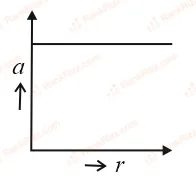
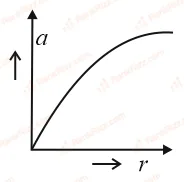
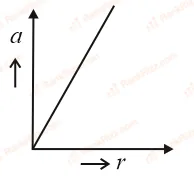
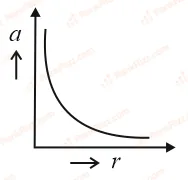
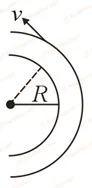
For a particle in uniform circular motion, the acceleration at any point on the circular path of radius is (when is measured from the positive -axis and is uniform speed):
- A
- B
- C
- D
Every JEE Main question on Kinematics of uniform circular motion, one of the ideas inside Circular Motion: 35 questions from 2004–2026, 22 of them in the last five years. Newest first, answer key on every one. Free to read.
Questions
35
Years asked
12
Since
2004
Of the chapter
47%
21–35 OF 35 · NEWEST FIRST
For a particle in uniform circular motion, the acceleration at any point on the circular path of radius is (when is measured from the positive -axis and is uniform speed):
A curved in a level road has a radius m. The maximum speed of a car turning this curved road can be m s without skidding. If radius of curved road is changed to m and the coefficient of friction between the tyres and the road remains same, then maximum allowed speed would be ______ m s.
A block of 200 g mass moves with a uniform speed in a horizontal circular groove, with vertical side walls of radius 20 cm. If the block takes 40 s to complete one round, the normal force by the side walls of the groove is:
0.0314 N
N
N
N
A modern grand-prix racing car of mass is travelling on a flat track in a circular arc of radius with a speed . If the coefficient of static friction between the tyres and the track is , then the magnitude of negative lift acting downwards on the car is:

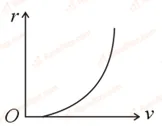
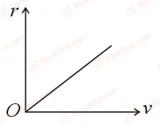
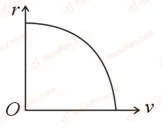
A particle of mass moves in a circular orbit under the central potential field, , where is a positive constant. The correct radius - velocity graph of the particle's motion is :


Statement I: A cyclist is moving on an unbanked road with a speed of 7 km h and takes a sharp circular turn along a path of the radius of 2 m without reducing the speed. The static friction coefficient is 0.2. The cyclist will not slip and pass the curve ( m s).
Statement II: If the road is banked at an angle of 45°, cyclist can cross the curve of 2 m radius with the speed of 18.5 km h without slipping. In the light of the above statements, choose the correct answer from the options given below.
Statement I is incorrect and Statement II is correct
Statement I is correct and Statement II is incorrect
Both statement I and statement II are false
Both statement I and statement II are true
A huge circular arc of length 4.4 ly subtends an angle 4s at the centre of the circle. How long it would take for a body to complete 4 revolution if its speed is 8 AU per second?
Given : 1 ly = m
1 AU = m
s
s
s
A particle of mass is suspended from a ceiling through a string of length . The particle moves in a horizontal circle of radius such that . The speed of particle will be:
A clock has a continuously moving second's hand of length. The average acceleration of the tip of the hand (in units of ) is of the order of:
A particle of mass is fixed to one end of a light spring having force constant and unstretched length . The other end is fixed. The system is given an angular speed about the fixed end of the spring such that it rotates in a circle in gravity free space. Then the stretch in the spring is:
A particle is moving along a circular path with a constant speed of . What is the magnitude of the change in velocity of the particle, when it moves through an angle of around the centre of the circle?
m/s
zero
m/s
m/s
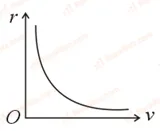
If a body moving in a circular path maintains constant speed of 10 m s, then which of the following correctly describes the relation between acceleration and radius?


Two cars of masses and are moving in circles of radii and , respectively. Their speeds are such that they make complete circles in the same time . The ratio of their centripetal acceleration is
For a particle in uniform circular motion the acceleration at a point on the circle of radius R is (here is measured from the -axis)
Which of the following statements is false for a particle moving in a circle with a constant angular speed?
The velocity vector is tangent to the circle.
The acceleration vector is tangent to the circle.
The acceleration vector points to the centre of the circle.
The velocity and acceleration vectors are perpendicular to each other.