JEE Main 2021 Physics question — Kinematics of uniform circular motion
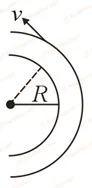
A modern grand-prix racing car of mass is travelling on a flat track in a circular arc of radius with a speed . If the coefficient of static friction between the tyres and the track is , then the magnitude of negative lift acting downwards on the car is:
SOLUTION
We need to determine the magnitude of the downward negative lift acting on a racing car moving along a flat circular track.
1. Identify the Forces Acting on the Car
From the problem statement on the page, the car is moving in a horizontal circle of radius with a speed . Let's analyze the forces acting in both vertical and horizontal directions:
-
Vertical Direction:
The forces keeping the car vertically balanced are:- Downward gravitational force:
- Downward negative lift force (aerodynamic downforce):
- Upward normal reaction force from the track:
-
Horizontal Direction:
The centripetal force required to keep the car moving in a circle of radius at speed is provided entirely by the static friction () between the tires and the track:
2. Relate Friction to the Normal Force
To safely navigate the turn at speed , the required centripetal friction must be provided by the maximum limiting static friction available ():
Solving for the normal force gives:
3. Solve for the Negative Lift ()
Now, equate Equation 1 and Equation 2 to eliminate :
Isolate the negative lift force :
Factoring out the mass from both terms yields the final expression:
Conclusion
The magnitude of the negative lift acting downwards on the car is , which corresponds to Option B.
Tagged Kinematics of uniform circular motion. Machine-assigned, so read it as a strong shortlist rather than a verdict.