JEE Main 2019 Physics question — Capacitance of isolated conductors and spherical/cylindrical capacitors
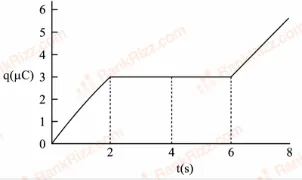
The charge on a capacitor plate in a circuit, as a function of time, is shown in the figure. What is the value of current at s?
SOLUTION
First, recall the fundamental relation between current and charge. The electric current through any conductor (or here, through the leads of the capacitor) is defined as the time‐rate of change of charge flowing past a given point. Mathematically, the definition is
We are given a graph of charge on the capacitor plate as a function of time. The question asks for the value of the current at the particular instant . From the definition above, this current is nothing but the slope of the -versus- curve at that instant.
Now, observe the portion of the graph that covers the interval from to . In this stretch, the plotted charge remains perfectly horizontal, indicating that the value of charge does not change with time. Expressed algebraically, during this interval we have
Since the function is constant, its derivative with respect to time is zero:
Substituting this derivative back into the current definition, we obtain
Hence, at —which lies squarely in the mentioned flat region—the current through the circuit is zero.
Hence, the correct answer is Option C.
Tagged Capacitance of isolated conductors and spherical/cylindrical capacitors. Machine-assigned, so read it as a strong shortlist rather than a verdict.