Let be a set of all 4-digit natural numbers whose exactly one digit is 7. Then the probability that a randomly chosen element of leaves remainder 2 when divided by 5 is:
- A
- B
- C
- D
Every JEE Main question on Probability using permutations and combinations, one of the ideas inside Probability: 39 questions from 2010–2026, 18 of them in the last five years. Newest first, answer key on every one. Free to read.
Questions
39
Years asked
14
Since
2010
Of the chapter
16%
21–39 OF 39 · NEWEST FIRST
Let be a set of all 4-digit natural numbers whose exactly one digit is 7. Then the probability that a randomly chosen element of leaves remainder 2 when divided by 5 is:
Let . Then the probability that a randomly chosen onto function from to satisfies is:
Four dice are thrown simultaneously and the numbers shown on these dice are recorded in matrices. The probability that such formed matrices have all different entries and are non-singular, is:
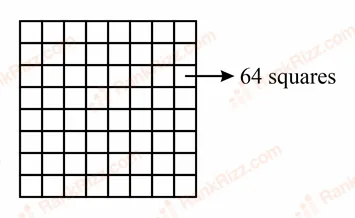
Two squares are chosen at random on a chessboard (see figure). The probability that they have a side in common is:

Let 9 distinct balls be distributed among 4 boxes , , and . If the probability that contains exactly 3 balls is then lies in the set:
A seven digit number is formed using digits 3, 3, 4, 4, 4, 5, 5. The probability, that number so formed is divisible by 2, is
If 10 different balls are to be placed in 4 distinct boxes at random, then the probability that two of these boxes contain exactly 2 and 3 balls is:
The probability that a randomly chosen 5-digit number is made from exactly two digits is:
Out of 11 consecutive natural numbers if three numbers are selected at random (without repetition), then the probability that they are in A.P. with positive common difference is:
If three of the six vertices of a regular hexagon are chosen at random, then the probability that the triangle formed with these chosen vertices is equilateral is:
Let . A subset B of S is said to be "nice" if the sum of the elements of B is 203. Then the probability that a randomly chosen subset of S is "nice" is:
None of the above
Two different families A and B are blessed with equal number of children. There are 3 tickets to be distributed amongst the children of these families so that no child gets more than one ticket. If the probability that all the tickets go to the children of the family B is , then the number of children in each family is:
6
5
3
4
From a group of 10 men and 5 women, four member committees are to be formed each of which must contain at least one woman. Then the probability for these committees to have more women than men, is:
If 12 identical balls are to be placed in 3 identical boxes, then the probability that one of the boxes contains exactly 3 balls is
Let X be a set containing 10 elements and P(X) be its power set. If A and B are picked up at random from P(X), with replacement, then the probability that A and B have equal number of elements is:
A set S contains 7 elements. A non-empty subset A of S and an element x of S are chosen at random. Then the probability that is:
If six students, including two particular students and , stand in a row, then the probability that and are separated with one student in between them is
Four numbers are chosen at random (without replacement) from the set . Statement-1: The probability that the chosen numbers when arranged in some order will form an AP is . Statement-2: If the four chosen numbers form an AP, then the set of all possible values of common difference is .
Statement-1 is true, Statement-2 is true; Statement-2 is not the correct explanation for Statement-1
Statement-1 is true, Statement-2 is false
Statement-1 is false, Statement-2 is true
Statement-1 is true, Statement-2 is true; Statement-2 is the correct explanation for Statement-1
An urn contains nine balls of which three are red, four are blue and two are green. Three balls are drawn at random without replacement from the urn. The probability that the three balls have different colours is