RankRizz

Applications of Derivatives — JEE Main Previous Year Questions

Every Applications of Derivatives question JEE Main has set from 2004–2026, grouped by the idea it tests rather than the order of the syllabus. 250 questions across 9 distinct ideas. Free to read, answer key on every one.

Questions

250

Distinct ideas

9

Share of marks

2%

Difficulty

HARD

The ideas inside Applications of Derivatives

A chapter is not one subject — it is a handful of procedures the examiner reuses. These are the ones Applications of Derivatives questions actually test.

Every Applications of Derivatives question

101–120 OF 250 · NEWEST FIRST

JEE MAIN 2021 · 16 MAR S2Monotonicity and intervals of increase/decreaseTRANSCRIBED

Let ff be a real valued function, defined on R−{−1,1}R - \{-1, 1\} and given by f(x)=3log⁡e∣x−1x+1∣−2x−1f(x) = 3\log_e\left|\frac{x-1}{x+1}\right| - \frac{2}{x-1}. Then in which of the following intervals, function f(x)f(x) is increasing?

  1. A

    (−∞,−1)∪([12,∞)−{1})(-\infty, -1) \cup \left(\left[\frac{1}{2}, \infty\right) - \{1\}\right)

  2. B

    (−∞,∞)−{−1,1}(-\infty, \infty) - \{-1, 1\}

  3. C

    (−1,12]\left(-1, \frac{1}{2}\right]

  4. D

    (−∞,12]−{−1}\left(-\infty, \frac{1}{2}\right] - \{-1\}

JEE MAIN 2021 · 20 JUL S2Local maxima and minima and concavityTRANSCRIBED

The sum of all the local minimum values of the twice differentiable function f:R→Rf : R \to R defined by f(x)=x3−3x2−3f′′(2)2x+f′′(1)f(x) = x^3 - 3x^2 - \frac{3f''(2)}{2}x + f''(1) is:

  1. A

    -22

  2. B

    5

  3. C

    -27

  4. D

    0

JEE MAIN 2021 · 01 SEP S2Monotonicity and intervals of increase/decreaseTRANSCRIBED

The function f(x)=x3−6x2+ax+bf(x) = x^3 - 6x^2 + ax + b is such that f(2)=f(4)=0f(2) = f(4) = 0. Consider two statements:
S1S_1: there exists x1,x2∈(2,4)x_1, x_2 \in (2, 4), x1<x2x_1 \lt x_2, such that f′(x1)=−1f'(x_1) = -1 and f′(x2)=0f'(x_2) = 0.
S2S_2: there exists x3,x4∈(2,4)x_3, x_4 \in (2, 4), x3<x4x_3 \lt x_4, such that ff is decreasing in (2,x4)(2, x_4), increasing in (x4,4)(x_4, 4) and 2f′(x3)=3f(x4)2f'(x_3) = \sqrt{3}f(x_4). Then

  1. A

    S1S_1 is true and S2S_2 is false

  2. B

    both S1S_1 and S2S_2 are false

  3. C

    both S1S_1 and S2S_2 are true

  4. D

    S1S_1 is false and S2S_2 is true

JEE MAIN 2021 · 26 FEB S2Optimization word and geometry problemsTRANSCRIBED

The triangle of maximum area that can be inscribed in a given circle of radius 'r' is:

  1. A

    An equilateral triangle having each of its side of length 3r\sqrt{3}r.

  2. B

    An isosceles triangle with base equal to 2r2r.

  3. C

    An equilateral triangle of height 2r3\frac{2r}{3}.

  4. D

    A right angle triangle having two of its sides of length 2r2r and rr.

JEE MAIN 2021 · 24 FEB S1Tangents and normals to curvesTRANSCRIBED

If the tangent to the curve y=x3y = x^3 at the point P(t,t3)P(t, t^3) meets the curve again at QQ, then the ordinate of the point which divides PQPQ internally in the ratio 1 : 2 is:

  1. A

    0

  2. B

    −2t3-2t^3

  3. C

    −t3-t^3

  4. D

    2t32t^3

JEE MAIN 2021 · 27 AUG S1Local maxima and minima and concavityTRANSCRIBED

A wire of length 20 m is to be cut into two pieces. One of the pieces is to be made into a square and the other into a regular hexagon. Then the length of the side (in meters) of the hexagon, so that the combined area of the square and the hexagon is minimum, is

  1. A

    102+33\frac{10}{2+3\sqrt{3}}

  2. B

    53+3\frac{5}{3+\sqrt{3}}

  3. C

    103+23\frac{10}{3+2\sqrt{3}}

  4. D

    52+3\frac{5}{2+\sqrt{3}}

JEE MAIN 2021 · 20 JUL S1Absolute maxima and minimaTRANSCRIBED

Let A=[aij]A = [a_{ij}] be a 3×33 \times 3 matrix, where aij={1,if i=j−x,if ∣i−j∣=12x+1,otherwisea_{ij} = \begin{cases} 1, & \text{if } i = j \\ -x, & \text{if } |i-j| = 1 \\ 2x+1, & \text{otherwise} \end{cases}
Let a function f:R→Rf : R \to R be defined as f(x)=det⁡(A)f(x) = \det(A). Then the sum of maximum and minimum values of ff on RR is equal to:

  1. A

    −2027-\frac{20}{27}

  2. B

    8827\frac{88}{27}

  3. C

    2027\frac{20}{27}

  4. D

    −8827-\frac{88}{27}

JEE MAIN 2021 · 25 FEB S1Rolle's theorem and Lagrange's mean value theoremTRANSCRIBED

If Rolle's theorem holds for the function f(x)=x3−ax2+bx−4f(x) = x^3 - ax^2 + bx - 4, x∈[1,2]x \in [1, 2] with f′(43)=0f'\left(\frac{4}{3}\right) = 0, then ordered pair (a,b)(a, b) is equal to:

  1. A

    (−5,−8)(-5, -8)

  2. B

    (−5,8)(-5, 8)

  3. C

    (5,8)(5, 8)

  4. D

    (5,−8)(5, -8)

JEE MAIN 2021 · 31 AUG S2Angle between curves and shortest distanceTRANSCRIBED

An angle of intersection of the curves, x2a2+y2b2=1\frac{x^2}{a^2} + \frac{y^2}{b^2} = 1 and x2+y2=abx^2 + y^2 = ab, a>ba \gt b, is:

  1. A

    tan⁡−12ab\tan^{-1} 2\sqrt{ab}

  2. B

    tan⁡−1a+bab\tan^{-1}\frac{a+b}{\sqrt{ab}}

  3. C

    tan⁡−1a−bab\tan^{-1}\frac{a-b}{\sqrt{ab}}

  4. D

    tan⁡−1a−b2ab\tan^{-1}\frac{a-b}{2\sqrt{ab}}

JEE MAIN 2021 · 17 MAR S2Monotonicity and intervals of increase/decreaseTRANSCRIBED

Consider the function f:R→Rf : R \to R defined by f(x)={(2−sin⁡(1x))∣x∣,x≠00,x=0f(x) = \begin{cases} \left(2 - \sin\left(\frac{1}{x}\right)\right)|x|, & x \neq 0 \\ 0, & x = 0 \end{cases}. Then ff is:

  1. A

    monotonic on (−∞,0)∪(0,∞)(-\infty, 0) \cup (0, \infty)

  2. B

    not monotonic on (−∞,0)(-\infty, 0) and (0,∞)(0, \infty)

  3. C

    monotonic on (0,∞)(0, \infty) only

  4. D

    monotonic on (−∞,0)(-\infty, 0) only

JEE MAIN 2021 · 22 JUL S1Monotonicity and intervals of increase/decreaseTRANSCRIBED

Let f:R→Rf : R \to R be defined as f(x)={−43x3+2x2+3x,x>03xex,x≤0f(x) = \begin{cases} -\frac{4}{3}x^3 + 2x^2 + 3x, & x > 0 \\ 3xe^x, & x \le 0 \end{cases}
Then ff is increasing function in the interval

  1. A

    (−12,2)\left(-\frac{1}{2}, 2\right)

  2. B

    (0,2)(0, 2)

  3. C

    (−1,32)\left(-1, \frac{3}{2}\right)

  4. D

    (−3,−1)(-3, -1)

JEE MAIN 2021 · 25 JUL S1Monotonicity and intervals of increase/decreaseTRANSCRIBED

Let f(x)=3sin⁡4x+10sin⁡3x+6sin⁡2x−3f(x) = 3\sin^4 x + 10\sin^3 x + 6\sin^2 x - 3, x∈[−π6,π2]x \in \left[-\frac{\pi}{6}, \frac{\pi}{2}\right]. Then, ff is:

  1. A

    increasing in (−π6,π2)\left(-\frac{\pi}{6}, \frac{\pi}{2}\right)

  2. B

    decreasing in (0,π2)\left(0, \frac{\pi}{2}\right)

  3. C

    increasing in (−π6,0)\left(-\frac{\pi}{6}, 0\right)

  4. D

    decreasing in (−π6,0)\left(-\frac{\pi}{6}, 0\right)

JEE MAIN 2021 · 20 JUL S1Local maxima and minima and concavityTRANSCRIBED

Let aa be a real number such that the function f(x)=ax2+6x−15f(x) = ax^2 + 6x - 15, x∈Rx \in R is increasing in (−∞,34)\left(-\infty, \frac{3}{4}\right) and decreasing in (34,∞)\left(\frac{3}{4}, \infty\right). Then the function g(x)=ax2−6x+15g(x) = ax^2 - 6x + 15, x∈Rx \in R has a

  1. A

    local maximum at x=−34x = -\frac{3}{4}

  2. B

    local minimum at x=−34x = -\frac{3}{4}

  3. C

    local maximum at x=34x = \frac{3}{4}

  4. D

    local minimum at x=34x = \frac{3}{4}

JEE MAIN 2021 · 25 FEB S2Angle between curves and shortest distanceTRANSCRIBED

The shortest distance between the line x−y=1x - y = 1 and the curve x2=2yx^2 = 2y is:

  1. A

    12\frac{1}{2}

  2. B

    12\frac{1}{\sqrt{2}}

  3. C

    122\frac{1}{2\sqrt{2}}

  4. D

    0

JEE MAIN 2021 · 31 AUG S2Rolle's theorem and Lagrange's mean value theoremTRANSCRIBED

Let ff be any continuous function on [0,2][0, 2] and twice differentiable on (0,2)(0, 2). If f(0)=0f(0) = 0, f(1)=1f(1) = 1 and f(2)=2f(2) = 2, then:

  1. A

    f′′(x)>0f''(x) > 0 for all x∈(0,2)x \in (0, 2)

  2. B

    f′(x)=0f'(x) = 0 for some x∈(0,2)x \in (0, 2)

  3. C

    f′′(x)=0f''(x) = 0 for some x∈(0,2)x \in (0, 2)

  4. D

    f′(x)=0f'(x) = 0 for all x∈(0,2)x \in (0, 2)

JEE MAIN 2021 · 26 AUG S2Local maxima and minima and concavityTRANSCRIBED

The local maximum value of the function, f(x)=(2x)x2f(x) = \left(\frac{2}{x}\right)^{x^2}, x>0x \gt 0, is:

  1. A

    1

  2. B

    (4e)e4\left(\frac{4}{\sqrt{e}}\right)^{\frac{e}{4}}

  3. C

    (e)2e(e)^{\frac{2}{e}}

  4. D

    (2e)1e(2\sqrt{e})^{\frac{1}{e}}

JEE MAIN 2021 · 31 AUG S1Monotonicity for inequalities and number of rootsTRANSCRIBED

The number of real roots of the equation e4x+2e3x−ex−6=0e^{4x} + 2e^{3x} - e^x - 6 = 0 is:

  1. A

    0

  2. B

    1

  3. C

    4

  4. D

    2

JEE MAIN 2021 · 25 JUL S2Optimization word and geometry problemsTRANSCRIBED

If a rectangle is inscribed in an equilateral triangle of side length 222\sqrt{2} as shown in the figure, then the square of the largest area of such a rectangle is _________.
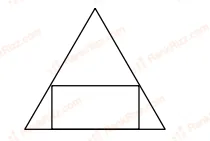
Figure for JEE Main 2021 Mathematics question on Optimization word and geometry problems
JEE MAIN 2021 · 31 AUG S1Monotonicity and intervals of increase/decreaseTRANSCRIBED

If RR is the least value of aa such that the function f(x)=x2+ax+1f(x) = x^2 + ax + 1 is increasing on [1,2][1, 2] and SS is the greatest value of aa such that the function f(x)=x2+ax+1f(x) = x^2 + ax + 1 is decreasing on [1,2][1, 2], then the value of ∣R−S∣|R - S| is _________.

JEE MAIN 2021 · 17 MAR S1Absolute maxima and minimaTRANSCRIBED

The maximum value of zz in the following equation z=6xy+y2z = 6xy + y^2, where 3x+4y≤1003x + 4y \leq 100 and 4x+3y≤754x + 3y \leq 75 for x≥0x \geq 0 and y≥0y \geq 0 is ________.