Crystal lattices, unit cells and density — JEE Main Previous Year Questions
Every JEE Main question on Crystal lattices, unit cells and density, one of the ideas inside Solid State: 41 questions from 2005–2023, 28 of them in the last five years. Newest first, answer key on every one. Free to read.
Every Crystal lattices, unit cells and density question
21–40 OF 41 · NEWEST FIRST
JEE MAIN 2019 · 11 JAN S2Crystal lattices, unit cells and densityTRANSCRIBED
The radius of the largest sphere which fits properly at the centre of the edge of a body centred cubic unit cell is: (Edge length is represented by 'a')
JEE MAIN 2019 · 08 APR S2Crystal lattices, unit cells and densityTRANSCRIBED
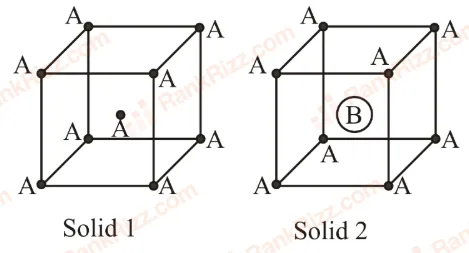
Consider the bcc unit cells of the solids 1 and 2 with the position of atoms as shown below. The radius of atom B is twice that of atom A. The unit cell edge length is 50% more in solid 2 than in 1. What is the approximate packing efficiency in solid 2?
JEE MAIN 2019 · 09 APR S2Crystal lattices, unit cells and densityTRANSCRIBED
10 mL of 1 mM surfactant solution forms a monolayer covering 0.24 cm2 on a polar substrate. If the polar head is approximated as a cube, what is its edge length?
JEE MAIN 2019 · 11 JAN S1Crystal lattices, unit cells and densityTRANSCRIBED
A solid having density of 9×10³ kg m−3 forms face centred cubic crystals of edge length 2002 pm. What is the molar mass of the solid? [Avogadro constant ≈6×10²³ mol−1, π≈3]
JEE MAIN 2019 · 08 APR S1Crystal lattices, unit cells and densityTRANSCRIBED
Element B forms ccp structure and A occupies half of the octahedral voids, while oxygen atoms occupy all the tetrahedral voids. The structure of bimetallic oxide is:
JEE MAIN 2019 · 12 APR S1Crystal lattices, unit cells and densityTRANSCRIBED
An element has a face-centered cubic fcc structure with a cell edge of a. The distance between the centres of two nearest tetrahedral voids in the lattice is
JEE MAIN 2017 · 02 APR OFFLINECrystal lattices, unit cells and densityTRANSCRIBED
A metal crystallizes in a face centred cubic structure. If the edge length of its unit cell is 'a', the closest approach between two atoms in the metallic crystal will be
JEE MAIN 2014 · 09 APR ONLINECrystal lattices, unit cells and densityTRANSCRIBED
In a face centered cubic lattice atoms A are at the corner points and atoms B at the face centered points. If atom B is missing from one of the face centered points, the formula of the ionic compound is:
JEE MAIN 2013 · 23 APR ONLINECrystal lattices, unit cells and densityTRANSCRIBED
In a face centred cubic lattice, atoms of A form the corner points and atoms of B form the face centred points. If two atoms of A are missing from the corner points, the formula of the ionic compound is :
JEE MAIN 2011Crystal lattices, unit cells and densityTRANSCRIBED
In a face centred cubic lattice, atom A occupies the corner positions and atom B occupies the face centre positions. If one atom of B is missing from one of the face centred points, the formula of the compound is: