JEE Main 2019 Chemistry question — Crystal lattices, unit cells and density
Consider the bcc unit cells of the solids 1 and 2 with the position of atoms as shown below. The radius of atom B is twice that of atom A. The unit cell edge length is 50% more in solid 2 than in 1. What is the approximate packing efficiency in solid 2?
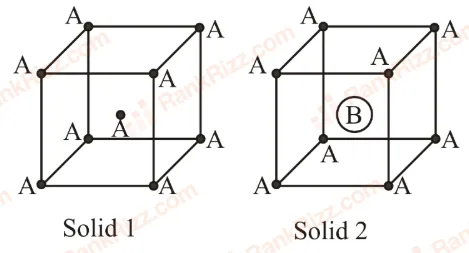
SOLUTION
Step 1: Determine the Relationship Along the Body Diagonal
In a body-centered cubic (BCC) unit cell, the constituent atoms touch along the body diagonal of the cube. Let the edge length of Solid 2 be . The length of its body diagonal is equal to .
According to the diagram for Solid 2:
- Corner sites are occupied by atoms of type A, contributing their radius .
- The body-center site is occupied by a single larger atom of type B, contributing its full diameter .
Therefore, along the body diagonal:
We are given that the radius of atom B is twice that of atom A (). Substituting this in:
Solving for the unit cell edge length in terms of :
Step 2: Calculate the Total Volume of Atoms in Solid 2
Let's calculate the effective number of atoms and their volumes contained inside the unit cell:
- Atoms of type A: 8 corners effective atom of A.
- Atoms of type B: 1 center effective atom of B.
The total volume occupied by the spheres () is:
Substitute :
Step 3: Calculate the Total Volume of the Unit Cell
The total volume of the cube () is given by :
Step 4: Compute the Packing Efficiency
Packing efficiency is the percentage of total space occupied by the spheres:
Substituting the values and :
Conclusion:
The calculated value yields an approximate space occupancy of roughly , which matches Option A perfectly.
Answer: Option A — 90 %
Tagged Crystal lattices, unit cells and density. Machine-assigned, so read it as a strong shortlist rather than a verdict.