JEE MAIN 2019 · 12 APR S2Group 14: trends and carbon allotropesTRANSCRIBED
The C - C bond length is maximum in:
- A
C
- B
C
- C
graphite
- D
diamond
Every JEE Main question on Group 14: trends and carbon allotropes, one of the ideas inside p-Block Elements: Groups 13 and 14: 36 questions from 2004–2026, 12 of them in the last five years. Newest first, answer key on every one. Free to read.
Questions
36
Years asked
14
Since
2004
Of the chapter
39%
21–36 OF 36 · NEWEST FIRST
The C - C bond length is maximum in:
C
C
graphite
diamond
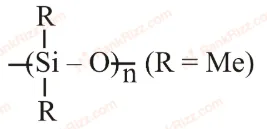
Correct statements among regarding silicones are:
(a) They are polymers with hydrophobic character.
(b) They are biocompatible.
(c) In general, they have high thermal stability and low dielectric strength.
(d) Usually, they are resistant to oxidation and used as greases.
(a), (b) and (c) only
(a) and (b) only
(a), (b), (c) and (d)
(a), (b) and (d) only
The correct order of catenation is:
Ge > Sn > Si > C
C > Sn > Si ≈ Ge
C > Si > Ge ≈ Sn
Si > Sn > C > Ge
The basic structural unit of feldspar, zeolites, mica, and asbestos is:
SiO
SiO
SiO
The one that is extensively used as a piezoelectric material is:
Tridymite
Quartz
Amorphous silica
Mica
The chloride that CANNOT get hydrolysed is:
In graphite and diamond, the percentage of p characters of the hybrid orbitals in hybridization are respectively:
33 and 25
67 and 75
50 and 75
33 and 75
Lithium aluminium hydride reacts with silicon tetrachloride to form:
LiCl, AlH and SiH
LiCl, AlCl and SiH
LiH, AlCl and SiCl
LiH, AlH and SiH
Assertion: Among the carbon allotropes, diamond is an insulator, whereas, graphite is a good conductor of electricity.
Reason: Hybridization of carbon in diamond and graphite are sp and sp respectively.
Both assertion and reason are correct, but the reason is not the correct explanation for the assertion.
Both assertion and reason are correct, but the reason is the correct explanation for the assertion.
Both assertion and reason are incorrect.
Assertion is incorrect statement, but the reason is correct.
Match the items in Column I with its main use listed in Column II:
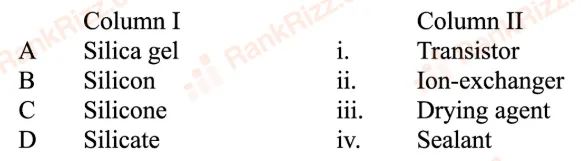
A - iii, B - i, C - iv, D - ii
A - iv, B - i, C - ii, D - iii
A - ii, B - i, C - iv, D - iii
A - ii, B - iv, C - i, D - iii
Example of a three-dimensional silicate is:
Ultramarines
Feldspars
Zeolites
All of these
The gas evolved on heating CaF and SiO with concentrated HSO, on hydrolysis gives a white gelatinous precipitate. The precipitate is:
Silicic acid
Calcium fluorosilicate
Hydrofluorosilicic acid
Silica gel
The catenation tendency of C, Si and Ge is in the order Ge < Si < C. The bond energies (in kJ mol) of C-C, Si-Si and Ge-Ge bonds are respectively ;
348, 297, 260
297, 348, 260
348, 260, 297
260, 297, 348
Identify the incorrect statement:
In , tetrahedral SiO units share two oxygen atoms.
Trialkylchlorosilane on hydrolysis gives RSiOH.
SiCl undergoes hydrolysis to give HSiO.
has cyclic structure.
The stability of dihalides of Si, Ge, Sn and Pb increases steadily in the sequence
The soldiers of Napolean army while at Alps during freezing winter suffered a serious problem as regards to the tin buttons of their uniforms. White metallic tin buttons got converted to grey powder. This transformation is related to
an interaction with nitrogen of the air at very low temperatures
an interaction with water vapour contained in the humid air
a change in the partial pressure of oxygen in the air
a change in the crystalline structure of tin
RELATED P-BLOCK ELEMENTS: GROUPS 13 AND 14 TOPICS