JEE MAIN 2021 · 25 FEB S2Solubility product and common ion effectTRANSCRIBED
The solubility of in water is:
[Given: The solubility product of in water ]
- A
- B
- C
- D
Every JEE Main question on Solubility product and common ion effect, one of the ideas inside Chemical and Ionic Equilibrium: 51 questions from 2004–2026, 20 of them in the last five years. Newest first, answer key on every one. Free to read.
Questions
51
Years asked
17
Since
2004
Of the chapter
19%
21–40 OF 51 · NEWEST FIRST
The solubility of in water is:
[Given: The solubility product of in water ]
The solubility of AgCN in a buffer solution of pH = 3 is x. The value of x is: [Assume: No cyano complex is formed; and ]
A solution is 0.1M in Cl and 0.001M in CrO.
Solid AgNO is gradually added to it. Assuming that the addition does not change in volume and
K(AgCl) = 1.7 10 M and
K(AgCrO) = 1.9 10 M.
Select correct statement from the following:
AgCl precipitates first because its K is high.
AgCrO precipitates first as its K is low.
AgCrO precipitates first because the amount of Ag needed is low.
AgCl will precipitate first as the amount of Ag needed to precipitate is low.
AB is a sparingly soluble salt of molar mass M (g mol) and solubility x g L. The solubility product satisfies K = . The value of a is _________. (Integer answer)
The solubility of CdSO in water is mol L. Its solubility in 0.01 M HSO solution is ___ mol L (Round off to the Nearest integer) (Assume that solubility is much less than 0.01 M)
Two salts and MX have the same value of solubility product of . The ratio of their molar solubilities i.e. = ________. (Round off to the Nearest Integer).
The solubility product of is . The solubility of lead iodide in 0.1 molar solution of lead nitrate is mol/L. The value of x is ______ (Rounded off to the nearest integer)
[Given ]
The molar solubility of Zn(OH) in 0.1M NaOH solution is M. The value of x is _________. (Nearest integer)
Given: The solubility product of Zn(OH) is
The solubility product of at 298K is . The concentration of hydroxide ions in a saturated solution of will be:
For the following Assertion and Reason, the correct option is:
Assertion (A): When Cu (II) and sulphide ions are mixed, they react together extremely quickly to give a solid.
Reason (R): The equilibrium constant of is high because the solubility product is low.
(A) is false and (R) is true.
Both (A) and (R) are false.
Both (A) and (R) are true but (R) is not the explanation for (A).
Both (A) and (R) are true and (R) is the explanation for (A).
The stoichiometry and solubility product of a salt with the solubility curve given below is, respectively:
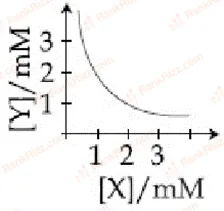
XY, M
XY, M
XY, M
XY, M
The for the following dissociation is
Which of the following choices is correct for a mixture of 300 mL 0.134 M and 100 mL 0.4 M NaCl?
Not enough data provided
If the solubility product of is , then the solubility of in pure water is ______ [Assuming that neither kind of ion reacts with water]
If solubility product of Zr(PO) is denoted by K and its molar solubility is denoted by S, then which of the following relation between S and K is correct?
A mixture of 100 m mol of and 2 g of sodium sulphate was dissolved in water and the volume was made up to 100 mL. What is the mass of calcium sulphate formed and the concentration of in resulting solution, respectively? (Molar mass of , and are 74, 143 and 136 g mol, respectively; of is )
1.9 g, 0.14 mol L
13.6 g, 0.28 mol L
1.9 g, 0.28 mol L
13.6 g, 0.14 mol L
The molar solubility of Cd(OH) is M in water. The expected solubility of Cd(OH) in a buffer solution of pH = 12 is:
M
M
M
M
What is the molar solubility of Al(OH) in 0.2 M NaOH solution? Given that, solubility product of Al(OH) = :
If of is , the molar solubility of in 0.1 M is:
M
M
M
M
The minimum volume of water required to dissolve 0.1 g lead (II) chloride to get a saturated solution ( of PbCl = ; atomic mass of Pb = 207 u) is:
1.798 L
0.36 L
17.95 L
0.18 L
Zirconium phosphate [Zr(PO)] dissociates into three zirconium cations of charge +4 and four phosphate anions of charge . If molar solubility of zirconium phosphate is denoted by s and its solubility product by K then which of the following relationship between s and K is correct?
RELATED CHEMICAL AND IONIC EQUILIBRIUM TOPICS