RankRizz

Law of mass action and equilibrium constants Kc and Kp — JEE Main Previous Year Questions

Every JEE Main question on Law of mass action and equilibrium constants Kc and Kp, one of the ideas inside Chemical and Ionic Equilibrium: 93 questions from 2004–2026, 47 of them in the last five years. Newest first, answer key on every one. Free to read.

Questions

93

Years asked

18

Since

2004

Of the chapter

34%

When JEE Main asked it

Questions on Law of mass action and equilibrium constants Kc and Kp in each year it was asked, the latest 12 of 18.

202613
20259
20248
20238
20229
202111
20208
20198
20181
20162
20152
20143

Every Law of mass action and equilibrium constants Kc and Kp question

1–20 OF 93 · NEWEST FIRST

JEE MAIN 2026 · 04 APR S1Law of mass action and equilibrium constants Kc and KpTRANSCRIBED

At TT(K), the equilibrium constant of A2(g)+B2(g)⇌C(g)A_2(g) + B_2(g) \rightleftharpoons C(g) is 2.7×10−52.7 \times 10^{-5}. What is the equilibrium constant for 13A2(g)+13B2(g)⇌13C(g)\frac{1}{3}A_2(g) + \frac{1}{3}B_2(g) \rightleftharpoons \frac{1}{3}C(g) at the same temperature?

  1. A

    (2.7×10⁻⁵)3(2.7 \times 10^{-5})^3

  2. B

    6×10⁻²⁶ \times 10^{-2}

  3. C

    2.7×10⁻⁵\sqrt{2.7 \times 10^{-5}}

  4. D

    3×10⁻²³ \times 10^{-2}

JEE MAIN 2026 · 08 APR S2Law of mass action and equilibrium constants Kc and KpTRANSCRIBED

Consider the following reactions in which all the reactants and products are present in gaseous state
2xy⇌x2+y2K1=2.5×1052xy \rightleftharpoons x_2 + y_2 \quad K_1 = 2.5 \times 10^5
xy+12z2⇌xyzK2=5×10⁻³xy + \frac{1}{2}z_2 \rightleftharpoons xyz \quad K_2 = 5 \times 10^{-3}
The value of K3K_3 for the equilibrium 12x2+12y2+12z2⇌xyz\frac{1}{2}x_2 + \frac{1}{2}y_2 + \frac{1}{2}z_2 \rightleftharpoons xyz is :

  1. A

    2.5×10−32.5 \times 10^{-3}

  2. B

    2.5×1032.5 \times 10^{3}

  3. C

    1.0×10−51.0 \times 10^{-5}

  4. D

    5×10⁻³⁵ \times 10^{-3}

JEE MAIN 2026 · 05 APR S2Law of mass action and equilibrium constants Kc and KpTRANSCRIBED

The reaction A(g)⇌B(g)+C(g)A(g) \rightleftharpoons B(g) + C(g) was initiated with the amount `aa` of A(g)A(g). At equilibrium it is found that the amount of A(g)A(g) remaining is (a−x)(a - x) at a total pressure of pp.
The equilibrium constant KpK_p of the reaction can be calculated from the expression:

  1. A

    x2a2+x2×p\frac{x^2}{a^2 + x^2} \times p

  2. B

    x2a2−x2×p\frac{x^2}{a^2 - x^2} \times p

  3. C

    a+x2x2×p\frac{a + x^2}{x^2} \times p

  4. D

    a2−x2x2×p\frac{a^2 - x^2}{x^2} \times p

JEE MAIN 2026 · 28 JAN S2Law of mass action and equilibrium constants Kc and KpTRANSCRIBED

Observe the following equilibrium in a 1 L flask.
A(g)⇌B(g)A(g)\rightleftharpoons B(g)
At T(K), the equilibrium concentrations of A and B are 0.5 Mand 0.375 M respectively. 0.1 moles of A is added into the flask and heated to T(K) to establish the equilibrium again. The new equilibrium concentrations (in M) of A and B are respectively

  1. A

    0.557, 0.418.

  2. B

    0.53, 0.4.

  3. C

    0.742, 0.557.

  4. D

    0.367, 0.275.

JEE MAIN 2026 · 06 APR S1Law of mass action and equilibrium constants Kc and KpTRANSCRIBED

One mole each of He and A(g) are taken in a 10 L closed flask and heated to 400 K to establish the following equilibrium.
A(g) ⇌\rightleftharpoons B(g)
Kc_c for this reaction at 400 K is 4.0. The partial pressures (in atm) of He and B(g) are respectively (at equilibrium)
(Assume He, A(g) and B(g) behave as ideal gases)
(Given: R = 0.082 L atm K−1^{-1} mol−1^{-1})

  1. A

    3.28, 2.624

  2. B

    2.624, 3.28

  3. C

    3.28, 0.656

  4. D

    0.656, 6.56

JEE MAIN 2026 · 23 JAN S1Law of mass action and equilibrium constants Kc and KpTRANSCRIBED

Consider the general reaction given below at 400 K
xA(g)⇌yB(g)xA(g)\rightleftharpoons yB(g).
The values of Kp and KcK_{p}\text{ and }K_{c} are studied under the same condition of temperature but variation in x and y
(i)Kp=85.87 and Kc=2.586K_{p}=85.87\text{ and }K_{c}=2.586 appropriate units
(ii)Kp=0.862 and Kc=28.62K_{p}=0.862\text{ and }K_{c}=28.62 appropriate units
The values of x and yin (i) and (ii) respectively are:

  1. A

    (i)1,2 (ii)2,1

  2. B

    (i)1,3 (ii)2,1

  3. C

    (i)4,1 (ii)4,1

  4. D

    (i)3,1 (ii)3,1

JEE MAIN 2026 · 22 JAN S1Law of mass action and equilibrium constants Kc and KpTRANSCRIBED

Dissociation of a gas A2A_{2} takes place according to the following chemical reaction.
At equilibrium, the total pressure is 1 bar at 300K.

A2(g)⇌2A(g)A_{2}(g)\rightleftharpoons 2A(g)

The standard Gibbs energy of formation of the involved substances has been
provided below:
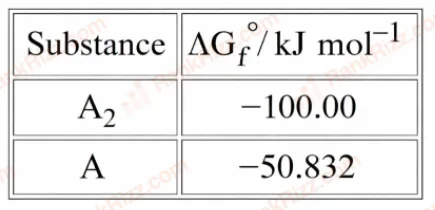
22nd slot 1 72


The degree of dissociation of A2(g)A_{2} (g) is given by (x×10−2)1/2(x\times10^{-2})^{1/2} where xx =
_____ . (Nearest integer).
[Given: R=8J mol−1K−1,log⁡2=0.3010,log⁡3=0.48]R=8 J \text{ }mol^{-1}K^{-1},\log{2}=0.3010, \log {3}=0.48]
Assume degree of dissociation is not negligible.

JEE MAIN 2026 · 23 JAN S2Law of mass action and equilibrium constants Kc and KpTRANSCRIBED

X2(g)+Y2(g)⇌2Z(g)X_2(g ) + Y_2(g ) \rightleftharpoons 2Z(g)

X2(g)X_2(g ) and Y2(g)Y_2(g ) are added to a 1 L flask and it is found that the system attains the above equilibrium at T(K) with the number of moles of X2(g), Y2(g)X_2(g ),\text{ } Y_2(g ) and Z(g)Z(g) being 3, 3 and 9 mol respectively (equilibrium moles). Under this condition of equilibrium, 10 mol of Z(gZ(g) is added to the flask and the temperature is maintained at T(K)T(K). Then the number of moles of Z(g)Z(g) in the flask when the new equilibrium is established is __ . (Nearest integer)

JEE MAIN 2026 · 23 JAN S1Law of mass action and equilibrium constants Kc and KpTRANSCRIBED

For the following gas phase equilibrium reaction at constant temperature,
NH3(g)⇌1/2N2(g)+3/2H2(g)NH_{3}(g)\rightleftharpoons 1/2N_{2}(g)+3/2H_{2}(g)
if the to tal pressure is 3\sqrt{3} atm and the pressure equilibrium constant (KpK_{p}) is 9 atm, then the degree of dissociation is given as (x×10−2)−1/2(x\times 10^{-2})^{-1/2}.The value of x is ______. (nearest integer)

JEE MAIN 2026 · 04 APR S2Law of mass action and equilibrium constants Kc and KpTRANSCRIBED

For the following reaction at 50 °C and at 2 atm pressure,

2N2O5(g)⇌2N2O4(g)+O2(g)2N_2O_5(g) \rightleftharpoons 2N_2O_4(g) + O_2(g)

N2_2O5_5 is 50% dissociated.

The magnitude of standard free energy change at this temperature is xx.

xx = _________ J mol−1^{-1} [Nearest integer].

Given: R=8.314R = 8.314 J mol−1^{-1} K−1^{-1}, log⁡2=0.30\log 2 = 0.30, log⁡3=0.48\log 3 = 0.48, ln⁡10=2.303\ln 10 = 2.303, °C + 273 = K

JEE MAIN 2026 · 06 APR S2Law of mass action and equilibrium constants Kc and KpTRANSCRIBED

In a closed flask at 600 K, one mole of X2Y4(g)X_2Y_4(g) attains equilibrium as given below : X2Y4(g)⇌2XY2(g)X_2Y_4(g) \rightleftharpoons 2XY_2(g)$ At equilibrium, 75% X2Y4(g)X_2Y_4(g) was dissociated and the total pressure is 1 atm. The magnitude of ΔrG⊖\Delta_r G^{\ominus} (in kJ mol−1^{-1}) at this temperature is __________. (Nearest Integer) (Given : R = 8.3 J mol−1^{-1} K−1^{-1}; ln 10 = 2.3, log 2 = 0.3, log 3 = 0.48, log 5 = 0.69, log 7 = 0.84)

JEE MAIN 2026 · 05 APR S1Law of mass action and equilibrium constants Kc and KpTRANSCRIBED

The values of pressure equilibrium constant recorded at different temperatures for the following equilibrium reaction have been given below
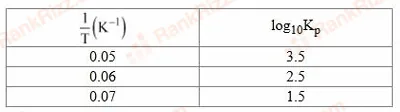
A(g)⇌B(g)+C(g)A(g) \rightleftharpoons B(g) + C(g)

Figure for JEE Main 2026 Chemistry question on Law of mass action and equilibrium constants Kc and Kp


The magnitude of ΔH∘R\frac{\Delta H^\circ}{R} calculated from the above data is _______. (Nearest integer)

JEE MAIN 2026 · 08 APR S2Law of mass action and equilibrium constants Kc and KpTRANSCRIBED

Solid carbon, CaO and CaCO3_3 are mixed and allowed to attain equilibrium at T K.
CaCO3(s)⇌CaO(s)+CO2(g)Kp1=0.08\text{CaCO}_3\text{(s)} \rightleftharpoons \text{CaO(s)} + \text{CO}_2\text{(g)} \quad K_{p_1} = 0.08 atm
C(s)+CO2(g)⇌2CO(g)Kp2=2\text{C(s)} + \text{CO}_2\text{(g)} \rightleftharpoons 2\text{CO(g)} \quad K_{p_2} = 2 atm
The partial pressure of CO is __________ ×10−1\times 10^{-1} atm

JEE MAIN 2025 · 29 JAN S1Law of mass action and equilibrium constants Kc and KpTRANSCRIBED

At temperature TT, compound AB2(g)AB_{2(g)} dissociates as AB2⇌AB(g)+12B2(g)AB_{2} \rightleftharpoons AB_{(g)}+\frac{1}{2}B_{2(g)} having degree of dissociation xx (small compared to unity). The correct expression for xx in terms of KpK_{p} and p is

  1. A

    sqrt[4]2Kppsqrt[4]{\frac{2K_{p}}{p}}

  2. B

    sqrt[3]2Kppsqrt[3]{\frac{2K_{p}}{p}}

  3. C

    sqrt[3]2Kp2psqrt[3]{\frac{2K_{p}^{2}}{p}}

  4. D

    sqrtKpsqrt{K_{p}}

JEE MAIN 2025 · 03 APR S1Law of mass action and equilibrium constants Kc and KpTRANSCRIBED

Given below are two statements
Statement I : A catalyst cannot alter the equilibrium constant (Kc)(K_c) of the reaction, temperature remaining constant
Statement II : A homogeneous catalyst can change the equilibrium composition of a system temperature remaining constant
In the light of the above statements, choose the correct answer from the options given below

  1. A

    Statement I is false but Statement II is true

  2. B

    Both Statement I and Statement II are true

  3. C

    Both Statement I and Statement II are false

  4. D

    Statement I is true but Statement II is false

JEE MAIN 2025 · 23 JAN S2Law of mass action and equilibrium constants Kc and KpTRANSCRIBED

Consider the reaction X2Y(g)=X2(g)+12Y2(g)X_{2}Y(g)=X_{2}(g)+\frac{1}{2}Y_{2}(g) The equation representing correct relationship between the degree of dissociation (x) of X2Y(g)X_{2}Y(g) with its equilibrium constant Kp is ______ . Assume x to be very very small.

  1. A

    x=2Kpp3x=\sqrt[3]{\frac{2Kp}{p}}

  2. B

    x=2Kp2p3x=\sqrt[3]{\frac{2Kp^{2}}{p}}

  3. C

    x=Kpp3x=\sqrt[3]{\frac{Kp}{p}}

  4. D

    x=Kp2p3x=\sqrt[3]{\frac{Kp}{2p}}

JEE MAIN 2025 · 24 JAN S2Law of mass action and equilibrium constants Kc and KpTRANSCRIBED

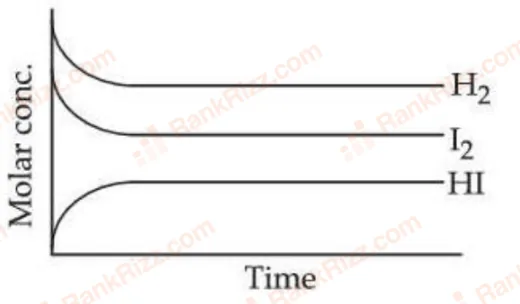
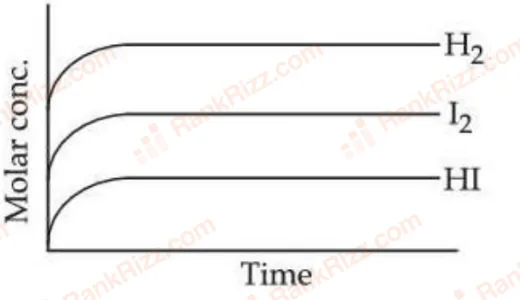
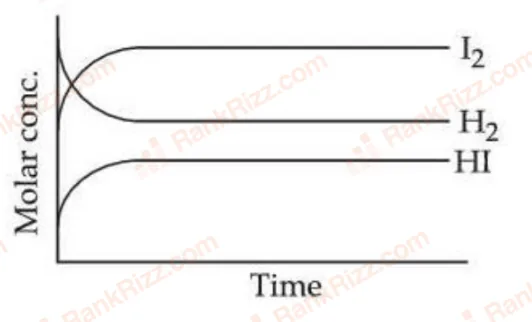
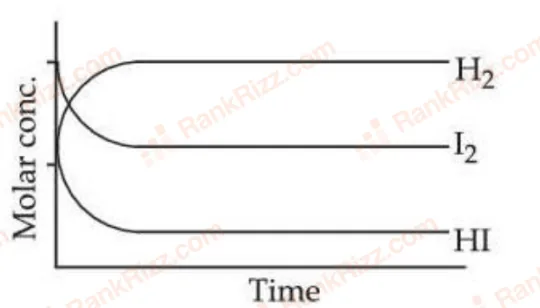
For the reaction, H2(g)+I2(g)⇌2HI(g),\text{For the reaction, } H_2(g) + I_2(g) \rightleftharpoons 2HI(g),  Attainment of equilibrium is predicted correctly by:
  1. A
    page11_img1
  2. B
    page11_img2
  3. C
    page11_img3
  4. D
    page11_img4
JEE MAIN 2025 · 22 JAN S1Law of mass action and equilibrium constants Kc and KpTRANSCRIBED

A vessel at 1000 K contains CO2CO_2 with a pressure of 0.5 atm . Some of CO2CO_2 is converted into CO on addition of graphite. If total pressure at equilibrium is 0.8 atm , then Kp is :

  1. A

    1.8 atm

  2. B

    0.3 atm

  3. C

    3 atm

  4. D

    0.18 atm

JEE MAIN 2025 · 02 APR S2Law of mass action and equilibrium constants Kc and KpTRANSCRIBED

Consider the following chemical equilibrium of the gas phase reaction at a constant temperature :
A(g)⇌B(g)+C(g)A(g) \rightleftharpoons B(g) + C(g)

If p being the total pressure, KpK_p is the pressure equilibrium constant and α\alpha is the degree of dissociation, then which of the following is true at equilibrium ?

  1. A

    If p value is extremely high compared to KpK_p, α≈1\alpha \approx 1

  2. B

    When p increases α\alpha decreases

  3. C

    If KpK_p value is extremely high compared to p, α\alpha becomes much less than unity

  4. D

    When p increases α\alpha increases

JEE MAIN 2025 · 24 JAN S1Law of mass action and equilibrium constants Kc and KpTRANSCRIBED

37.8 g N2O537.8\,g\,N_2O_5 was taken in a  1 L1\,L reaction vessel and allowed to undergo the following reaction at 500 K  2N2O5(g)⇌2N2O4(g)+O2(g)2N_2O_5(g) \rightleftharpoons 2N_2O_4(g) + O_2(g) The total pressure at equilibrium was found to be  18.65 18.65\,bar.  Then, Kp=‾×10−2K_p = \underline{\hspace{2cm}}\times10^{-2}  [nearest integer]. Assume  N2O5N_2O_5  to behave ideally under these conditions. Given:  R=0.082 bar L mol−1K−1R=0.082\,bar\,L\,mol^{-1}K^{-1}