RankRizz

Law of mass action and equilibrium constants Kc and Kp — JEE Main Previous Year Questions

Every JEE Main question on Law of mass action and equilibrium constants Kc and Kp, one of the ideas inside Chemical and Ionic Equilibrium: 93 questions from 2004–2026, 47 of them in the last five years. Newest first, answer key on every one. Free to read.

Questions

93

Years asked

18

Since

2004

Of the chapter

34%

Every Law of mass action and equilibrium constants Kc and Kp question

61–80 OF 93 · NEWEST FIRST

JEE MAIN 2020 · 06 SEP S2Law of mass action and equilibrium constants Kc and KpTRANSCRIBED

The value of KcK_c is 64 at 800 K for the reaction
N2(g)+3H2(g)→2NH3(g)\text{N}_2(g) + 3\text{H}_2(g) \to 2\text{NH}_3(g)
The value of KcK_c for the following reaction is:
NH3(g)→12N2(g)+32H2(g)\text{NH}_3(g) \to \frac{1}{2}\text{N}_2(g) + \frac{3}{2}\text{H}_2(g)

  1. A

    1/64

  2. B

    8

  3. C

    1/4

  4. D

    1/8

JEE MAIN 2020 · 05 SEP S1Law of mass action and equilibrium constants Kc and KpTRANSCRIBED

Consider the following reaction:
N2O4(g)=2NO2(g);  ΔH0=+58 k\text{N}_2\text{O}_4(g) = 2\text{NO}_2(g);\;\Delta H^0 = +58\,\text{k}
For each of the following cases (a, b), the direction in which the equilibrium shifts is:
(a) Temperature is decreased.
(b) Pressure is increased by adding N2\text{N}_2 at constant T.

  1. A

    (a) towards product, (b) towards reactant

  2. B

    (a) towards reactant, (b) towards product

  3. C

    (a) towards reactant, (b) no change

  4. D

    (a) towards product, (b) no change

JEE MAIN 2020 · 09 JAN S2Law of mass action and equilibrium constants Kc and KpTRANSCRIBED

In the figure shown below reactant A (represented by square) is in equilibrium with product B (represented by circle). The equilibrium constant is (approx):

Figure for JEE Main 2020 Chemistry question on Law of mass action and equilibrium constants Kc and Kp
  1. A

    4

  2. B

    8

  3. C

    1

  4. D

    2

JEE MAIN 2020 · 04 SEP S2Law of mass action and equilibrium constants Kc and KpTRANSCRIBED

If the equilibrium constant for A⇌B+CA \rightleftharpoons B + C is Keq(1)K_{eq}^{(1)} and that of B+C⇌PB + C \rightleftharpoons P is Keq(2)K_{eq}^{(2)}, the equilibrium constant for A⇌PA \rightleftharpoons P is:

  1. A

    Keq(1)/Keq(2)K_{eq}^{(1)}/K_{eq}^{(2)}

  2. B

    Keq(2)−Keq(1)K_{eq}^{(2)} - K_{eq}^{(1)}

  3. C

    Keq(1)+Keq(2)K_{eq}^{(1)} + K_{eq}^{(2)}

  4. D

    Keq(1)Keq(2)K_{eq}^{(1)} K_{eq}^{(2)}

JEE MAIN 2020 · 04 SEP S1Law of mass action and equilibrium constants Kc and KpTRANSCRIBED

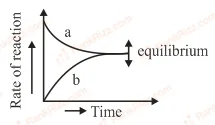
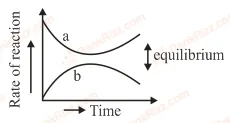
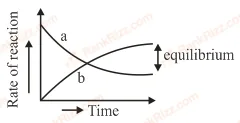
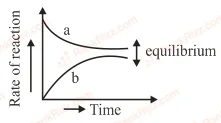
For the equilibrium A⇌BA \rightleftharpoons B, the variation of the rate of the forward (a) and reverse (b) reaction with time is given by:
  1. A
    Figure for JEE Main 2020 Chemistry question on Law of mass action and equilibrium constants Kc and Kp
  2. B
    Figure for JEE Main 2020 Chemistry question on Law of mass action and equilibrium constants Kc and Kp
  3. C
    Figure for JEE Main 2020 Chemistry question on Law of mass action and equilibrium constants Kc and Kp
  4. D
    Figure for JEE Main 2020 Chemistry question on Law of mass action and equilibrium constants Kc and Kp
JEE MAIN 2020 · 05 SEP S2Law of mass action and equilibrium constants Kc and KpTRANSCRIBED

For a reaction X+Y=2ZX + Y = 2Z, 1.0 mol1.0\,\text{mol} of X, 1.5 mol1.5\,\text{mol} of Y and 0.5 mol0.5\,\text{mol} of Z were taken in a 1L vessel and allowed to react. At equilibrium, the concentration of Z was 1.0 mol L−11.0\,\text{mol L}^{-1}. The equilibrium constant of the reaction is x15\frac{x}{15}. The value of x is.......

JEE MAIN 2019 · 10 JAN S1Law of mass action and equilibrium constants Kc and KpTRANSCRIBED

What are the values of KpKc\frac{K_p}{K_c} for the following reactions at 300 K respectively?
(At 300 K, RT = 24.62 dm2^2 atm mol−1^{-1})
N2(g)+O2(g)⇌2NO(g)N_2(g) + O_2(g) \rightleftharpoons 2NO(g)
N2O4(g)⇌2NO(g)N_2O_4(g) \rightleftharpoons 2NO(g)
N2(g)+3H2(g)⇌2NH3(g)N_2(g) + 3H_2(g) \rightleftharpoons 2NH_3(g)

  1. A

    24.63 dm3^3 atm mol−1^{-1}, 606.0 dm6^6 atm2^2 mol−2^{-2}, 1.65×10−31.65 \times 10^{-3} dm−6^{-6} atm−2^{-2} mol2^2

  2. B

    1, 24.62 dm6^6 atm3^3 mol−1^{-1}, 606.0 dm6^6 atm2^2 mol−2^{-2}

  3. C

    1, 24.62 dm3^3 atm mol−1^{-1}, 1.65×10−31.65 \times 10^{-3} dm−6^{-6} atm−2^{-2} mol2^2

  4. D

    1, 4.1×10−24.1 \times 10^{-2} dm−3^{-3} atm−1^{-1} mol, 606 dm6^6 atm2^2 mol−2^{-2}

JEE MAIN 2019 · 10 JAN S2Law of mass action and equilibrium constants Kc and KpTRANSCRIBED

5.1 g NH4SHNH_4SH is introduced in 3.0 L evacuated flask at 327∘^{\circ}C. 30% of the solid NH4SHNH_4SH is decomposed to NH3NH_3 and H2SH_2S as gases. The KPK_P of the reaction at 327∘^{\circ}C is: (R=0.082R = 0.082 L atm mol−1^{-1} K−1^{-1}, Molar mass of S = 32 g mol−1^{-1}, Molar mass of N = 14 g mol−1^{-1})

  1. A

    0.242 atm2^2

  2. B

    0.242×10−40.242 \times 10^{-4} atm2^2

  3. C

    1×10−41 \times 10^{-4} atm2^2

  4. D

    4.9×10−34.9 \times 10^{-3} atm2^2

JEE MAIN 2019 · 12 APR S2Law of mass action and equilibrium constants Kc and KpTRANSCRIBED

In which one of the following equilibria, Kp_p ≠ Kc_c?

  1. A

    2HI(g) ⇌\rightleftharpoons H2_2(g) + I2_2(g)

  2. B

    2C(s) + O2_2(g) ⇌\rightleftharpoons 2CO(g)

  3. C

    2NO(g) ⇌\rightleftharpoons N2_2(g) + O2_2(g)

  4. D

    NO2_2(g) + SO2_2(g) ⇌\rightleftharpoons NO(g) + SO3_3(g)

JEE MAIN 2019 · 11 JAN S1Law of mass action and equilibrium constants Kc and KpTRANSCRIBED

Consider the reaction N2(g)+3H2(g)⇌2NH3(g)N_2(g) + 3H_2(g) \rightleftharpoons 2NH_3(g). The equilibrium constant of the above reaction is KPK_P. If pure ammonia is left to dissociate, the partial pressure of ammonia at equilibrium is given by (Assume that PNH3≪PtotalP_{NH_3} \ll P_{total} at equilibrium)

  1. A

    33/2KP1/2P216\frac{3^{3/2} K_P^{1/2} P^2}{16}

  2. B

    KP1/2P216\frac{K_P^{1/2} P^2}{16}

  3. C

    KP1/2P24\frac{K_P^{1/2} P^2}{4}

  4. D

    33/2KP1/2P24\frac{3^{3/2} K_P^{1/2} P^2}{4}

JEE MAIN 2019 · 12 JAN S1Law of mass action and equilibrium constants Kc and KpTRANSCRIBED

In a chemical reaction, A+2B⇌K2C+DA + 2B \xrightleftharpoons{K} 2C + D, the initial concentration of B was 1.5 times the concentration of A, but the equilibrium concentrations of A and B were found to be equal. The equilibrium constant (K) for the chemical reaction is:

  1. A

    1

  2. B

    4

  3. C

    14\frac{1}{4}

  4. D

    16

JEE MAIN 2019 · 08 APR S2Law of mass action and equilibrium constants Kc and KpTRANSCRIBED

For the following reaction, equilibrium constants are given:
S(s)+O2(g)⇌SO2(g);K1=1052S(s) + O_2(g) \rightleftharpoons SO_2(g); \quad K_1 = 10^{52}
2S(s)+3O2(g)⇌2SO3(g);K2=101292S(s) + 3O_2(g) \rightleftharpoons 2SO_3(g); \quad K_2 = 10^{129}
The equilibrium constant for the reaction, 2SO2(g)+O2(g)⇌2SO3(g)2SO_2(g) + O_2(g) \rightleftharpoons 2SO_3(g) is:

  1. A

    1015410^{154}

  2. B

    102510^{25}

  3. C

    1018110^{181}

  4. D

    107710^{77}

JEE MAIN 2019 · 12 JAN S1Law of mass action and equilibrium constants Kc and KpTRANSCRIBED

Two solids dissociate as follows: A(s)⇌B(g)+C(g)A(s) \rightleftharpoons B(g) + C(g); KP1=xK_{P_1} = x atm2^2, D(s)⇌C(g)+E(g)D(s) \rightleftharpoons C(g) + E(g); KP2=yK_{P_2} = y atm2^2. The total pressure when both the solids dissociate simultaneously is:

  1. A

    x+y\sqrt{x+y} atm

  2. B

    x2+y2x^2 + y^2 atm

  3. C

    (x + y) atm

  4. D

    2(x+y)2\left(\sqrt{x+y}\right) atm

JEE MAIN 2019 · 09 JAN S2Law of mass action and equilibrium constants Kc and KpTRANSCRIBED

Consider the following reversible chemical reactions:
A2(g)+B2(g) ⇌k12AB(g)…(1)A_2(g) + B_2(g) \stackrel{k_1}{\rightleftharpoons} 2AB(g) \ldots (1) 
6AB(g) ⇌k23A2(g)+3B2(g)…(2)6AB(g) \stackrel{k_2}{\rightleftharpoons} 3A_2(g) + 3B_2(g) \ldots (2) 
The relation between K1K_1 and K2K_2 is:

  1. A

    K2=K1−3K_2 = K_1^{-3}

  2. B

    K1K2=13K_1 K_2 = \frac{1}{3}

  3. C

    K2=K13K_2 = K_1^3

  4. D

    K1K2=3K_1 K_2 = 3

JEE MAIN 2018 · 15 APR S2Law of mass action and equilibrium constants Kc and KpTRANSCRIBED

At a certain temperature in a 5L vessel, 2 moles of carbon monoxide and 3 moles of chlorine were allowed to reach equilibrium according to the reaction, CO + Cl2_2 ⇌\rightleftharpoons COCl2_2. At equilibrium, if one mole of CO is present then equilibrium constant (Kc_c) for the reaction is:

  1. A

    2.5

  2. B

    4

  3. C

    2

  4. D

    3

JEE MAIN 2016 · 10 APR ONLINELaw of mass action and equilibrium constants Kc and KpTRANSCRIBED

A solid XY kept in an evacuated sealed container undergoes decomposition to form a mixture of gases X and Y at temperature T. The equilibrium pressure is 10 bar in this vessel. KpK_p for this reaction is?

  1. A

    25

  2. B

    100

  3. C

    10

  4. D

    5

JEE MAIN 2016 · 03 APR OFFLINELaw of mass action and equilibrium constants Kc and KpTRANSCRIBED

The equilibrium constant at 298 K for a reaction A+B⇌C+DA + B \rightleftharpoons C + D is 100. If the initial concentration of all the four species were 1 M each, then the equilibrium concentration of D (in mol L−1L^{-1}) will be:

  1. A

    1.818

  2. B

    1.182

  3. C

    0.182

  4. D

    0.818

JEE MAIN 2015 · 04 APR OFFLINELaw of mass action and equilibrium constants Kc and KpTRANSCRIBED

The standard Gibbs energy change at 300 K for the reaction 2A⇌B+C2A \rightleftharpoons B + C is 2494.2 J. At a given time, the composition of the reaction mixture is [A]=12[A] = \frac{1}{2}, [B]=2[B] = 2 and [C]=12[C] = \frac{1}{2}. The reaction proceeds in the:
[R = 8.314 J/K-mol, e = 2.718] {Given antilog (-0.44) = 0.36}

  1. A

    Reverse direction because Q<KCQ < K_C

  2. B

    Forward direction because Q>KCQ > K_C

  3. C

    Reverse direction because Q>KCQ > K_C

  4. D

    Forward direction because Q<KCQ < K_C

JEE MAIN 2015 · 10 APR ONLINELaw of mass action and equilibrium constants Kc and KpTRANSCRIBED

Gaseous N2O4N_2O_4 dissociates into gaseous NO2NO_2 according to the reaction N2O4(g)⇌2NO2(g)N_2O_4(g) \rightleftharpoons 2NO_2(g). At 300 K and 1 atm pressure, the degree of dissociation of N2O4N_2O_4 is 0.2. If one mole of N2O4N_2O_4 gas is contained in a vessel, then the density of the equilibrium mixture is:

  1. A

    3.11 g/L

  2. B

    1.56 g/L

  3. C

    4.56 g/L

  4. D

    6.22 g/L

JEE MAIN 2014 · 19 APR ONLINELaw of mass action and equilibrium constants Kc and KpTRANSCRIBED

For the decomposition of the compound, represented as NH2_2COONH4_4(s) ⇌\rightleftharpoons 2NH3_3(g) + CO2_2(g), the Kp_p = 2.9×10−52.9 \times 10^{-5} atm3^3. If the reaction is started with 1 mole of the compound, the total pressure at equilibrium would be:

  1. A

    7.66×10−27.66 \times 10^{-2} atm

  2. B

    38.8×10−238.8 \times 10^{-2} atm

  3. C

    5.82×10−25.82 \times 10^{-2} atm

  4. D

    1.94×10−21.94 \times 10^{-2} atm