Among Sc, Mn, Co and Cu, identify the element with highest enthalpy of atomisation. The spin only magnetic moment value of that element in its +2 oxidation state is ________ BM (in nearest integer).
Every JEE Main question on General properties of transition elements, one of the ideas inside d- and f-Block Elements: 94 questions from 2004–2026, 59 of them in the last five years. Newest first, answer key on every one. Free to read.
Questions
94
Years asked
16
Since
2004
Of the chapter
41%
21–40 OF 94 · NEWEST FIRST
Among Sc, Mn, Co and Cu, identify the element with highest enthalpy of atomisation. The spin only magnetic moment value of that element in its +2 oxidation state is ________ BM (in nearest integer).
The spin only magnetic moment ( ) value (B.M.) of the compound with strongest oxidising power among TiO and VO is ____ B.M. (Nearest integer).
Which of the following electronic configuration would be associated with the highest magnetic moment?
Arrange the following elements in the increasing order of number of unpaired electrons in it. (A) Sc (B) Cr (C) V (D) Ti (E) Mn. Choose the correct answer from the options given below :
Choose the correct option having all the elements with electronic configuration from the following:
Which of the following statements are correct about Zn, Cd and Hg?
A. They exhibit high enthalpy of atomization as the d-subshell is full.
B. Zn and Cd do not show variable oxidation state while Hg shows +I and +II.
C. Compounds of Zn, Cd and Hg are paramagnetic in nature.
D. Zn, Cd and Hg are called soft metals.
Choose the most appropriate from the options given below:
B, D only
B, C only
A, D only
C, D only
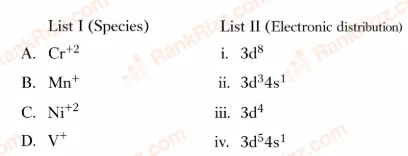
Match List-I with List-II

(A)-I, (B)-II, (C)-III, (D)-IV
(A)-III, (B)-IV, (C)-I, (D)-II
(A)-IV, (B)-III, (C)-I, (D)-II
(A)-II, (B)-I, (C)-IV, (D)-III
Given below are two statements: Statement I : The higher oxidation states are more stable down the group among transition elements unlike p-block elements. Statement II : Copper can not liberate hydrogen from weak acids. In the light of the above statements, choose the correct answer from the options given below :
Both Statement I and Statement II are true
Statement I is false but Statement II is true
Both Statement I and Statement II are false
Statement I is true but Statement II is false
The element which shows only one oxidation state other than its elemental form is:
Cobalt
Titanium
Nickel
Scandium
The number of ions from the following that have the ability to liberate hydrogen from a dilute acid is ______. and
2
3
1
0
Iron (III) catalyses the reaction between iodide and persulphate ions, in which
A. oxidises the iodide ion
B. oxidises the persulphate ion
C. reduces the iodide ion
D. reduces the persulphate ion.
Choose the most appropriate answer from the options given below:
B only
A only
B and C only
A and D only
The metal that shows highest and maximum number of oxidation state is :
Fe
Mn
Co
Ti
Electronic configuration of Cu(II) is whereas that of Cu(I) is . Which of the following is correct?
Stability of Cu(I) and Cu(II) depends on nature of copper salts
Cu(II) is more stable
Cu(I) and Cu(II) are equally stable
Cu(II) is less stable
Given below are two statements: one is labelled as Assertion A and the other is labelled as Reason R.
Assertion A: In aqueous solutions is reducing while is oxidising in nature.
Reason R: Extra stability to half filled electronic configuration is observed than incompletely filled electronic configuration.
In the light of the above statement, choose the most appropriate answer from the options given below:
Both A and R are true and R is the correct explanation of A
Both A and R are true but R is not the correct explanation of A
A is false but R is true
A is true but R is false
Among , and , the spin-only magnetic moment value of the species with least oxidising ability is ___________ BM (Nearest integer). (Given atomic number )
A first row transition metal with highest enthalpy of atomisation, upon reaction with oxygen at high temperature forms oxides of formula (where ). The 'spin-only' magnetic moment value of the amphoteric oxide from the above oxides is ______ BM (nearest integer). (Given atomic number: Sc: 21, Ti: 22, V: 23, Cr: 24, Mn: 25, Fe: 26, Co: 27, Ni: 28, Cu: 29, Zn: 30)
Among , and , the sum of spin-only magnetic moment values of basic and amphoteric oxides is _______ BM (nearest integer). (Given atomic number of Cr is 24)
A transition metal '' among and has the highest second ionisation enthalpy. The spin-only magnetic moment value of ion is ______ BM (Near integer) (Given atomic number )
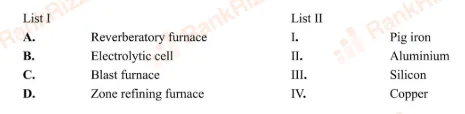
Match List I with List II.

A - IV, B - II, C - I, D - III
A - I, B - IV, C - II, D - III
A - I, B - III, C - II, D - IV
A - III, B - IV, C - I, D - II
In chromyl chloride, the number of d-electrons present on chromium is same as in (Given at no. of Ti: 22, V: 23, Cr: 24, Mn: 25, Fe: 26)
V (IV)
Mn (VII)
Fe (III)
Ti (III)
RELATED D- AND F-BLOCK ELEMENTS TOPICS