RankRizz
JEE MAIN 2026 · 22 JAN S1+4 / −1MEDIUMTRANSCRIBED

JEE Main 2026 Chemistry question — Stability and applications of coordination compounds

A first row transition metal (M) does not liberate H2H_{2} gas from dilute HCI. 1 mol of aqueous solution of MSO4MSO_{4} is treated with excess of aqueous KCN and then H2S(g)H_{2} S(g) is passed through the solution. The amount of MS (metal sulphide) formed from the above reaction is _______ mol.

SOLUTION
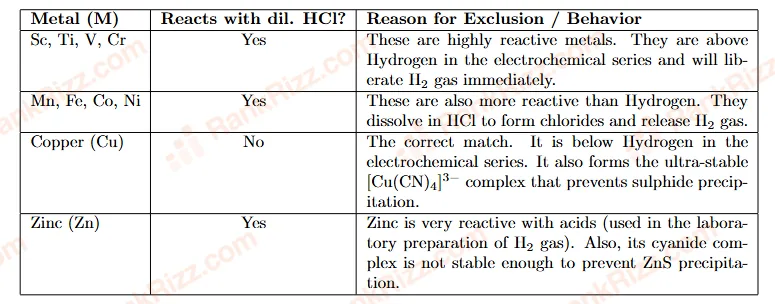
  • Metal Identification: 
  • image
  • Reaction with KCN (Masking): When excess KCNKCN added to CuSO4CuSO_4, a two-step reaction occurs. First, Cu2+Cu^{2+} is reduced to Cu+Cu^{+}, and then it forms an extremely stable complex called Potassium tetracyanocuprate(I), represented as K3[Cu(CN)4]K_3[Cu(CN)_4].
  • Reaction with H2SH_2S: In Group II of basic radical analysis, Cu2+Cu^{2+} usually precipitates as black CuSCuS. However, in this specific experiment, the Cyanide ligands (CN−CN^-) bind to the copper so tightly that they "lock" the metal ions away. The concentration of free copper ions left in the solution is so low that it cannot react with H2SH_2S to form a precipitate.
  • Final Result: Since the copper ions are effectively hidden, 0 mol of Metal Sulphide (MSMS) is formed.
  • Tagged Stability and applications of coordination compounds. Machine-assigned, so read it as a strong shortlist rather than a verdict.

    SubjectChemistry
    TopicStability and applications of coordination compounds
    TypeMultiple choice