JEE Main 2020 Chemistry question — Nucleophilic addition reactions of carbonyl compounds
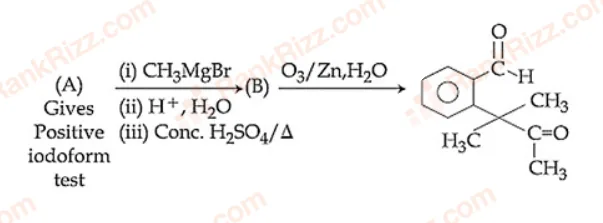
Identify (A) in the following reaction sequence:
SOLUTION
-
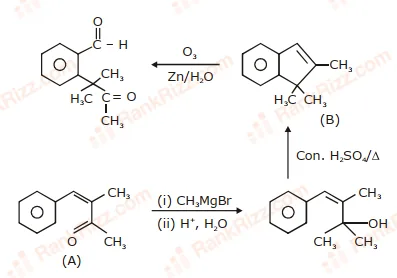
Step 1: Grignard Addition to Ketone (A Tertiary Alcohol)
Compound A contains both an alkene group and a methyl ketone group (). When treated with methylmagnesium bromide () followed by acid workup (), the nucleophilic Grignard reagent selectively attacks the carbonyl carbon of the ketone to yield a tertiary alcohol containing a group.
-
Step 2: Acid-Catalyzed Cyclization / Dehydration (Formation of B)
Treating the tertiary alcohol intermediate with concentrated sulfuric acid and heat () leads to protonation of the hydroxyl group followed by the loss of water () to form a stable carbocation. This carbocation undergoes an intramolecular electrophilic aromatic substitution (Friedel-Crafts alkylation-type cyclization) with the adjacent alkene/aromatic network, closing into a stable indene-like fused five-membered ring structure B.
-
Step 3: Reductive Ozonolysis Verification
Subjecting the cyclic alkene B to ozonolysis () oxidatively cleaves the newly formed ring double bond, generating the dicarbonyl compound shown at the top left containing both a formyl () and an acetyl () group, fully validating the carbon skeleton of A.
Conclusion:
Compound A is an ortho-substituted benzene derivative containing a 1-propenyl side chain and a methyl ketone side chain, which undergoes nucleophilic addition followed by dehydration-cyclization.
Answer: Structure (A) as shown in the reaction scheme.
Tagged Nucleophilic addition reactions of carbonyl compounds. Machine-assigned, so read it as a strong shortlist rather than a verdict.