All 75 questions of JEE Main 09 Jan 2020, Shift 1, in the order they were asked. Pick an answer on any question to check it against the key. Free to read, nothing to download.
Questions
75
Physics · Mathematics · Chemistry
Answer key
72
questions with a checked key
Under review
3
key not yet trusted
Price
Free
no sign-up
Physics
Q1JEE MAIN 2020 · 09 JAN S1Dimensional analysis: deriving and checking relationsTRANSCRIBED
A quantity f is given by f=Ghc5 where c is speed of light, G is universal gravitational constant and h is the Planck's constant. Dimension of f is that of:
Q2JEE MAIN 2020 · 09 JAN S1Work done by constant and variable forcesTRANSCRIBED
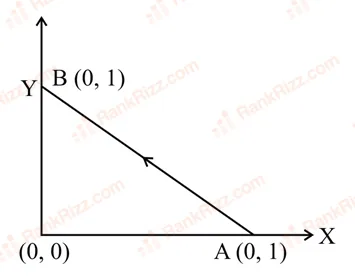
Consider a force F=−xi^+yj^. The work done by this force in moving a particle from point A(1,0) to B(0,1) along the line segment is: (all quantities are in SI units)
Q3JEE MAIN 2020 · 09 JAN S1Head-on collisions and coefficient of restitutionTRANSCRIBED
Two particles of equal mass m have respective initial velocities ui^ and u(2i^+j^). They collide completely inelastically. The energy lost in the process is:
Q4JEE MAIN 2020 · 09 JAN S1Moment of inertia of standard bodies and composite systemsTRANSCRIBED
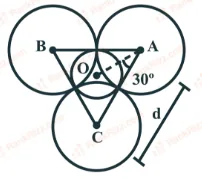
Three solid spheres each of mass m and diameter d are stuck together such that the lines connecting the centres form an equilateral triangle of side of length d. The ratio IAI0 of moment of inertia I0 of the system about an axis passing the centroid and about center of any of the spheres IA and perpendicular to the plane of the triangle is:
Q5JEE MAIN 2020 · 09 JAN S1Satellites: orbital speed, period, energy and geostationary orbitsTRANSCRIBED
A body A of mass m is moving in a circular orbit of radius R about a planet. Another body B of mass 2m collides with A with a velocity which is half (2v) the instantaneous velocity v of A. The collision is completely inelastic. Then, the combined body:
A
continues to move in a circular orbit
B
Escapes from the Planet's Gravitational field
C
Falls vertically downwards towards the planet
D
starts moving in an elliptical orbit around the planet
Q6JEE MAIN 2020 · 09 JAN S1Equation of continuity and Bernoulli's theoremTRANSCRIBED
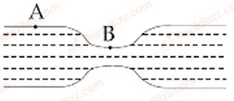
Water flows in a horizontal tube (see figure). The pressure of water changes by 700Nm−2 between A and B where the area of cross section are 40cm2 and 20cm2, respectively. Find the rate of flow of water through the tube. (density of water =1000kgm−3)
Q7JEE MAIN 2020 · 09 JAN S1Work done in thermodynamic processes and P-V diagramsTRANSCRIBED
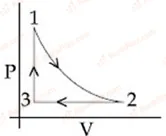
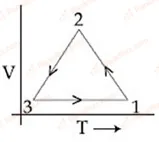
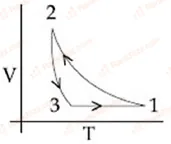
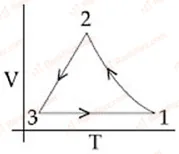
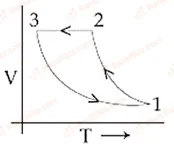
Which of the following is an equivalent cyclic process corresponding to the thermodynamic cyclic given in the figure? Where, 1→2 is adiabatic. (Graphs are schematic and are not to scale)
Q8JEE MAIN 2020 · 09 JAN S1Molar specific heats of gases, Mayer's relation and gas mixturesTRANSCRIBED
Consider two ideal diatomic gases A and B at some temperature T. Molecules of the gas A are rigid, and have a mass m. Molecules of the gas B have an additional vibrational mode and have a mass 4m. The ratio of the specific heats (CV)A and (CV)B of gas A and B, respectively is:
Q9JEE MAIN 2020 · 09 JAN S1Organ pipes and resonance columnsTRANSCRIBED
Three harmonic waves having equal frequency ν and same intensity I0, have phase angles 0, 4π and −4π respectively. When they are superimposed the intensity of the resultant wave is close to:
Q10JEE MAIN 2020 · 09 JAN S1Electric field of continuous charge distributionsTRANSCRIBED
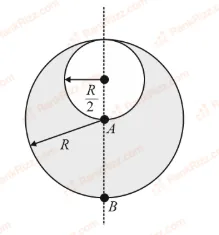
Consider a sphere of radius R which carries a uniform charge density ρ. If a sphere of radius 2R is carved out of it, as shown, the ratio ∣EB∣∣EA∣ of magnitude of electric field EA and EB, respectively, at points A and B due to the remaining portion is:
Q11JEE MAIN 2020 · 09 JAN S1Electric dipole and dipole in external fieldTRANSCRIBED
An electric dipole of moment p=(−i^−3j^+2k^)×10−29 C m at the origin (0,0,0). The electric field due to this dipole at r=+i^+3j^+5k^ (note that r⋅p=0) is parallel to:
Q13JEE MAIN 2020 · 09 JAN S1Photoelectric effect and Einstein's equationTRANSCRIBED
Radiation, with wavelength 6561 Å falls on a metal surface to produce photoelectrons. The electrons are made to enter a uniform magnetic field of 3×10⁻⁴ T. If the radius of the largest circular path followed by the electrons is 10 mm, the work function of the metal is close to:
Q14JEE MAIN 2020 · 09 JAN S1Ampere's circuital law: cylinders, solenoids and toroidsTRANSCRIBED
A long, straight wire of radius a carries a current distributed uniformly over its cross-section. The ratio of the magnetic fields due to the wire at distance 3a and 2a, respectively from the axis of the wire is:
Q15JEE MAIN 2020 · 09 JAN S1Charged particles in combined electric and magnetic fieldsTRANSCRIBED
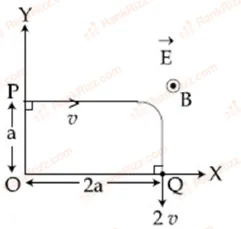
A charged particle of mass 'm' and charge 'q' moving under the influence of uniform electric field Ei^ and a uniform magnetic field Bk^ follows a trajectory from point P to Q as shown in figure. The velocities at P and Q are respectively, vi^ and −2vj^. Then which of the following statements (A, B, C, D) are the correct? (Trajectory shown is schematic and not to scale)
(A) E=43(qamv2) (B) Rate of work done by the electric field at P is 43(amv3) (C) Rate of work done by both the fields at Q is zero (D) The difference between the magnitude of angular momentum of the particle at P and Q is 2mav.
Q16JEE MAIN 2020 · 09 JAN S1Properties of EM waves: fields, energy, intensity and momentumTRANSCRIBED
The electric fields of two plane electromagnetic waves in vacuum are given by E1=E0j^cos(ωt−kx) and E2=E0k^cos(ωt−ky). At t=0, a particle of charge q is at origin with a velocity v=0.8cj^ (c is the speed of light in vacuum). The instantaneous force experienced by the particle is:
Q17JEE MAIN 2020 · 09 JAN S1Refraction at plane surfaces, Snell's law and apparent depthTRANSCRIBED
A vessel of depth 2h is half filled with a liquid of refractive index 22 and the upper half with another liquid of refractive index 2. The liquids are immiscible. The apparent depth of the inner surface of the bottom of the vessel will be:
Q18JEE MAIN 2020 · 09 JAN S1Resolving power of microscopes and telescopesTRANSCRIBED
The aperture diameter of a telescope is 5 m. The separation between the moon and the earth is 4×10⁵ km. With light of wavelength 5500 Å, the minimum separation between objects on the surface of moon, so that they are just resolved, is close to:
Q20JEE MAIN 2020 · 09 JAN S1Screw gauge: pitch, least count and zero errorTRANSCRIBED
If the screw on a screw-gauge is given six rotations, it moves by 3mm on the main scale. If there are 50 divisions on the circular scale the least count of the screw gauge is:
Q21JEE MAIN 2020 · 09 JAN S1Non-uniform acceleration using calculusTRANSCRIBED
The distance x covered by a particle in one dimensional motion varies with time t as x2=at2+2bt+c. If the acceleration of the particle depends on x as x−n, where n is an integer, the value of n is ___________.
Q22JEE MAIN 2020 · 09 JAN S1Fixed-axis rotation: kinematics, rotational energy and pulleysTRANSCRIBED
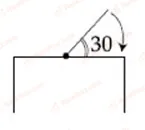
One end of a straight uniform 1m long bar is pivoted on horizontal table. It is released from rest when it makes an angle 30° from the horizontal (see figure). Its angular speed when it hits the table is given as n rad s−1, where n is an integer. The value of n is ___________.
Q23JEE MAIN 2020 · 09 JAN S1Stress, strain, Hooke's law and Young's modulusTRANSCRIBED
A body of mass m=10 kg is attached to one end of a wire of length 0.3 m. What is the maximum angular speed (in rad s−1) with which it can be rotated about its other end in a space station without breaking the wire? [Breaking stress of wire (σ)=4.8×10⁷ N m−2 and area of cross-section of the wire =10−2cm2]
Q24JEE MAIN 2020 · 09 JAN S1Self inductance and energy stored in inductorsTRANSCRIBED
In a fluorescent lamp choke (a small transformer) 100V of reverse voltage is produced when the choke current changes uniformly from 0.25A to 0 in a duration of 0.025ms. The self-inductance of the choke (in mH) is estimated to be ___________.
Q25JEE MAIN 2020 · 09 JAN S1p-n junction diode and its characteristicsTRANSCRIBED
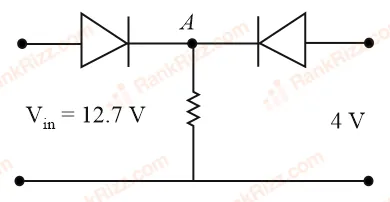
Both the diodes used in the circuit shown are assumed to be ideal and have negligible resistance when these are forward biased. Built in potential in each diode is 0.7V. For the input voltages shown in the figure, the voltage (in Volts) at point A is ___________.
Q32JEE MAIN 2020 · 09 JAN S1Standard ellipse and basic propertiesTRANSCRIBED
If e1 and e2 are the eccentricities of the ellipse 18x2+4y2=1 and the hyperbola 9x2−4y2=1 respectively and (e1,e2) is a point on the ellipse 15x2+3y2=k, then the value of k is equal to:
Q34JEE MAIN 2020 · 09 JAN S1Variance and standard deviationTRANSCRIBED
Let the observation xi(1≤i≤10) satisfy the equations ∑i=110(xi−5)=10, ∑i=110(xi−5)2=40. If μ and λ are the mean and the variance of the observations, x1−3,x2−3,…,x10−3, then the ordered pair (μ,λ) is equal to:
Q38JEE MAIN 2020 · 09 JAN S1Rolle's theorem and Lagrange's mean value theoremTRANSCRIBED
Let f be any function continuous on [a,b] and twice differentiable on (a,b). If all x∈(a,b), f'(x) > 0 and f''(x) < 0, then for any c∈(a,b), f(b)−f(c)f(c)−f(a) is:
Q39JEE MAIN 2020 · 09 JAN S1Rate of change of quantitiesTRANSCRIBED
A spherical iron ball of 10 cm radius is coated with a layer of ice of uniform thickness that melts at a rate of 50cm3/min. When the thickness of ice is 5 cm, then the rate (in cm/min) at which the thickness of ice decreases, is:
Q44JEE MAIN 2020 · 09 JAN S1Centroid, incentre, circumcentre and orthocentreTRANSCRIBED
Let D be the centroid of the triangle with vertices (3,−1), (1,3) and (2,4). Let P be the point of intersection of the lines x+3y−1=0 and 3x−y+1=0. Then, the line passing through the points D and P also passes through the point:
Q45JEE MAIN 2020 · 09 JAN S1Classical probability and sample spacesTRANSCRIBED
In a box, there are 20 cards, out of which 10 are labelled as A and the remaining 10 are labelled as B. Cards are drawn at random, one after the other and with replacement, till a second A card is obtained. The probability that the second A card appears before the third B card is:
Q49JEE MAIN 2020 · 09 JAN S1Scalar triple product and coplanarityTRANSCRIBED
If the vectors, p=(a+1)i^+aj^+ak^, q=ai^+(a+1)j^+ak^ and r=ai^+aj^+(a+1)k^(a∈R) are coplanar and 3(p⋅q)2−λ∣r×q∣2=0, then the value of λ is ___________.
Q52JEE MAIN 2020 · 09 JAN S1Ionisation enthalpyTRANSCRIBED
B has a smaller first ionization enthalpy than Be. Consider the following statement: (I) it is easier to remove 2p electron than 2s electron (II) 2p electron of B is more shielded from the nucleus by the inner core of electrons than the 2s electrons of Be (III) 2s electron has more penetration power than 2p electron (IV) atomic radius of B is more than Be (atomic number B : 5, Be = 4) The correct statements are:
Q56JEE MAIN 2020 · 09 JAN S1Solubility product and common ion effectTRANSCRIBED
The Ksp for the following dissociation is 1.6×10⁻⁵ PbCl2(s)⇌Pb(aq)2++2Cl(aq)− Which of the following choices is correct for a mixture of 300 mL 0.134 M Pb(NO3)2 and 100 mL 0.4 M NaCl?
Q62JEE MAIN 2020 · 09 JAN S1Arrhenius equation and activation energyTRANSCRIBED
For the following reactions: A700KProduct A500KcatalystProduct It was found that the Ea is decreased by 30 KJ/mol in the presence of catalyst. If the rate remains unchanged, the activation energy for catalysed reaction is (Assume pre-exponential factor is same):
Q65JEE MAIN 2020 · 09 JAN S1Structural isomerism in complexesTRANSCRIBED
Complex X of composition Cr(H2O)6Cln has a spin only magnetic moment of 3.83 B.M. It reacts with AgNO3 and shows geometrical isomerism. The IUPAC nomenclature of X is:
Q66JEE MAIN 2020 · 09 JAN S1Colour and magnetic behaviour of complexes from CFTTRANSCRIBED
[Pd(F)(Cl)(Br)(I)]2− has n number of geometrical isomers. Then, the spin-only magnetic moment and crystal field stabilization energy [CFSE] of [Fe(CN)6]n−6, respectively, are: [Note: Ignore the pairing energy]
Q70JEE MAIN 2020 · 09 JAN S1Chemicals in foodTRANSCRIBED
A chemist has 4 samples of artificial sweetener A, B, C and D. To identify these samples, he performed certain experiments and noted the following observations: (i) A and D both form blue-violet colour with ninhydrin. (ii) Lassaigne extract of C gives positive AgNO3 test and negative Fe4[Fe(CN)6]3 test. (iii) Lassaigne extract of B and D gives positive sodium nitroprusside test. Based on these observations which option is correct?
A
A : Aspartame; B : Saccharin; C : Sucralose; D : Alitame
B
A : Alitame; B : Saccharin; C : Aspartame; D : Sucralose
C
A : Saccharin; B : Alitame; C : Sucralose; D : Aspartame
D
A : Aspartame; B : Alitame; C : Sucralose; D : Saccharin
Q72JEE MAIN 2020 · 09 JAN S1Concentration terms and their interconversionTRANSCRIBED
The hardness of a water sample containing 10−3 M MgSO4 expressed as CaCO3 equivalents (in ppm) is ___________. (molar mass of MgSO4 is 120.37 g/mol)
Q73JEE MAIN 2020 · 09 JAN S1Abnormal molar mass and van't Hoff factorTRANSCRIBED
How much amount of NaCl should be added to 600 g of water (ρ=1.00g/mL) to decrease the freezing point of water to −0.2 °C? ___________. (The freezing point depression constant for water =2 K kgmol−1)
Q74JEE MAIN 2020 · 09 JAN S1Conductance, conductivity and molar conductivityTRANSCRIBED
108 g of silver (molar mass 108 gmol−1) is deposited at cathode from AgNO3(aq) solution by a certain quantity of electricity. The volume (in L) of oxygen gas produced at 273 K and 1 bar pressure from water by the same quantity of electricity is ___________.