RankRizz

JEE Main 28 Jan 2025, Shift 2: Chemistry

The 25 Chemistry questions of JEE Main 28 Jan 2025, Shift 2, numbered across the whole paper. Pick an answer on any question to check it against the key. Free to read, nothing to download.

Chemistry

Q26Concentration terms and their interconversionTRANSCRIBED

Concentrated nitric acid is labelled as 75% by mass. The volume in mL of the solution which contains 30 g of nitric acid is ____. Given : Density of nitric acid solution is 1.25 g/mL .

  1. A

    40

  2. B

    32

  3. C

    45

  4. D

    55

Q27Structural isomerismTRANSCRIBED

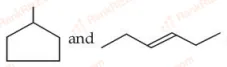
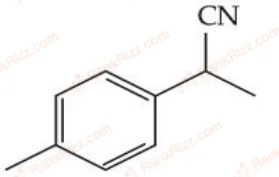
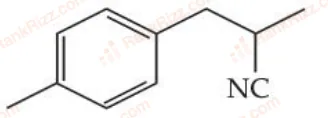
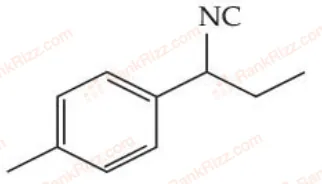
Given below are two statements : Statement (I) :

page7_img3

are isomeric compounds. Statement (II) :

page7_img4


are functional group isomers.

  1. A

    Both Statement (I) and Statement (II) are false.

  2. B

    Both Statement (I) and Statement (II) are true.

  3. C

    Statement (I) is false but Statement (II) is true.

  4. D

    Statement (I) is true but Statement (II) is false.

Q28Reactions of alkynesTRANSCRIBED

Identify product [A],[B] and [C] in the following reaction sequence.
CH3−C≡CH→H2Pd/C[A]→(ii) Zn, H2O(i) O3[B]+[C]\mathrm{CH_3 - C \equiv CH \xrightarrow[\mathrm{H_2}]{\mathrm{Pd/C}} [A] \xrightarrow[\mathrm{(ii)\ Zn,\ H_2O}]{\mathrm{(i)\ O_3}} [B] + [C]}

  1. A
    page8_img2
  2. B
    page8_img3
  3. C
    page8_img4
  4. D
    page8_img5
Q29Preparation of carboxylic acidsTRANSCRIBED

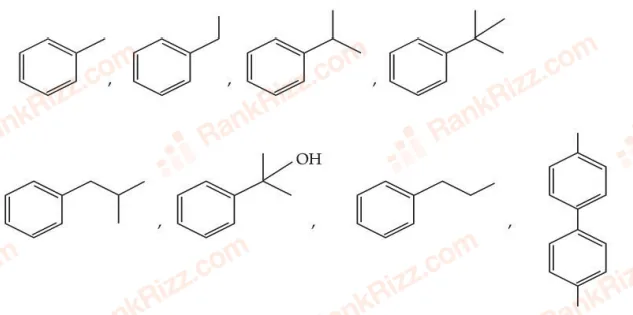
The total number of compounds from below when treated with hot KMnO4KMnO_{4} giving benzoic acid is :

page8_img6
  1. A

    6

  2. B

    3

  3. C

    5

  4. D

    4

Q30Carbohydrates: classification and monosaccharidesTRANSCRIBED

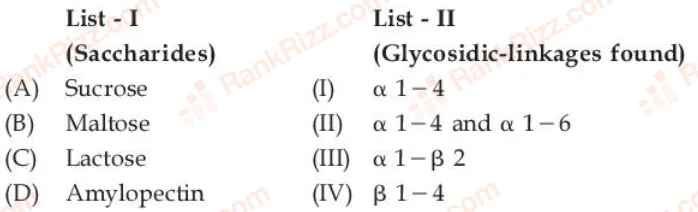
Match List - I with List - II.

page8_img7

Choose the correct answer from the options given below :

  1. A

    (A)-(I), (B)-(IV), (C)-(III), (D)-(II)

  2. B

    (A)-(I), (B)-(II), (C)-(III), (D)-(IV)

  3. C

    (A)-(III), (B)-(IV), (C)-(I), (D)-(II)

  4. D

    (A)-(III), (B)-(II), (C)-(I), (D)-(IV)

Q31Diazonium saltsTRANSCRIBED

Identify correct statements : (A) Primary amines do not give diazonium salts when treated with NaNO2NaNO_{2} in acidic condition. (B) Aliphatic and aromatic primary amines on heating with CHCl3CHCl_{3}and ethanolic KOH form carbylamines. (C) Secondary and tertiary amines also give carbylamine test. (D) Benzenesulfonyl chloride is known as Hinsberg's reagent. (E) Tertiary amines reacts with benzenesulfonyl chloride very easily. Choose the correct answer from the options given below :

  1. A

    (A) and (B) only

  2. B

    (D) and (E) only

  3. C

    (B) and (D) only

  4. D

    (B) and (C) only

Q32Radioactivity and nuclear reactionsTRANSCRIBED

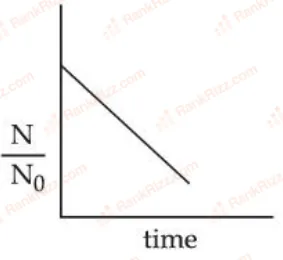
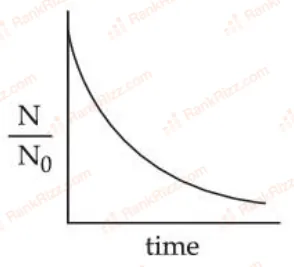
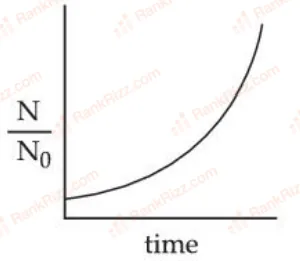
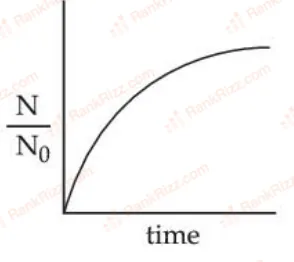
For bacterial growth in a cell culture, growth law is very similar to the law of radioactive decay. Which of the following graphs is most suitable to represent bacterial colony growth ? Where N - Number of Bacteria at any time, N0N_{0} - Initial number of Bacteria.

  1. A
    page9_img1
  2. B
    page9_img2
  3. C
    page9_img3
  4. D
    page9_img4
Q33General properties of transition elementsTRANSCRIBED

The amphoteric oxide among V2O3V_{2}O_{3} and V2O5V_{2}O_{5} , upon reaction with alkali leads to formation of an oxide anion. The oxidation state of V in the oxide anion is :

  1. A

    +3

  2. B

    +4

  3. C

    +7

  4. D

    +5

Q34Solubility product and common ion effectTRANSCRIBED

Arrange the following in increasing order of solubility product :Ca(OH)2, AgBr, PbS, HgS\mathrm{Ca(OH)_2, \ AgBr, \ PbS, \ HgS}

  1. A

    HgS<AgBr<PbS<Ca(OH)2\mathrm{HgS < AgBr < PbS < Ca(OH)_2}

  2. B

    Ca(OH)2<AgBr<HgS<PbS\mathrm{Ca(OH)_2 < AgBr < HgS < PbS}

  3. C

    PbS<HgS<Ca(OH)2<AgBr\mathrm{PbS < HgS < Ca(OH)_2 < AgBr}

  4. D

    HgS<PbS<AgBr<Ca(OH)2\mathrm{HgS < PbS < AgBr < Ca(OH)_2}

Q35Methods of purification of organic compoundsTRANSCRIBED

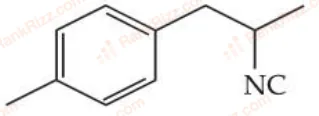
The purification method based on the following physical transformation is :

page9_img5
  1. A

    Distillation

  2. B

    Extraction

  3. C

    Sublimation

  4. D

    Crystallization

Q36Quantum numbers and shapes of orbitalsTRANSCRIBED

Which of the following is/are not correct with respect to energy of atomic orbitals of hydrogen atom? (A)1s < 2p < 3d < 4s (B) 1s < 2s = 2p < 3s = 3p (C)1s < 2s < 2p < 3s < 3p (D) 1s < 2s < 4s < 3d
Choose the correct answer from the options given below :

  1. A

    (A) and (C) only

  2. B

    (B) and (D) only

  3. C

    (C) and (D) only

  4. D

    (A) and (B) only

Q37Rate law, order and molecularityTRANSCRIBED

Consider an elementary reaction A(g)+B(g)→C(g)+D(g)A(g)+B(g)\rightarrow C(g)+D(g) If the volume of reaction mixture is suddenly reduced to 13\frac{1}{3} of its initial volume, the reaction rate will become 'x' times of the original reaction rate. The value of x is :

  1. A

    3

  2. B

    19\frac{1}{9}

  3. C

    9

  4. D

    13\frac{1}{3}

Q38Electrophilic addition to alkenesTRANSCRIBED

The product formed in the following reaction sequence is :

page10_img1
  1. A
    page10_img2
  2. B
    page10_img3
  3. C
    page10_img4
  4. D
    page10_img5
Q39Osmosis and osmotic pressureTRANSCRIBED

Assume a living cell with 0.90.9%(\omega / \omega) of glucose solution (aqueous). This cell is immersed in another solution having equal mole fraction of glucose and water. (Consider the data upto first decimal place only) The cell will

  1. A

    show no change in volume since solution is 0.90.9%(\omega / \omega)

  2. B

    shrink since solution is 0.50.5%(\omega / \omega)

  3. C

    swell up since solution is 0.10.1%(\omega / \omega)

  4. D

    None of these

Q40Modern periodic table and classification of elementsTRANSCRIBED

Given below are two statements : Statement (I): According to the Law of Octaves, the elements were arranged in the increasing order of their atomic number. Statement (II): Meyer observed a periodically repeated pattern upon plotting physical properties of certain elements against their respective atomic numbers. In the light of the above statements, choose the correct answer from the options given below :

  1. A

    Both Statement (I) and Statement (II) are false.

  2. B

    Both Statement (I) and Statement (II) are true.

  3. C

    Statement (I) is false but Statement (II) is true.

  4. D

    Statement (I) is true but Statement (II) is false.

Q41Valence bond theory of complexesTRANSCRIBED

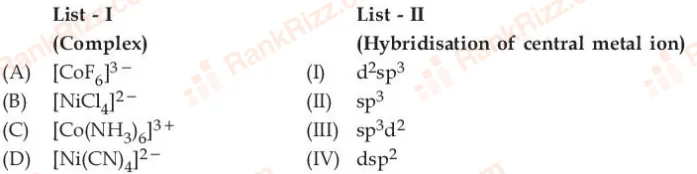
Match List - I with List - II.

page11_img1

Choose the correct answer from the options given below :

  1. A

    (A)-(IV), (B)-(II), (C)-(I), (D)-(III)

  2. B

    (A)-(I), (B)-(II), (C)-(III), (D)-(IV)

  3. C

    (A)-(III), (B)-(I), (C)-(IV), (D)-(II)

  4. D

    (A)-(II), (B)-(IV), (C)-(III), (D)-(I)

Q42First law: work, heat and internal energyTRANSCRIBED
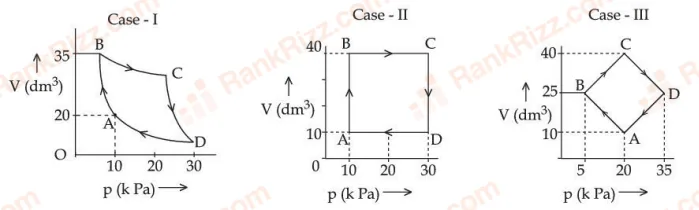
page11_img2

An ideal gas undergoes a cyclic transformation starting from the point A and coming back to the same point by tracing the path A→B→C→D→AA \rightarrow B \rightarrow C \rightarrow D \rightarrow A as shown in the three cases above. Choose the correct option regarding ΔU\Delta U :

  1. A

    ΔU(Case-I)=ΔU(Case-II)=ΔU(Case-III)\Delta U(\text{Case-I}) = \Delta U(\text{Case-II}) = \Delta U(\text{Case-III})

  2. B

    ΔU(Case-I)>ΔU(Case-III)>ΔU(Case-II)\Delta U(\text{Case-I}) > \Delta U(\text{Case-III}) > \Delta U(\text{Case-II})

  3. C

    ΔU(Case-III)>ΔU(Case-II)>ΔU(Case-I)\Delta U(\text{Case-III}) > \Delta U(\text{Case-II}) > \Delta U(\text{Case-I})

  4. D

    ΔU(Case-I)>ΔU(Case-II)>ΔU(Case-III)\Delta U(\text{Case-I}) > \Delta U(\text{Case-II}) > \Delta U(\text{Case-III})

Q43Chemical principles of qualitative analysisTRANSCRIBED

Identify the inorganic sulphides that are yellow in colour : (A) (NH4)2S\mathrm{(NH_4)_2S} (B) PbS\mathrm{PbS} (C) CuS\mathrm{CuS} (D) As2S3\mathrm{As_2S_3} (E) As2S5\mathrm{As_2S_5} Choose the correct answer from the options given below :

  1. A

    (A), (D) and (E) only

  2. B

    (D) and (E) only

  3. C

    (A) and (B) only

  4. D

    (A) and (C) only

Q44Nucleophilic substitution (SN1 and SN2)TRANSCRIBED

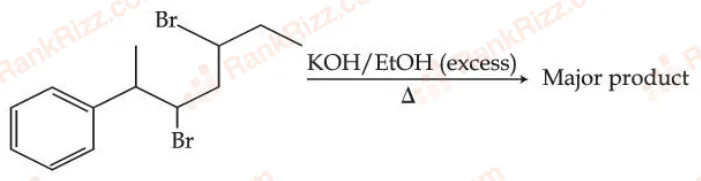
The major product of the following reaction is :

page11_img3
  1. A

    2-Phenylhepta-2,5-diene

  2. B

    6-Phenylhepta-2,4-diene

  3. C

    6-Phenylhepta-3,5-diene

  4. D

    2-Phenylhepta-2,4-diene

Q45Carbohydrates: classification and monosaccharidesTRANSCRIBED

Identify correct conversion during acidic hydrolysis from the following : (A) starch gives galactose. (B) cane sugar gives equal amount of glucose and fructose. (C) milk sugar gives glucose and galactose. (D) amylopectin gives glucose and fructose. (E) amylose gives only glucose. Choose the correct answer from the options given below :

  1. A

    (A), (B) and (C) only

  2. B

    (B), (C) and (E) only

  3. C

    (C), (D) and (E) only

  4. D

    (B), (C) and (D) only

Q46Conductance, conductivity and molar conductivityTRANSCRIBED

Electrolysis of 600 mL aqueous solution of NaCl for 5 min changes the pH of the solution to 12 . The current in Amperes used for the given electrolysis is ____. (Nearest integer).

Q47Group 15: trends and hydridesTRANSCRIBED

A group 15 element forms dπ−dπd\pi-d\pi bond with transition metals. It also forms hydride, which is a strongest base among the hydrides of other group members that form dπ−dπd\pi-d\pi bond. The atomic number of the element is ____.

Q48Molecular orbital theory of diatomic speciesTRANSCRIBED

Total number of molecules/species from following which will be paramagnetic is ______
O2O_{2}, O2+O_2^+, O2−O_2^-, NONO, NO2NO_{2}, COCO, K2[NiCl4]K_{2}[NiCl_{4}], [Co(NH3)6]Cl3[Co(NH_{3})_{6}]Cl_{3}, K2[Ni(CN)4]K_{2}[Ni(CN)_{4}]

Q49Enthalpies of reaction and Hess's lawTRANSCRIBED

Consider the following data : Heat of formation of CO2CO_{2}(g)= -393.5 kJ mol−1mol^{-1} Heat of formation of H20H_{2}0(l) = - 286.0 kJ mol−1mol^{-1} Heat of combustion of benzene =-3267.0 kJ mol−1mol^{-1} The heat of formation of benzene is _ . (Nearest integer)

Q50General properties of transition elementsTRANSCRIBED

The spin only magnetic moment ( μ\mu) value (B.M.) of the compound with strongest oxidising power among Mn2O3,Mn_{2}O_{3}, TiO and VO is ____ B.M. (Nearest integer).

NEXT IN THIS PAPER →Maths, Q51 onwards