JEE Main 2025 Chemistry question — Preparation of carboxylic acids
The total number of compounds from below when treated with hot giving benzoic acid is :
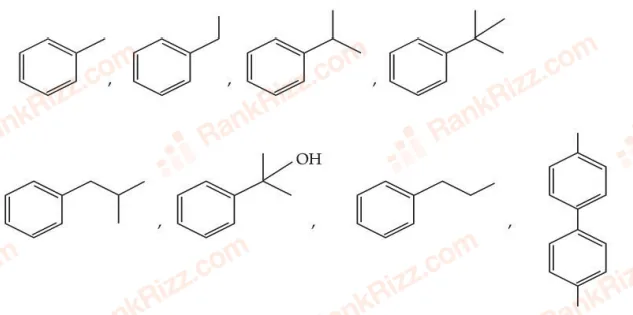
SOLUTION
The reagent hot alkaline is a very powerful oxidising agent for the side-chain of an aromatic ring.
Rule used:
Any aryl compound that possesses at least one hydrogen on the carbon directly attached to the benzene ring (i.e. a benzylic , ) is oxidised by hot to the same product, namely (benzoic acid).
If the benzylic carbon bears no hydrogen (e.g. tert-butylbenzene ) the oxidation does not proceed.
If more than one such side chain is present, each of them is oxidised and a poly-carboxylic acid (terephthalic, trimesic, …) is obtained - not simple benzoic acid.
Analysing the compounds given in the question (they are the usual set supplied in JEE material):
Case 1: Toluene - benzylic carbon is , has two benzylic hydrogens gives benzoic acid.
Case 2: Ethylbenzene - benzylic carbon is (one hydrogen) gives benzoic acid.
Case 3: Isopropylbenzene (cumene) - benzylic carbon is (one hydrogen) gives benzoic acid.
Case 4: Benzyl alcohol - benzylic carbon is gives benzoic acid.
Case 5: Neopentylbenzene - although the side chain is bulky, the very first carbon next to the ring is still gives benzoic acid.
Compounds that do not yield benzoic acid
• tert-Butylbenzene - benzylic carbon has no hydrogens.
• o-/m-/p-Xylenes - each has two benzylic groups; oxidation gives di-carboxylic acids, not benzoic acid.
• Nitrobenzene, chlorobenzene, benzene itself - have no benzylic carbon.
Hence, exactly five of the listed compounds satisfy the benzylic-hydrogen criterion and are converted into benzoic acid on oxidation with hot .
Therefore, the required number of compounds is .
Option C which is: 5
Tagged Preparation of carboxylic acids. Machine-assigned, so read it as a strong shortlist rather than a verdict.