RankRizz

JEE Main 24 Jan 2025, Shift 2: Chemistry

The 25 Chemistry questions of JEE Main 24 Jan 2025, Shift 2, numbered across the whole paper. Pick an answer on any question to check it against the key. Free to read, nothing to download.

Chemistry

Q26Quantum mechanical model, wave function and probabilityTRANSCRIBED

For hydrogen atom, the orbital/s with lowest energy is/are: (A) 4s (B) 3px (C) 3dx2−y2 (D) 3dz2 (E) 4pz\text{ (A) } 4s \text{ (B) } 3p_x \text{ (C) } 3d_{x^2-y^2} \text{ (D) } 3d_{z^2} \text{ (E) } 4p_z  Choose the correct answer from the options given below:

  1. A

    (B), (C) and (D) only

  2. B

    (A) and (E) only

  3. C

    (A) only

  4. D

    (B) only

Q27Nucleic acidsTRANSCRIBED

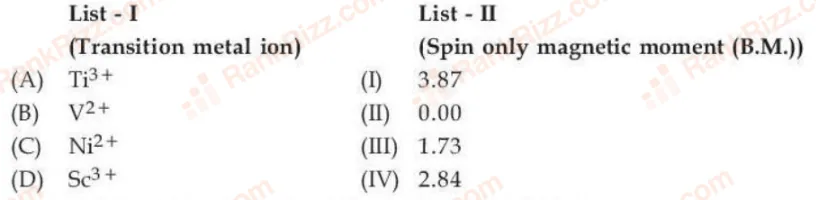
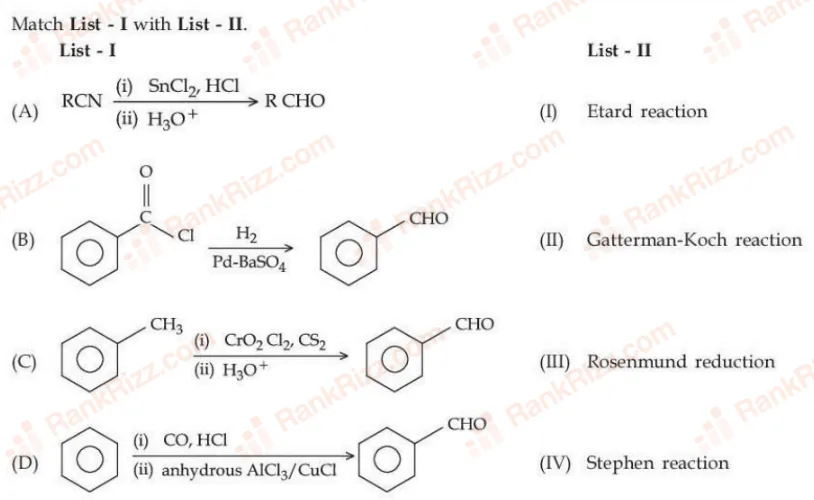
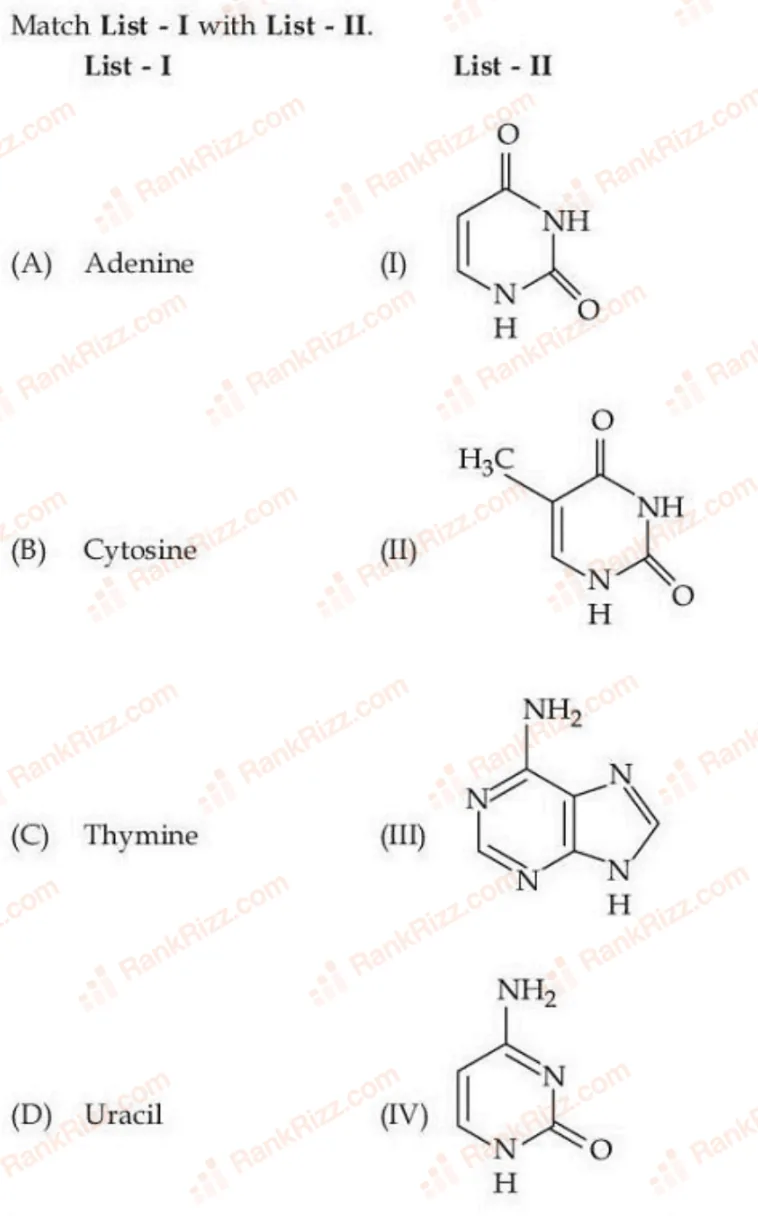
Match List - I with List - II.

page9_img2

Choose the correct answer from the options given below :

  1. A

    (A) − (III), (B) − (I), (C) − (IV), (D) − (II)

  2. B

    (A) − (III), (B) − (I), (C) − (II), (D) − (IV)

  3. C

    (A) − (IV), (B) − (II), (C) − (III), (D) − (I)

  4. D

    (A) − (II), (B) − (IV), (C) − (I), (D) − (III)

Q28Resonance and bond parametersTRANSCRIBED

Given below are two statements : Statement (I): Experimentally determined oxygen-oxygen bond lengths in the O3O_3 are found to be same and the bond length is greater than that of a O=OO = O (double bond) but less than that of a single (O−O)(O - O) bond. Statement (II) : The strong lone pair-lone pair repulsion between oxygen atoms is solely responsible for the fact that the bond length in ozone is smaller than that of a double bond (O=O)(O = O) but more than that of a single bond (O−O)(O - O). In the light of the above statements, choose the correct answer from the options given below :

  1. A

    Both Statement I and Statement II are false

  2. B

    Statement I is false but Statement II is true

  3. C

    Statement I is true but Statement II is false

  4. D

    Both Statement I and Statement II are true

Q29Colour and magnetic behaviour of complexes from CFTTRANSCRIBED

When Ethane-1,2-diamine is added progressively to an aqueous solution of Nickel (II) chloride, the sequence of colour change observed will be :

  1. A

    Violet→Blue→Pale Blue→Green\text{Violet} \rightarrow \text{Blue} \rightarrow \text{Pale Blue} \rightarrow \text{Green}

  2. B

    Pale Blue→Blue→Green→Violet\text{Pale Blue} \rightarrow \text{Blue} \rightarrow \text{Green} \rightarrow \text{Violet}

  3. C

    Green→Pale Blue→Blue→Violet\text{Green} \rightarrow \text{Pale Blue} \rightarrow \text{Blue} \rightarrow \text{Violet}

  4. D

    Pale Blue→Blue→Violet→Green\text{Pale Blue} \rightarrow \text{Blue} \rightarrow \text{Violet} \rightarrow \text{Green}

Q30Ionisation enthalpyTRANSCRIBED

Given below are two statements :
Statement (I) : The first ionization energy of Pb is greater than that of Sn .
Statement (II) : The first ionization energy of Ge is greater than that of Si .
In the light of the above statements, choose the correct answer from the options given below :

  1. A

    Statement I is false but Statement II is true

  2. B

    Statement I is true but Statement II is false

  3. C

    Both Statement I and Statement II are true

  4. D

    Both Statement I and Statement II are false

Q31Directive influence of substituentsTRANSCRIBED

Identify correct statement/s : (A)−OCH3 and −NHCOCH3 are activating groups. (B)−CN and −OH are meta directing groups. (C)−CN and −SO3H\text{Identify correct statement/s : }(A) -OCH_3 \text{ and } -NHCOCH_3 \text{ are activating groups. } (B)-CN \text{ and } -OH \text{ are meta directing groups. } (C) -CN \text{ and } -SO_3H are meta directing groups.  (D)(D) Activating groups act as ortho- and para-directing groups.  (E)(E) Halides are activating groups. Choose the correct answer from the options given below:

  1. A

    (A) only

  2. B

    (A), (B) and (E) only

  3. C

    (A) and (C) only

  4. D

    (A), (C) and (D) only

Q32Electrode potentials, electrochemical series and cell EMFTRANSCRIBED

Based on the data given below: ECr2O72−/Cr3+∘=1.33VECl2/Cl−∘=1.36 VEMnO4−/Mn2+∘=1.51VECr3+/Cr∘=−0.74 V\begin{aligned}E^\circ_{\text{Cr}_2\text{O}_7^{2-}/\text{Cr}^{3+}} &= 1.33 \text{V} &E^\circ_{\text{Cl}_2/\text{Cl}^-} &= 1.36\ \text{V} \\E^\circ_{\text{MnO}_4^-/\text{Mn}^{2+}} &= 1.51 \text{V} &E^\circ_{\text{Cr}^{3+}/\text{Cr}} &= -0.74\ \text{V}\end{aligned} the strongest reducing agent is:

  1. A

    Cr\text{Cr}

  2. B

    Cl−\text{Cl}^-

  3. C

    MnO4−\text{MnO}_4^-

  4. D

    Mn2+\text{Mn}^{2+}

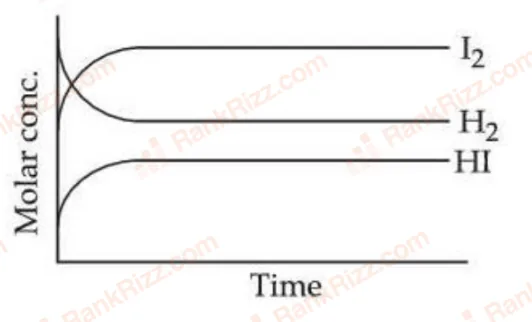
Q33Law of mass action and equilibrium constants Kc and KpTRANSCRIBED

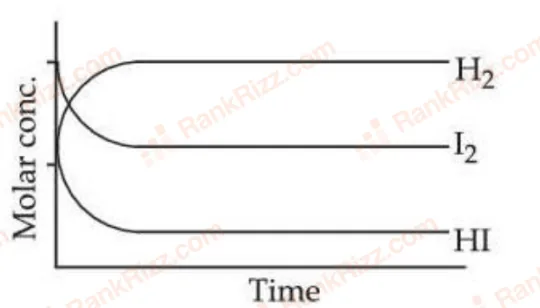
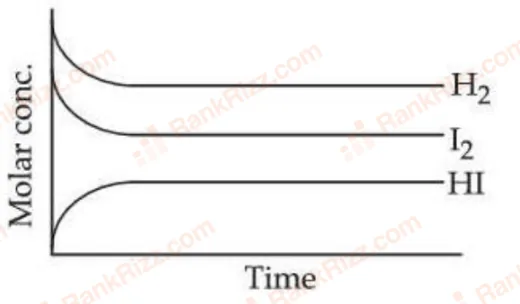
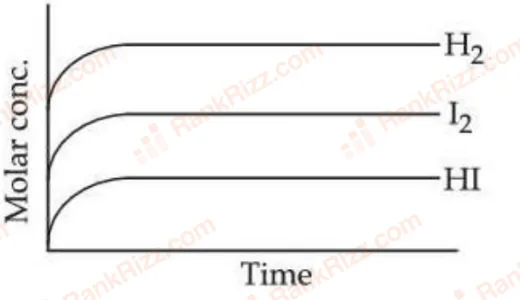
For the reaction, H2(g)+I2(g)⇌2HI(g),\text{For the reaction, } H_2(g) + I_2(g) \rightleftharpoons 2HI(g),  Attainment of equilibrium is predicted correctly by:

  1. A
    page11_img1
  2. B
    page11_img2
  3. C
    page11_img3
  4. D
    page11_img4
Q34Group analysis and confirmatory tests of cationsTRANSCRIBED

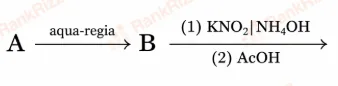
Find the compound ' A ' from the following reaction sequences. 

Figure for JEE Main 2025 Chemistry question on Group analysis and confirmatory tests of cations

yellow ppt

  1. A

    CoS

  2. B

    ZnS

  3. C

    NiS

  4. D

    MnS

Q35Mole concept, atomic and molar massTRANSCRIBED

The elemental composition of a compound is  54.2%C, 9.2%H54.2\%C,\ 9.2\%H  and  36.6%O.36.6\%O. If the molar mass of the compound is  132 g mol−1,132\ \text{g mol}^{-1}, the molecular formula of the compound is: [Given: Relative atomic masses  C:H:O = 12:1:16]

  1. A

    C4H9O3C_4H_9O_3

  2. B

    C6H12O6C_6H_{12}O_6

  3. C

    C4H8O2C_4H_8O_2

  4. D

    C6H12O3C_6H_{12}O_3

Q36Colour and magnetic behaviour of complexes from CFTTRANSCRIBED

{The conditions and consequence that favours the  t2ggeg1t_{2gg} e_g^1  configuration in a metal complex are:

  1. A

    weak field ligand, low spin complex

  2. B

    weak field ligand, high spin complex

  3. C

    strong field ligand, high spin complex

  4. D

    strong field ligand, low spin complex

Q37Hybridisation and bond anglesTRANSCRIBED

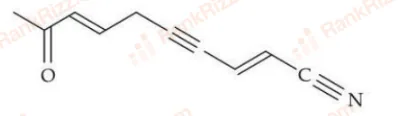
In the given structure, the number of sp and sp2sp \text{ and } sp^2 hybridized carbon atoms present respectively are:

page11_img5
  1. A

    4 and 5

  2. B

    3 and 5

  3. C

    3 and 6

  4. D

    4 and 6

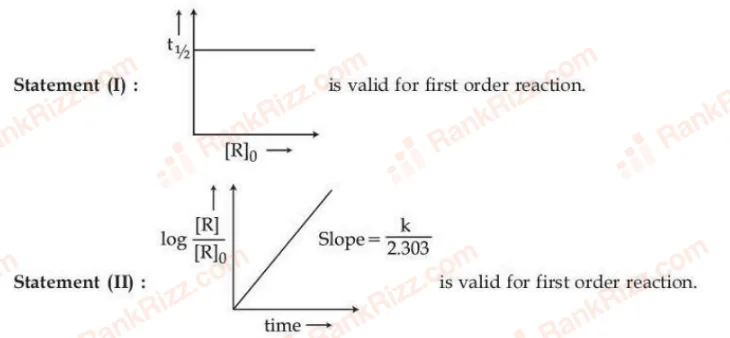
Q38Integrated rate laws and half-life (zero and first order)TRANSCRIBED
page12_img1

Given below are two statements :
In the light of the above statements, choose the correct answer from the options given below :

  1. A

    Both Statement I and Statement II are true

  2. B

    Statement I is false but Statement II is true

  3. C

    Statement I is true but Statement II is false

  4. D

    Both Statement I and Statement II are false

Q39General properties of transition elementsTRANSCRIBED
page12_img2

Choose the correct answer from the options given below :

  1. A

    (A)-(III), (B)-(IV), (C)-(II), (D)-(I)

  2. B

    (A)-(I), (B)-(III), (C)-(II), (D)-(IV)

  3. C

    (A)-(III), (B)-(IV), (C)-(I), (D)-(II)

  4. D

    (A)-(IV), (B)-(III), (C)-(I), (D)-(II)

Q40Nucleophilic substitution (SN1 and SN2)TRANSCRIBED

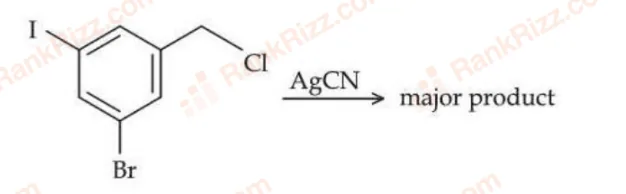
The structure of the major product formed in the following reaction is :

page12_img3
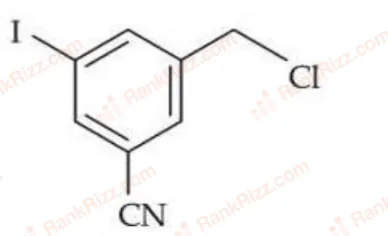
  1. A
    page13_img1
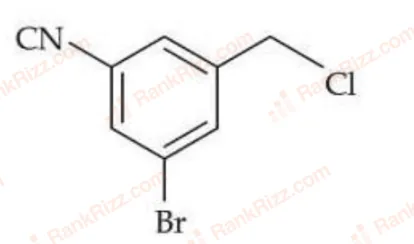
  2. B
    page13_img2
  3. C
    page13_img3
  4. D
    page13_img4
Q41Electrophilic substitution of anilineTRANSCRIBED
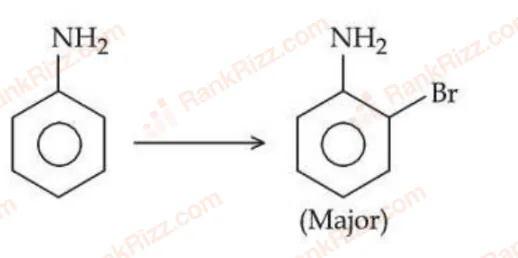
page13_img5

For reaction
The correct order of set of reagents for the above conversion is :

  1. A

    Br2  ∣  FeBr3,  H2O(Δ),  NaOHBr_2 \;|\; FeBr_3,\; H_2O(\Delta),\; NaOH

  2. B

    H2SO4,  Ac2O,  Br2,  H2O(Δ),  NaOHH_2SO_4,\; Ac_2O,\; Br_2,\; H_2O(\Delta),\; NaOH

  3. C

    Ac2O,  Br2,  H2O(Δ),  NaOHAc_2O,\; Br_2,\; H_2O(\Delta),\; NaOH

  4. D

    Ac2O,  H2SO4,  Br2,  NaOHAc_2O,\; H_2SO_4,\; Br_2,\; NaOH

Q42Ionisation enthalpyTRANSCRIBED

The successive 5 ionisation energies of an element are 800, 2427, 3658, 25024 and 32824 kJ/mol, respectively. By using the above values predict the group in which the above element is present:

  1. A

    Group 13

  2. B

    Group 14

  3. C

    Group 2

  4. D

    Group 4

Q43Nucleophilic addition reactions of carbonyl compoundsTRANSCRIBED
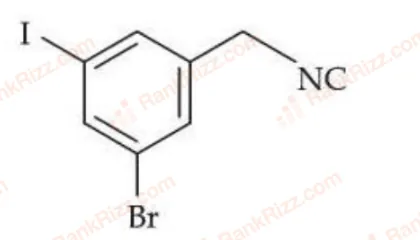
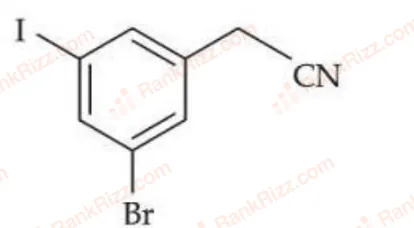
page14_img1

Choose the correct answer from the options given below :

  1. A

    (A)-(IV), (B)-(III), (C)-(II), (D)-(I)

  2. B

    (A)-(III), (B)-(IV), (C)-(II), (D)-(I)

  3. C

    (A)-(III), (B)-(IV), (C)-(I), (D)-(II)

  4. D

    (A)-(III), (B)-(I), (C)-(IV), (D)-(II)

Q44Enthalpies of reaction and Hess's lawTRANSCRIBED

Which of the following mixing of 1 M base and 1 M acid leads to the largest increase in temperature?

  1. A

    30 ml CH3COOH and 30 ml NaOH30\,\text{ml } CH_3COOH \text{ and } 30\,\text{ml } NaOH

  2. B

    45 ml CH3COOH and 25 ml NaOH45\,\text{ml } CH_3COOH \text{ and } 25\,\text{ml } NaOH

  3. C

    30 ml HCl and 30 ml NaOH30\,\text{ml } HCl \text{ and } 30\,\text{ml } NaOH

  4. D

    50 ml HCl and 20 ml NaOH50\,\text{ml } HCl \text{ and } 20\,\text{ml } NaOH

Q45Enthalpies of reaction and Hess's lawTRANSCRIBED

S(g)+32O2(g)→SO3(g)+2x kcalSO2(g)+12O2(g)→SO3(g)+y kcalThe heat of formation of SO2(g) is given by:S(g) + \frac{3}{2}O_2(g) \rightarrow SO_3(g) + 2x\,\text{kcal} \\SO_2(g) + \frac{1}{2}O_2(g) \rightarrow SO_3(g) + y\,\text{kcal}\\\text{The heat of formation of } SO_2(g) \text{ is given by:}

  1. A

    x+y kcalx + y \,\text{kcal}

  2. B

    y−2x kcaly - 2x \,\text{kcal}

  3. C

    2xy kcal\frac{2x}{y} \,\text{kcal}

  4. D

    2x+y kcal2x + y \,\text{kcal}

Q46Quantitative estimation of elementsTRANSCRIBED

In Carius method of estimation of halogen, 0.25 g0.25\,g  of an organic compound gave  0.15 g0.15\,g  of silver bromide (AgBr).(AgBr). The percentage of Bromine in the organic compound is ‾×10−1\underline{\hspace{2cm}}\times 10^{-1} (Nearest integer). }[ Given: Molar mass of Ag is 108 and Br is 80 g  mol−1mol^{-1}]

Q47Abnormal molar mass and van't Hoff factorTRANSCRIBED

The observed and normal molar masses of compound  MX2MX_2 are  65.665.6  and  164164  respectively. The percent degree of ionisation of  MX2MX_2  is  ‾%.\underline{\hspace{2cm}}\%.  (Nearest integer)

Q48Arrhenius equation and activation energyTRANSCRIBED

Consider a complex reaction taking place in three steps with rate constants k1,  k2 and k3k_1,\; k_2 \text{ and } k_3 respectively. The overall rate constant  kk is given by k=k1k3k2k=\sqrt{\frac{k_1k_3}{k_2}}. If the activation energies of the three steps are 60,  3060,\;30  and  10 kJ mol−110\,kJ\,mol^{-1}  respectively, then the overall energy of activation in  kJ mol−1kJ\,mol^{-1} is  ‾.\underline{\hspace{2cm}}. (Nearest integer)

Q49Structural isomerismTRANSCRIBED

The possible number of stereoisomers for 5-phenylpent -4-en-2-ol is ‾.\underline{\hspace{2cm}}.

Q50IUPAC nomenclature of organic compoundsTRANSCRIBED

The hydrocarbon  (X)(X)  with molar mass  80 g mol−180\,g\,mol^{-1} and  90%90\% carbon has ‾\underline{\hspace{2cm}}  degree of unsaturation.

NEXT IN THIS PAPER →Maths, Q51 onwards