JEE Main 2025 Chemistry question — Nucleophilic substitution (SN1 and SN2)
The structure of the major product formed in the following reaction is :
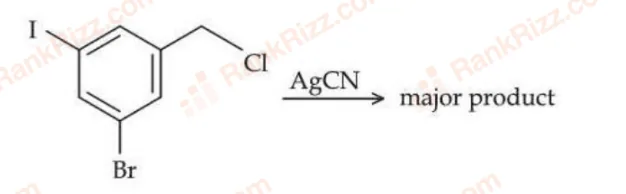
SOLUTION
The given substrate is -bromobutane and the reagent is hot alcoholic .
Step 1 : Nature of the reagent
Alcoholic behaves predominantly as a strong base.
With alkyl halides it favours -elimination (E2) far more than nucleophilic substitution, especially when a secondary (or tertiary) halide is present.
Step 2 : Identification of the β-hydrogens
In -bromobutane the carbon bearing the halogen is C-2.
Its two adjacent (β) carbons are
• C-1 carrying two hydrogens (-H) and
• C-3 carrying one hydrogen (-H).
Removal of any one of these β-hydrogens together with the leaving group will give an alkene.
Step 3 : Possible alkenes and Zaitsev (Saytzeff) rule
β-Elimination across C-1/C-2 gives (1-butene, monosubstituted).
β-Elimination across C-2/C-3 gives (2-butene, disubstituted).
Zaitsev rule: the more substituted alkene is formed preferentially because it is thermodynamically more stable.
Hence 2-butene is the major product.
Step 4 : Geometrical (E/Z) outcome in an E2
The anti-periplanar arrangement required for a concerted E2 is achieved more easily when the two larger groups ( and ) end up on opposite sides of the emerging bond.
Therefore the trans (E) isomer of 2-butene is favoured over the cis (Z) form.
Major product
The principal product is trans-2-butene:
with groups on opposite sides of the double bond.
Among the given structures, this corresponds to Option C.
Hence the correct answer is:
Option C which is: trans-2-butene ().
Tagged Nucleophilic substitution (SN1 and SN2). Machine-assigned, so read it as a strong shortlist rather than a verdict.