RankRizz

JEE Main 09 Apr 2024, Shift 2: Maths

The 30 Maths questions of JEE Main 09 Apr 2024, Shift 2, numbered across the whole paper. Pick an answer on any question to check it against the key. Free to read, nothing to download.

Maths

Q61Relation between roots and coefficientsTRANSCRIBED

Let α,β;α>β\alpha, \beta; \alpha > \beta, be the roots of the equation x2−2x−3=0x^2 - \sqrt{2}x - \sqrt{3} = 0. Let Pn=αn−βn,n∈NP_n = \alpha^n - \beta^n, n \in \mathbb{N}. Then (113−102)P10+(112+10)P11−11P12(11\sqrt{3} - 10\sqrt{2})P_{10} + (11\sqrt{2} + 10)P_{11} - 11P_{12} is equal to

  1. A

    103P910\sqrt{3}P_9

  2. B

    113P911\sqrt{3}P_9

  3. C

    102P910\sqrt{2}P_9

  4. D

    112P911\sqrt{2}P_9

Q62Locus and regions in the Argand planeTRANSCRIBED

Let zz be a complex number such that the real part of z−2iz+2i\frac{z-2i}{z+2i} is zero. Then, the maximum value of ∣z−(6+8i)∣|z - (6 + 8i)| is equal to

  1. A

    12

  2. B

    10

  3. C

    8

  4. D

    ∞\infty

Q63Geometric progression and infinite GPTRANSCRIBED

Let a,ar,ar2,…a, ar, ar^2, \ldots be an infinite G.P. If ∑n=0∞arn=57\sum_{n=0}^{\infty} ar^n = 57 and ∑n=0∞a3r3n=9747\sum_{n=0}^{\infty} a^3 r^{3n} = 9747, then a+18ra + 18r is equal to

  1. A

    46

  2. B

    38

  3. C

    31

  4. D

    27

Q64Sums of binomial coefficientsTRANSCRIBED

The sum of the coefficient of x2/3x^{2/3} and x−2/5x^{-2/5} in the binomial expansion of (x2/3+12x−2/5)9\left(x^{2/3} + \frac{1}{2}x^{-2/5}\right)^9 is

  1. A

    21/421/4

  2. B

    63/1663/16

  3. C

    19/419/4

  4. D

    69/1669/16

Q65Centroid, incentre, circumcentre and orthocentreTRANSCRIBED

Two vertices of a triangle ABCABC are A(3,−1)A(3, -1) and B(−2,3)B(-2, 3), and its orthocentre is P(1,1)P(1, 1). If the coordinates of the point CC are (α,β)(\alpha, \beta) and the centre of the circle circumscribing the triangle PABPAB is (h,k)(h, k), then the value of (α+β)+2(h+k)(\alpha + \beta) + 2(h + k) equals

  1. A

    5

  2. B

    81

  3. C

    15

  4. D

    51

Q66Standard hyperbola and basic propertiesTRANSCRIBED

Let the foci of a hyperbola HH coincide with the foci of the ellipse E:(x−1)2100+(y−1)275=1E : \frac{(x-1)^2}{100} + \frac{(y-1)^2}{75} = 1 and the eccentricity of the hyperbola HH be the reciprocal of the eccentricity of the ellipse EE. If the length of the transverse axis of HH is α\alpha and the length of its conjugate axis is β\beta, then 3α2+2β23\alpha^2 + 2\beta^2 is equal to

  1. A

    237

  2. B

    242

  3. C

    205

  4. D

    225

Q67Leibniz rule for differentiating integralsTRANSCRIBED

lim⁡x→π2(∫x3(π/2)3(sin⁡(2t1/3)+cos⁡(t1/3))dt(x−π2)2)\lim_{x \to \frac{\pi}{2}} \left(\frac{\int_{x^3}^{(\pi/2)^3} \left(\sin(2t^{1/3}) + \cos(t^{1/3})\right) dt}{\left(x - \frac{\pi}{2}\right)^2}\right) is equal to

  1. A

    5π29\frac{5\pi^2}{9}

  2. B

    9π28\frac{9\pi^2}{8}

  3. C

    11π210\frac{11\pi^2}{10}

  4. D

    3π22\frac{3\pi^2}{2}

Q68Limits of exponential and logarithmic functionsTRANSCRIBED

lim⁡x→0e−(1+2x)12xx\lim_{x \to 0} \frac{e - (1+2x)^{\frac{1}{2x}}}{x} is equal to

  1. A

    0

  2. B

    −2e\frac{-2}{e}

  3. C

    ee

  4. D

    e−e2e - e^2

Q69Variance and standard deviationTRANSCRIBED

If the variance of the frequency distribution
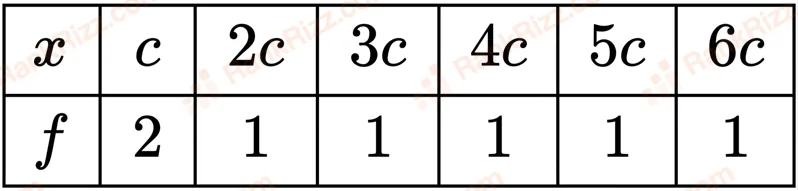
Figure for JEE Main 2024 Mathematics question on Variance and standard deviation


is 160, then the value of c∈Nc \in \mathbb{N} is

  1. A

    7

  2. B

    8

  3. C

    5

  4. D

    6

Q70Adjoint and inverse of a matrixTRANSCRIBED

Let B=[1315]B = \begin{bmatrix} 1 & 3 \\ 1 & 5 \end{bmatrix} and AA be a 2×22 \times 2 matrix such that AB−1=A−1AB^{-1} = A^{-1}. If BCB−1=ABCB^{-1} = A and C4+αC2+βI=OC^4 + \alpha C^2 + \beta I = O, then 2β−α2\beta - \alpha is equal to

  1. A

    16

  2. B

    2

  3. C

    8

  4. D

    10

Q71Definite integrals: properties and King's ruleTRANSCRIBED

The integral ∫1/43/4cos⁡(2cot⁡−11−x1+x)dx\int_{1/4}^{3/4} \cos\left(2\cot^{-1}\sqrt{\frac{1-x}{1+x}}\right) dx is equal to

  1. A

    1/21/2

  2. B

    −1/2-1/2

  3. C

    −1/4-1/4

  4. D

    1/41/4

Q72Range and extreme values of trigonometric expressionsTRANSCRIBED

Let the range of the function f(x)=12+sin⁡3x+cos⁡3x,x∈Rf(x) = \frac{1}{2 + \sin 3x + \cos 3x}, x \in \mathbb{R} be [a,b][a, b]. If α\alpha and β\beta are respectively the A.M. and the G.M. of aa and bb, then αβ\frac{\alpha}{\beta} is equal to

  1. A

    π\pi

  2. B

    π\sqrt{\pi}

  3. C

    22

  4. D

    2\sqrt{2}

Q73Inverse trigonometric differentiation and derivative w.r.t. a functionTRANSCRIBED

If log⁡ey=3sin⁡−1x\log_e y = 3\sin^{-1} x, then (1−x2)y′′−xy′(1 - x^2)y'' - xy' at x=12x = \frac{1}{2} is equal to

  1. A

    3eπ/63e^{\pi/6}

  2. B

    9eπ/29e^{\pi/2}

  3. C

    3eπ/23e^{\pi/2}

  4. D

    9eπ/69e^{\pi/6}

Q74Linear first-order differential equationsTRANSCRIBED

Let ∫0x1−(y′(t))2 dt=∫0xy(t) dt, 0≤x≤3, y≥0, y(0)=0\int_0^x \sqrt{1 - (y'(t))^2} \, dt = \int_0^x y(t) \, dt, \, 0 \le x \le 3, \, y \ge 0, \, y(0) = 0. Then at x=2x = 2, y′′+y+1y'' + y + 1 is equal to

  1. A

    1

  2. B

    2

  3. C

    2\sqrt{2}

  4. D

    1/21/2

Q75Definite integrals: properties and King's ruleTRANSCRIBED

The value of the integral ∫−12log⁡e(x+x2+1)dx\int_{-1}^{2} \log_e\left(x + \sqrt{x^2 + 1}\right) dx is

  1. A

    5−2+log⁡e(7+451+2)\sqrt{5} - \sqrt{2} + \log_e\left(\frac{7 + 4\sqrt{5}}{1 + \sqrt{2}}\right)

  2. B

    5−2+log⁡e(9+451+2)\sqrt{5} - \sqrt{2} + \log_e\left(\frac{9 + 4\sqrt{5}}{1 + \sqrt{2}}\right)

  3. C

    2−5+log⁡e(7+451+2)\sqrt{2} - \sqrt{5} + \log_e\left(\frac{7 + 4\sqrt{5}}{1 + \sqrt{2}}\right)

  4. D

    2−5+log⁡e(9+451+2)\sqrt{2} - \sqrt{5} + \log_e\left(\frac{9 + 4\sqrt{5}}{1 + \sqrt{2}}\right)

Q76Area between curvesTRANSCRIBED

The area (in square units) of the region enclosed by the ellipse x2+3y2=18x^2 + 3y^2 = 18 in the first quadrant below the line y=xy = x is

  1. A

    3π−34\sqrt{3}\pi - \frac{3}{4}

  2. B

    3π+1\sqrt{3}\pi + 1

  3. C

    3π\sqrt{3}\pi

  4. D

    3π+34\sqrt{3}\pi + \frac{3}{4}

Q77Vector (cross) product and areaTRANSCRIBED

Between the following two statements: Statement I : Let a⃗=i^+2j^−3k^\vec{a} = \hat{i} + 2\hat{j} - 3\hat{k} and b⃗=2i^+j^−k^\vec{b} = 2\hat{i} + \hat{j} - \hat{k}. Then the vector r⃗\vec{r} satisfying a⃗×r⃗=a⃗×b⃗\vec{a} \times \vec{r} = \vec{a} \times \vec{b} and a⃗⋅r⃗=0\vec{a} \cdot \vec{r} = 0 is of magnitude 10\sqrt{10}. Statement II : In a triangle ABCABC, cos⁡2A+cos⁡2B+cos⁡2C≥−32\cos 2A + \cos 2B + \cos 2C \ge -\frac{3}{2}.

  1. A

    Statement I is incorrect but Statement II is correct.

  2. B

    Both Statement I and Statement II are correct.

  3. C

    Statement I is correct but Statement II is incorrect.

  4. D

    Both Statement I and Statement II are incorrect.

Q78Vector (cross) product and areaTRANSCRIBED

Let a⃗=2i^+αj^+k^,b⃗=−i^+k^,c⃗=βj^−k^\vec{a} = 2\hat{i} + \alpha\hat{j} + \hat{k}, \vec{b} = -\hat{i} + \hat{k}, \vec{c} = \beta\hat{j} - \hat{k}, where α\alpha and β\beta are integers and αβ=−6\alpha\beta = -6. Let the values of the ordered pair (α,β)(\alpha, \beta), for which the area of the parallelogram of diagonals a⃗+b⃗\vec{a} + \vec{b} and b⃗+c⃗\vec{b} + \vec{c} is 212\frac{\sqrt{21}}{2}, be (α1,β1)(\alpha_1, \beta_1) and (α2,β2)(\alpha_2, \beta_2). Then α12+β12−α2β2\alpha_1^2 + \beta_1^2 - \alpha_2\beta_2 is equal to

  1. A

    19

  2. B

    17

  3. C

    24

  4. D

    21

Q79Foot of perpendicular, image and distance from a lineTRANSCRIBED

Consider the line LL passing through the points (1,2,3)(1, 2, 3) and (2,3,5)(2, 3, 5). The distance of the point (113,113,193)\left(\frac{11}{3}, \frac{11}{3}, \frac{19}{3}\right) from the line LL along the line 3x−112=3y−111=3z−192\frac{3x-11}{2} = \frac{3y-11}{1} = \frac{3z-19}{2} is equal to

  1. A

    6

  2. B

    5

  3. C

    4

  4. D

    3

Q80Classical probability and sample spacesTRANSCRIBED

If an unbiased dice is rolled thrice, then the probability of getting a greater number in the ithi^{th} roll than the number obtained in the (i−1)th(i-1)^{th} roll, i=2,3i = 2, 3, is equal to

  1. A

    3/543/54

  2. B

    2/542/54

  3. C

    1/541/54

  4. D

    5/545/54

Q81Combinations and selections with conditionsTRANSCRIBED

The number of integers, between 100 and 1000 having the sum of their digits equals to 14, is ________

Q82Sums of natural numbers, squares and cubesTRANSCRIBED

If (1α+1+1α+2+…+1α+1012)−(12⋅1+14⋅3+16⋅5+…+12024⋅2023)=12024\left(\frac{1}{\alpha+1} + \frac{1}{\alpha+2} + \ldots + \frac{1}{\alpha+1012}\right) - \left(\frac{1}{2 \cdot 1} + \frac{1}{4 \cdot 3} + \frac{1}{6 \cdot 5} + \ldots + \frac{1}{2024 \cdot 2023}\right) = \frac{1}{2024}, then α\alpha is equal to ________

Q83Standard parabola and basic propertiesTRANSCRIBED

Let A,BA, B and CC be three points on the parabola y2=6xy^2 = 6x and let the line segment ABAB meet the line LL through CC parallel to the xx-axis at the point DD. Let MM and NN respectively be the feet of the perpendiculars from AA and BB on LL. Then (AM⋅BNCD)2\left(\frac{AM \cdot BN}{CD}\right)^2 is equal to ________

Q84Chords of a parabola and position of a pointTRANSCRIBED

Consider the circle C:x2+y2=4C : x^2 + y^2 = 4 and the parabola P:y2=8xP : y^2 = 8x. If the set of all values of α\alpha, for which three chords of the circle CC on three distinct lines passing through the point (α,0)(\alpha, 0) are bisected by the parabola PP is the interval (p,q)(p, q), then (2q−p)2(2q - p)^2 is equal to ________

Q85Systems of linear equationsTRANSCRIBED

Consider the matrices : A=[2−53m],B=[20m]A = \begin{bmatrix} 2 & -5 \\ 3 & m \end{bmatrix}, B = \begin{bmatrix} 20 \\ m \end{bmatrix} and X=[xy]X = \begin{bmatrix} x \\ y \end{bmatrix}. Let the set of all mm, for which the system of equations AX=BAX = B has a negative solution (i.e., x<0x < 0 and y<0y < 0), be the interval (a,b)(a, b). Then 8∫ab∣A∣ dm8\int_a^b |A| \, dm is equal to ________

Q86Domain, range and principal valuesTRANSCRIBED

Let the inverse trigonometric functions take principal values. The number of real solutions of the equation 2sin⁡−1x+3cos⁡−1x=2π52\sin^{-1} x + 3\cos^{-1} x = \frac{2\pi}{5}, is ________

Q87One-one, onto functions and counting functionsTRANSCRIBED

Let A={(x,y):2x+3y=23,x,y∈N}A = \{(x, y) : 2x + 3y = 23, x, y \in \mathbb{N}\} and B={x:(x,y)∈A}B = \{x : (x, y) \in A\}. Then the number of one-one functions from AA to BB is equal to ________

Q88Linear first-order differential equationsTRANSCRIBED

For a differentiable function f:R→Rf : \mathbb{R} \to \mathbb{R}, suppose f′(x)=3f(x)+αf'(x) = 3f(x) + \alpha, where α∈R\alpha \in \mathbb{R}, f(0)=1f(0) = 1 and lim⁡x→−∞f(x)=7\lim_{x \to -\infty} f(x) = 7. Then 9f(−log⁡e3)9f(-\log_e 3) is equal to ________

Q89Monotonicity and intervals of increase/decreaseTRANSCRIBED

Let the set of all values of pp, for which f(x)=(p2−6p+8)(sin⁡22x−cos⁡22x)+2(2−p)x+7f(x) = (p^2 - 6p + 8)(\sin^2 2x - \cos^2 2x) + 2(2 - p)x + 7 does not have any critical point, be the interval (a,b)(a, b). Then 16ab16ab is equal to ________

Q90Foot of perpendicular, image and distance from a lineTRANSCRIBED

The square of the distance of the image of the point (6,1,5)(6, 1, 5) in the line x−13=y2=z−24\frac{x-1}{3} = \frac{y}{2} = \frac{z-2}{4}, from the origin is ________