RankRizz

JEE Main 30 Jan 2024, Shift 2: Maths

The 30 Maths questions of JEE Main 30 Jan 2024, Shift 2, numbered across the whole paper. Pick an answer on any question to check it against the key. Free to read, nothing to download.

Maths

Q61Cube roots and nth roots of unityTRANSCRIBED

If zz is a complex number, then the number of common roots of the equation z1985+z100+1=0z^{1985} + z^{100} + 1 = 0 and z3+2z2+2z+1=0z^3 + 2z^2 + 2z + 1 = 0, is equal to:

  1. A

    1

  2. B

    2

  3. C

    0

  4. D

    3

Q62Geometric progression and infinite GPTRANSCRIBED

Let aa and bb be two distinct positive real numbers. Let 11th term of a GP, whose first term is aa and third term is bb, is equal to pthp^{th} term of another GP, whose first term is aa and fifth term is bb. Then pp is equal to

  1. A

    20

  2. B

    25

  3. C

    21

  4. D

    24

Q63Sums of binomial coefficientsTRANSCRIBED

Suppose 28−p28 - p, pp, 70−α70 - \alpha, α\alpha are the coefficients of four consecutive terms in the expansion of (1+x)n(1 + x)^n. Then the value of 2α−3p2\alpha - 3p equals

  1. A

    7

  2. B

    10

  3. C

    4

  4. D

    6

Q64Compound angles and conditional identitiesTRANSCRIBED

For α,β∈(0,π2)\alpha, \beta \in \left(0, \frac{\pi}{2}\right), let 3sin⁡(α+β)=2sin⁡(α−β)3\sin(\alpha + \beta) = 2\sin(\alpha - \beta) and a real number kk be such that tan⁡α=ktan⁡β\tan\alpha = k\tan\beta. Then the value of kk is equal to

  1. A

    −5-5

  2. B

    55

  3. C

    23\frac{2}{3}

  4. D

    −23-\frac{2}{3}

Q65Distance from a line, foot of perpendicular and imageTRANSCRIBED

If x2−y2+2hxy+2gx+2fy+c=0x^2 - y^2 + 2hxy + 2gx + 2fy + c = 0 is the locus of a point, which moves such that it is always equidistant from the lines x+2y+7=0x + 2y + 7 = 0 and 2x−y+8=02x - y + 8 = 0, then the value of g+c+h−fg + c + h - f equals

  1. A

    14

  2. B

    6

  3. C

    8

  4. D

    29

Q66Standard ellipse and basic propertiesTRANSCRIBED

Let A(α,0)A(\alpha, 0) and B(0,β)B(0, \beta) be the points on the line 5x+7y=505x + 7y = 50. Let the point PP divide the line segment ABAB internally in the ratio 7:37:3. Let 3x−25=03x - 25 = 0 be a directrix of the ellipse E:x2a2+y2b2=1E: \frac{x^2}{a^2} + \frac{y^2}{b^2} = 1 and the corresponding focus be SS. If from SS, the perpendicular on the xx-axis passes through PP, then the length of the latus rectum of EE is equal to

  1. A

    253\frac{25}{3}

  2. B

    329\frac{32}{9}

  3. C

    259\frac{25}{9}

  4. D

    325\frac{32}{5}

Q67Standard hyperbola and basic propertiesTRANSCRIBED

Let PP be a point on the hyperbola H:x29−y24=1H: \frac{x^2}{9} - \frac{y^2}{4} = 1, in the first quadrant such that the area of triangle formed by PP and the two foci of HH is 2132\sqrt{13}. Then, the square of the distance of PP from the origin is

  1. A

    18

  2. B

    26

  3. C

    22

  4. D

    20

Q68Trace and special matricesTRANSCRIBED

Let R=(x000y000z)R = \begin{pmatrix} x & 0 & 0 \\ 0 & y & 0 \\ 0 & 0 & z \end{pmatrix} be a non-zero 3×33 \times 3 matrix, where xsin⁡θ=ysin⁡(θ+2π3)=zsin⁡(θ+4π3)≠0x\sin\theta = y\sin\left(\theta + \frac{2\pi}{3}\right) = z\sin\left(\theta + \frac{4\pi}{3}\right) \neq 0, θ∈(0,2π)\theta \in (0, 2\pi).
For a square matrix MM, let Trace(MM) denote the sum of all the diagonal entries of MM. Then, among the statements:
(I) Trace(RR) = 0
(II) If Trace(adj(adj(RR))) = 0, then RR has exactly one non-zero entry.

  1. A

    Both (I) and (II) are true

  2. B

    Only (II) is true

  3. C

    Neither (I) nor (II) is true

  4. D

    Only (I) is true

Q69Systems of linear equationsTRANSCRIBED

Consider the system of linear equations x+y+z=5x + y + z = 5, x+2y+λ2z=9x + 2y + \lambda^2 z = 9 and x+3y+λz=μx + 3y + \lambda z = \mu, where λ,μ∈R\lambda, \mu \in R. Then, which of the following statement is NOT correct?

  1. A

    System has infinite number of solution if λ=1\lambda = 1 and μ=13\mu = 13

  2. B

    System is inconsistent if λ=1\lambda = 1 and μ≠13\mu \neq 13

  3. C

    System has unique solution if λ≠1\lambda \neq 1 and μ≠13\mu \neq 13

  4. D

    System is consistent if λ≠1\lambda \neq 1 and μ=13\mu = 13

Q70Domain of real functionsTRANSCRIBED

If the domain of the function f(x)=log⁡e2x+34x2+x−3+cos⁡−12x−1x+2f(x) = \log_e\frac{2x+3}{4x^2+x-3} + \cos^{-1}\frac{2x-1}{x+2} is (α,β](\alpha, \beta], then the value of 5β−4α5\beta - 4\alpha is equal to

  1. A

    10

  2. B

    12

  3. C

    11

  4. D

    9

Q71Definite integrals: properties and King's ruleTRANSCRIBED

Let f:R→Rf: R \rightarrow R be a function defined f(x)=x(1+x4)1/4f(x) = \frac{x}{(1+x^4)^{1/4}} and g(x)=f(f(f(f(x))))g(x) = f(f(f(f(x)))) then 18∫025x2g(x) dx18\int_0^{\sqrt{2\sqrt{5}}} x^2 g(x) \, dx

  1. A

    33

  2. B

    36

  3. C

    42

  4. D

    39

Q72Functions defined by integrals and integral equationsTRANSCRIBED

Let aa and bb be real constants such that the function ff defined by f(x)={x2+3x+a,x≤1bx+2,x>1f(x) = \begin{cases} x^2 + 3x + a, & x \leq 1 \\ bx + 2, & x > 1 \end{cases} be differentiable on RR. Then, the value of ∫−22f(x) dx\int_{-2}^{2} f(x) \, dx equals

  1. A

    156\frac{15}{6}

  2. B

    196\frac{19}{6}

  3. C

    21

  4. D

    17

Q73Derivatives of standard and composite functionsTRANSCRIBED

Let f:R−{0}→Rf: R - \{0\} \rightarrow R be a function satisfying f(xy)=f(x)f(y)f\left(\frac{x}{y}\right) = \frac{f(x)}{f(y)} for all x,yx, y, f(y)≠0f(y) \neq 0. If f′(1)=2024f'(1) = 2024, then

  1. A

    xf′(x)−2024f(x)=0xf'(x) - 2024f(x) = 0

  2. B

    xf′(x)+2024f(x)=0xf'(x) + 2024f(x) = 0

  3. C

    xf′(x)+f(x)=2024xf'(x) + f(x) = 2024

  4. D

    xf′(x)−2023f(x)=0xf'(x) - 2023f(x) = 0

Q74Local maxima and minima and concavityTRANSCRIBED

Let f(x)=(x+3)2(x−2)3f(x) = (x+3)^{2}(x-2)^3, x∈[−4,4]x \in [-4, 4]. If MM and mm are the maximum and minimum values of ff, respectively in [−4,4][-4, 4], then the value of M−mM - m is:

  1. A

    600

  2. B

    392

  3. C

    608

  4. D

    108

Q75Evaluation by fundamental theorem and substitutionTRANSCRIBED

Let y=f(x)y = f(x) be a thrice differentiable function in (−5,5)(-5, 5). Let the tangents to the curve y=f(x)y = f(x) at (1,f(1))(1, f(1)) and (3,f(3))(3, f(3)) make angles π6\frac{\pi}{6} and π4\frac{\pi}{4}, respectively with positive x-axis. If 27∫13{f′(t)}2+1}f′′(t) dt=α+β327\int_1^3 \{f'(t)\}^2 + 1\} f''(t) \, dt = \alpha + \beta\sqrt{3} where α,β\alpha, \beta are integers, then the value of α+β\alpha + \beta equals

  1. A

    −14-14

  2. B

    26

  3. C

    −16-16

  4. D

    36

Q76Leibniz rule for differentiating integralsTRANSCRIBED

Let f:R→Rf: R \rightarrow R be defined f(x)=ae2x+bex+cxf(x) = ae^{2x} + be^x + cx. If f(0)=−1f(0) = -1, f′(log⁡e2)=21f'(\log_e 2) = 21 and ∫0log⁡4(f(x)−cx) dx=392\int_0^{\log 4}(f(x) - cx) \, dx = \frac{39}{2}, then the value of ∣a+b+c∣|a + b + c| equals:

  1. A

    16

  2. B

    10

  3. C

    12

  4. D

    8

Q77Vector (cross) product and areaTRANSCRIBED

Let a⃗=i^+αj^+βk^\vec{a} = \hat{i} + \alpha\hat{j} + \beta\hat{k}, α,β∈R\alpha, \beta \in R. Let a vector b⃗\vec{b} be such that the angle between a⃗\vec{a} and b⃗\vec{b} is π4\frac{\pi}{4} and ∣b⃗∣2=6|\vec{b}|^2 = 6. If a⃗⋅b⃗=32\vec{a} \cdot \vec{b} = 3\sqrt{2}, then the value of (α2+β2)∣a⃗×b⃗∣2(\alpha^2 + \beta^2)|\vec{a} \times \vec{b}|^2 is equal to

  1. A

    90

  2. B

    75

  3. C

    95

  4. D

    85

Q78Vector (cross) product and areaTRANSCRIBED

Let a⃗\vec{a} and b⃗\vec{b} be two vectors such that ∣b⃗∣=1|\vec{b}| = 1 and ∣b⃗×a⃗∣=2|\vec{b} \times \vec{a}| = 2. Then ∣(b⃗×a⃗)−b⃗∣2|(\vec{b} \times \vec{a}) - \vec{b}|^2 is equal to

  1. A

    3

  2. B

    5

  3. C

    1

  4. D

    4

Q79Foot of perpendicular, image and distance from a lineTRANSCRIBED

Let L1:r⃗=(i^−j^+2k^)+λ(i^−j^+2k^)L_1: \vec{r} = (\hat{i} - \hat{j} + 2\hat{k}) + \lambda(\hat{i} - \hat{j} + 2\hat{k}), λ∈R\lambda \in R, L2:r⃗=(j^−k^)+μ(3i^+j^+pk^)L_2: \vec{r} = (\hat{j} - \hat{k}) + \mu(3\hat{i} + \hat{j} + p\hat{k}), μ∈R\mu \in R and L3:r⃗=δ(li^+mj^+nk^)L_3: \vec{r} = \delta(l\hat{i} + m\hat{j} + n\hat{k}), δ∈R\delta \in R be three lines such that L1L_1 is perpendicular to L2L_2 and L3L_3 is perpendicular to both L1L_1 and L2L_2. Then the point which lies on L3L_3 is

  1. A

    (−1,7,4)(-1, 7, 4)

  2. B

    (−1,−7,4)(-1, -7, 4)

  3. C

    (1,7,−4)(1, 7, -4)

  4. D

    (1,−7,4)(1, -7, 4)

Q80Bayes' theoremTRANSCRIBED

Bag AA contains 3 white, 7 red balls and bag BB contains 3 white, 2 red balls. One bag is selected at random and a ball is drawn from it. The probability of drawing the ball from the bag AA, if the ball drawn is white, is:

  1. A

    14\frac{1}{4}

  2. B

    19\frac{1}{9}

  3. C

    13\frac{1}{3}

  4. D

    310\frac{3}{10}

Q81Equations with modulus and greatest integerTRANSCRIBED

The number of real solutions of the equation x(x2+3∣x∣+5∣x−1∣+6∣x−2∣)=0x(x^2 + 3|x| + 5|x-1| + 6|x-2|) = 0 is ______.

Q82Combinations and selections with conditionsTRANSCRIBED

In an examination of Mathematics paper, there are 20 questions of equal marks and the question paper is divided into three sections: A, B and C. A student is required to attempt total 15 questions taking at least 4 questions from each section. If section A has 8 questions, section B has 6 questions and section C has 6 questions, then the total number of ways a student can select 15 questions is _________.

Q83Sums of natural numbers, squares and cubesTRANSCRIBED

Let SnS_n be the sum to n-terms of an arithmetic progression 3,7,11,…3, 7, 11, \ldots, if 40<6n(n+1)∑k=1nSk<4240 < \frac{6}{n(n+1)}\sum_{k=1}^{n} S_k < 42, then nn equals ____________.

Q84Sums of binomial coefficientsTRANSCRIBED

Let α=∑k=0nnCk2k+1\alpha = \sum_{k=0}^{n} \frac{{}^nC_k^2}{k+1} and β=∑k=0n−1nCk⋅nCk+1k+2\beta = \sum_{k=0}^{n-1} \frac{{}^nC_k \cdot {}^nC_{k+1}}{k+2}. If 5α=6β5\alpha = 6\beta, then nn equals

Q85Orthogonal circles, common chord and radical axisTRANSCRIBED

Consider two circles C1:x2+y2=25C_1: x^2 + y^2 = 25 and C2:(x−α)2+y2=16C_2: (x-\alpha)^2 + y^2 = 16, where α∈(5,9)\alpha \in (5, 9). Let the angle between the two radii (one to each circle) drawn from one of the intersection points of C1C_1 and C2C_2 be sin⁡−1638\sin^{-1}\frac{\sqrt{63}}{8}. If the length of common chord of C1C_1 and C2C_2 is β\beta, then the value of (αβ)2(\alpha\beta)^2 equals _________.

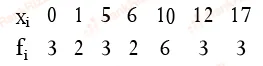
Q86Variance and standard deviationTRANSCRIBED

If the variance σ2\sigma^2 of the data

Figure for JEE Main 2024 Mathematics question on Variance and standard deviation


is kk, then the value of [k][k] is ______ (where .. denotes the greatest integer function)

Q87Cartesian products and counting relationsTRANSCRIBED

The number of symmetric relations defined on the set {1,2,3,4}\{1, 2, 3, 4\} which are not reflexive is _______.

Q88Area between curvesTRANSCRIBED

The area of the region enclosed by the parabola (y−2)2=x−1(y-2)^2 = x - 1, the line x−2y+4=0x - 2y + 4 = 0 and the positive coordinate axes is __________.

Q89Variable separable equationsTRANSCRIBED

Let Y=Y(X)Y = Y(X) be a curve lying in the first quadrant such that the area enclosed by the line Y−y=Y′(x)(X−x)Y - y = Y'(x)(X - x) and the co-ordinate axes, where (x,y)(x, y) is any point on the curve, is always −y22Y′(x)+1\frac{-y^2}{2Y'(x)} + 1, Y′(x)≠0Y'(x) \neq 0. If Y(1)=1Y(1) = 1, then 12Y(2)12Y(2) equals ________.

Q90Foot of perpendicular, image and distance from a lineTRANSCRIBED

Let a line passing through the point (−1,2,3)(-1, 2, 3) intersect the lines L1:x−13=y−22=z+1−2L_1: \frac{x-1}{3} = \frac{y-2}{2} = \frac{z+1}{-2} at M(α,β,γ)M(\alpha, \beta, \gamma) and L2:x+2−3=y−2−2=z−14L_2: \frac{x+2}{-3} = \frac{y-2}{-2} = \frac{z-1}{4} at N(a,b,c)N(a, b, c). Then the value of (α+β+γ)2(a+b+c)2\frac{(\alpha + \beta + \gamma)^2}{(a + b + c)^2} equals ________________.