Q31Quantum numbers and shapes of orbitalsTRANSCRIBED
Given below are two statements:
Statement-I: The orbitals having same energy are called as degenerate orbitals.
Statement-II: In hydrogen atom, 3p and 3d orbitals are not degenerate orbitals.
In the light of the above statements, choose the most appropriate answer from the options given
- A
Statement-I is true but Statement-II is false
- B
Both Statement-I and Statement-II are true
- C
Both Statement-I and Statement-II are false
- D
Statement-I is false but Statement-II is true
Q32Atomic and ionic radiiTRANSCRIBED
Given below are the two statements: one is labeled as Assertion (A) and the other is labeled as Reason (R).
Assertion (A): There is a considerable increase in covalent radius from N to P. However from As to Bi only a small increase in covalent radius is observed.
Reason (R): covalent and ionic radii in a particular oxidation state increases down the group.
In the light of the above statement, choose the most appropriate answer from the options given below:
- A
(A) is false but (R) is true
- B
Both (A) and (R) are true but (R) is not the correct explanation of (A)
- C
(A) is true but (R) is false
- D
Both (A) and (R) are true and (R) is the correct explanation of (A)
Q33Dinitrogen, ammonia, nitric acid and oxides of nitrogenTRANSCRIBED
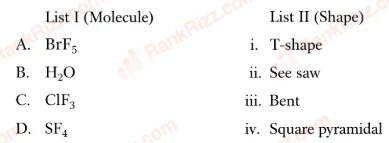
Match List - I with List-II
- A
(A)-I, (B)-II, (C)-IV, (D)-III
- B
(A)-II, (B)-I, (C)-III, (D)-IV
- C
(A)-III, (B)-IV, (C)-I, (D)-II
- D
(A)-IV, (B)-III, (C)-I, (D)-II
Q34IUPAC nomenclature of organic compoundsTRANSCRIBED
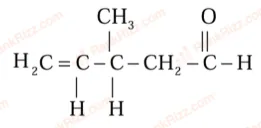
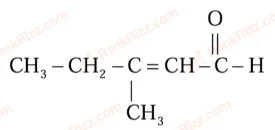
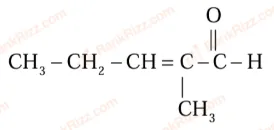
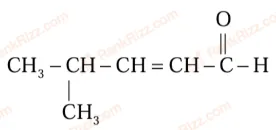
Structure of 4−Methylpent−2−enal is:
- A
- B
- C
- D
Q35Nucleophilic substitution (SN1 and SN2)TRANSCRIBED
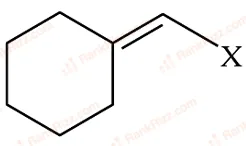
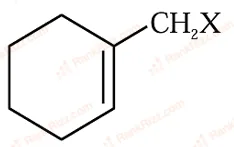
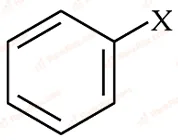
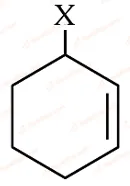
Example of vinylic halide is
- A
- B
- C
- D
Q36Nucleophilic substitution (SN1 and SN2)TRANSCRIBED
Given below are two statements one is labeled as Assertion (A) and the other is labeled as Reason (R).
Assertion (A): CH2=CH−CH2−Cl is an example of allyl halide
Reason (R): Allyl halides are the compounds in which the halogen atom is attached to sp2 hybridised carbon atom.
In the light of the two above statements, choose the most appropriate answer from the options given below:
- A
(A) is true but (R) is false
- B
Both (A) and (R) are true but (R) is not the correct explanation of A
- C
(A) is false but (R) is true
- D
Both (A) and (R) are true and (R) is the correct explanation of (A)
Q37AromaticityTRANSCRIBED
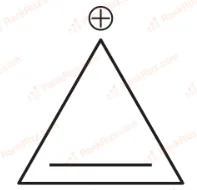
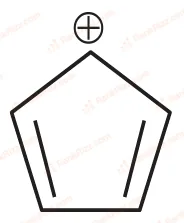
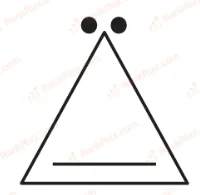
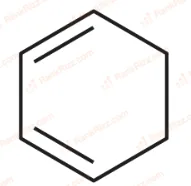
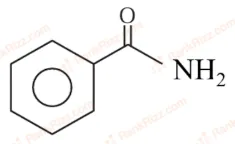
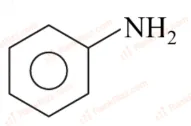
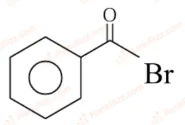
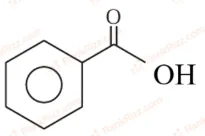
Which of the following molecule/species is most stable?
- A
- B
- C
- D
Q38Reactions of alkynesTRANSCRIBED
Compound A formed in the following reaction reacts with B gives the product C. Find out A and B.

- A
A=CH3−C≡C−Na+, B=CH3−CH2−CH2−Br
- B
A=CH3−CH=CH2, B=CH3−CH2−CH2−Br
- C
A=CH3−CH2−CH3, B=CH3−C≡CH
- D
A=CH3−C≡C−Na+, B=CH3−CH2−CH3
Q39Preparation of aldehydes and ketonesTRANSCRIBED
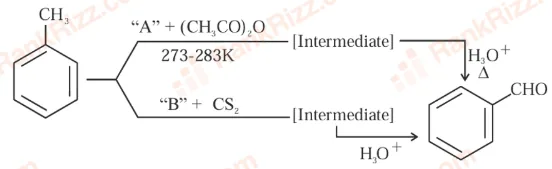
In the given reactions identify the reagent A and reagent B
- A
A−CrO3, B−CrO3
- B
A−CrO3, B−CrO2Cl2
- C
A−CrO2Cl2, B−CrO2Cl2
- D
A−CrO2Cl2, B−CrO3
Q40Depression in freezing pointTRANSCRIBED
What happens to freezing point of benzene when small quantity of naphthalene is added to benzene?
- A
- B
- C
First decreases and then increases
- D
Q41Lanthanoids and lanthanoid contractionTRANSCRIBED
Diamagnetic Lanthanoid ions are:
- A
Nd3+ and Eu3+
- B
La3+ and Ce4+
- C
Nd3+ and Ce4+
- D
Lu3+ and Eu3+
Q42General properties of transition elementsTRANSCRIBED
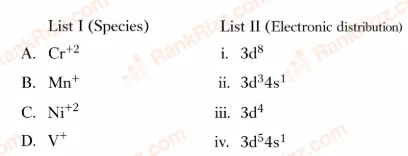
Match List-I with List-II
- A
(A)-I, (B)-II, (C)-III, (D)-IV
- B
(A)-III, (B)-IV, (C)-I, (D)-II
- C
(A)-IV, (B)-III, (C)-I, (D)-II
- D
(A)-II, (B)-I, (C)-IV, (D)-III
Q43Stability and applications of coordination compoundsTRANSCRIBED
Choose the correct Statements from the following:
(A) Ethane-1,2-diamine is a chelating ligand.
(B) Metallic aluminium is produced by electrolysis of aluminium oxide in presence of cryolite.
(C) Cyanide ion is used as ligand for leaching of silver.
(D) Phosphine acts as a ligand in Wilkinson catalyst.
(E) The stability constants of Ca2+ and Mg2+ are similar with EDTA complexes.
- A
- B
- C
- D
Q44VSEPR theory and shapes of molecules and ionsTRANSCRIBED
Aluminium chloride in acidified aqueous solution forms an ion having geometry
- A
- B
- C
- D
Q45Oxidation and reduction of carbonyl compoundsTRANSCRIBED
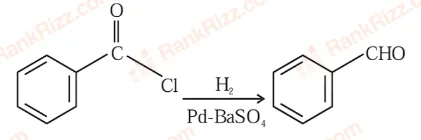
This reduction reaction is known as:
- A
- B
- C
- D
Q46Electrophilic substitution of anilineTRANSCRIBED
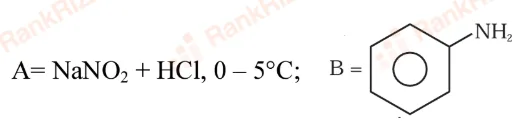
Following is a confirmatory test for aromatic primary amines. Identify reagent (A) and (B)

- A
- B
- C
- D
Q47Reactions of alkanesTRANSCRIBED
The final product A, formed in the following multistep reaction sequence is:
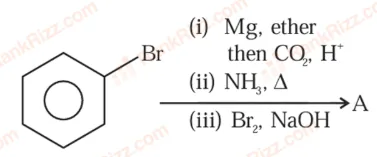
- A
- B
- C
- D
Q48Analysis of anionsTRANSCRIBED
Given below are two statements:
Statement-I: The gas liberated on warming a salt with dil H2SO4, turns a piece of paper dipped in lead acetate into black, it is a confirmatory test for sulphide ion.
Statement-II: In statement-I the colour of paper turns black because of formation of lead sulphite.
In the light of the above statements, choose the most appropriate answer from the options given below:
- A
Both Statement-I and Statement-II are false
- B
Statement-I is false but Statement-II is true
- C
Statement-I is true but Statement-II is false
- D
Both Statement-I and Statement-II are true
Q49Quantitative estimation of elementsTRANSCRIBED
The Lassaigne's extract is boiled with dil HNO3 before testing for halogens because,
- A
AgCN is soluble in HNO3
- B
Silver halides are soluble in HNO3
- C
Ag2S is soluble in HNO3
- D
Na2S and NaCN are decomposed by HNO3
Q50Carbohydrates: classification and monosaccharidesTRANSCRIBED
Sugar which does not give reddish brown precipitate with Fehling's reagent is:
- A
- B
- C
- D
Q51Mole concept, atomic and molar massTRANSCRIBED
0.05 cm thick coating of silver is deposited on a plate of area 0.05 m2. The number of silver atoms deposited on plate are _______ ×1023. (At mass Ag=108, d=7.9 g cm−3) Round off to the nearest integer.
Q52Modern periodic table and classification of elementsTRANSCRIBED
If IUPAC name of an element is "Unununnium" then the element belongs to nth group of periodic table. The value of n is _______.
Q53Molecular orbital theory of diatomic speciesTRANSCRIBED
The total number of molecular orbitals formed from 2s and 2p atomic orbitals of a diatomic molecule is _______.
Q54First law: work, heat and internal energyTRANSCRIBED
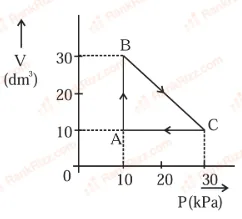
An ideal gas undergoes a cyclic transformation starting from the point A and coming back to the same point by tracing the path A→B→C→A as shown in the diagram. The total work done in the process is _____ J.
Q55Solubility product and common ion effectTRANSCRIBED
The pH at which Mg(OH)2[Ksp=1×10⁻¹¹] begins to precipitate from a solution containing 0.10 M Mg2+ ions is ______.
Q56Balancing redox equationsTRANSCRIBED
2MnO4−+bI−+cH2O→xI2+yMnO2+zOH−
If the above equation is balanced with integer coefficients, the value of z is ________.
Q57Methods of purification of organic compoundsTRANSCRIBED
On a thin layer chromatographic plate, an organic compound moved by 3.5 cm, while the solvent moved by 5 cm. The retardation factor of the organic compound is ____________ ×10−1.
Q58Concentration terms and their interconversionTRANSCRIBED
The mass of sodium acetate (CH3COONa) required to prepare 250 mL of 0.35 M aqueous solution is _____ g. (Molar mass of CH3COONa is 82.02 g mol−1) Round off to the nearest integer.
Q59Integrated rate laws and half-life (zero and first order)TRANSCRIBED
The rate of first order reaction is 0.04 mol L−1s−1 at 10 minutes and 0.03 mol L−1s−1 at 20 minutes after initiation. Half life of the reaction is ______ minutes. (Given log2=0.3010, log3=0.4771)
Round off your answer to the nearest integer.
Q60Nucleophilic addition reactions of carbonyl compoundsTRANSCRIBED
The compound formed by the reaction of ethanal with semicarbazide contains _______ number of nitrogen atoms.