JEE Main 2024 Chemistry question — Oxidation and reduction of carbonyl compounds
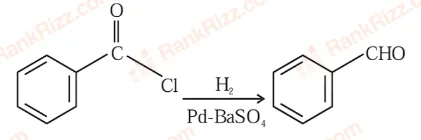
This reduction reaction is known as:
SOLUTION
We need to identify the given organic reduction reaction where benzoyl chloride () is converted into benzaldehyde ().
Statement (A): Rosenmund reduction. The Rosenmund reduction is a hydrogenation process where an acyl chloride is selectively reduced to an aldehyde using hydrogen gas () over palladium on barium sulfate (). The barium sulfate acts as a catalyst poison to prevent further reduction of the aldehyde into a primary alcohol. This matches the given reaction perfectly. This is TRUE.
Statement (B): Wolff-Kishner reduction. The Wolff-Kishner reduction is used to convert a carbonyl group (aldehyde or ketone) into a methylene group () using hydrazine () and a strong base like . This is FALSE.
Statement (C): Stephen reduction. The Stephen reduction involves the preparation of aldehydes from nitrites () using tin(II) chloride () and hydrochloric acid (), followed by hydrolysis. This is FALSE.
Statement (D): Etard reduction. The Etard reduction is a reaction that oxidizes an aromatic methyl group to an aldehyde group using chromyl chloride (). This is FALSE.
The given reaction represents the Rosenmund reduction.
Answer: Option A — Rosenmund reduction
Tagged Oxidation and reduction of carbonyl compounds. Machine-assigned, so read it as a strong shortlist rather than a verdict.