Q31Radial and angular nodes and orbital energiesTRANSCRIBED
The number of radial node/s for 3p orbital is:
- A
1
- B
4
- C
2
- D
3
The 30 Chemistry questions of JEE Main 01 Feb 2024, Shift 2, numbered across the whole paper. Pick an answer on any question to check it against the key. Free to read, nothing to download.
The number of radial node/s for 3p orbital is:
1
4
2
3
Given below are two statements:
Statement (I): Both metal and non-metal exist in p and d-block elements.
Statement (II): Non-metals have higher ionisation enthalpy and higher electronegativity than the metals.
In the light of the above statements, choose the most appropriate answer from the options given below:
Both Statement I and Statement II are false
Statement I is false but Statement II is true
Statement I is true but Statement II is false
Both Statement I and Statement II are true
Given below are two statements:
Statement (I): A bonding MO has lower electron density above and below the inter-nuclear axis.
Statement (II): The antibonding MO has a node between the nuclei.
In light of the above statements, choose the most appropriate answer from the options given below:
Both Statement I and Statement II are false
Both Statement I and Statement II are true
Statement I is false but Statement II is true
Statement I is true but Statement II is false
Select the compound from the following that will show intramolecular hydrogen bonding.
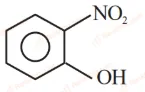
Solubility of calcium phosphate (molecular mass, M) in water is W g per 100 mL at 25°C. Its solubility product at 25°C will be approximately.
Match List - I with List - II.
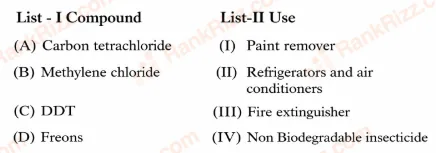
Choose the correct answer from the options given below:
(A)-(I), (B)-(II), (C)-(III), (D)-(IV)
(A)-(III), (B)-(I), (C)-(IV), (D)-(II)
(A)-(IV), (B)-(III), (C)-(II), (D)-(I)
(A)-(II), (B)-(III), (C)-(I), (D)-(IV)
Given below are two statements:
Statement (I): and are acidic while SnO and PbO are amphoteric in nature.
Statement (II): Allotropic forms of carbon are due to property of catenation and bond formation.
In the light of the above statements, choose the most appropriate answer from the options given below:
Both Statement I and Statement II are false
Both Statement I and Statement II are true
Statement I is true but Statement II is false
Statement I is true but Statement II is true
Which among the following has highest boiling point?
The set of meta directing functional groups from the following sets is:
The functional group that shows negative resonance effect is:
Lassaigne's test is used for detection of:
Nitrogen and Sulphur only
Nitrogen, Sulphur and Phosphorous Only
Phosphorous and halogens only
Nitrogen, Sulphur, and halogens
In the given reactions identify A and B.
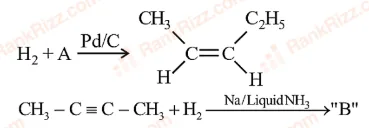
A : 2-Pentyne, B : trans-2-butene
A : n-Pentane, B : trans-2-butene
A : 2-Pentyne, B : Cis-2-butene
A : n-Pentane, B : Cis-2-butene
The strongest reducing agent among the following is:
The transition metal having highest 3rd ionisation enthalpy is:
Cr
Mn
V
Fe
Which of the following compounds show colour due to d-d transition?
Given below are two statements: one is labelled as Assertion A and the other is labelled as Reason R.
Assertion A: In aqueous solutions is reducing while is oxidising in nature.
Reason R: Extra stability to half filled electronic configuration is observed than incompletely filled electronic configuration.
In the light of the above statement, choose the most appropriate answer from the options given below:
Both A and R are true and R is the correct explanation of A
Both A and R are true but R is not the correct explanation of A
A is false but R is true
A is true but R is false
Given below are two statements:
Statement (I): Dimethyl glyoxime forms a six membered covalent chelate when treated with solution in presence of .
Statement (II): Prussian blue precipitate contains iron both in +2 and +3 oxidation states.
In the light of the above statements, choose the most appropriate answer from the options given below:
Statement I is false but Statement II is true
Both Statement I and Statement II are true
Both Statement I and Statement II are false
Statement I is true but Statement II is false
and are respectively known as:
Spin free Complex, Spin paired Complex
Spin paired Complex, Spin free Complex
Outer orbital Complex, Inner orbital Complex
Inner orbital Complex, Spin paired Complex
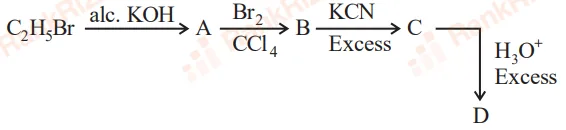
Acid D formed in above reaction is:
Gluconic acid
Succinic acid
Oxalic acid
Malonic acid
Match List - I with List - II.
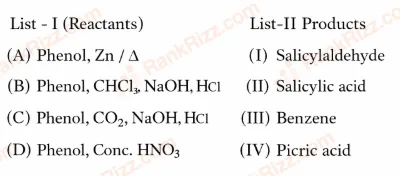
Choose the correct answer from the options given below:
(A)-(IV), (B)-(II), (C)-(I), (D)-(III)
(A)-(IV), (B)-(I), (C)-(II), (D)-(III)
(A)-(III), (B)-(I), (C)-(II), (D)-(IV)
(A)-(III), (B)-(IV), (C)-(I), (D)-(II)
10 mL of gaseous hydrocarbon on combustion gives 40 mL of and 50 mL of water vapour. Total number of carbon and hydrogen atoms in the hydrocarbon is ______.
For a certain reaction at 300 K, K = 10, then for the same reaction is - ______ . (Given )
Following Kjeldahl's method, 1 g of organic compound released ammonia, that neutralised 10 mL of . The percentage of nitrogen in the compound is ______ %.
Total number of isomeric compounds (including stereoisomers) formed by monochlorination of 2-methylbutane is ______.
Mass of ethylene glycol (antifreeze) to be added to 18.6 kg of water to protect the freezing point at is ______ kg (Molar mass in g mol for ethylene glycol 62, of water = )
The amount of electricity in Coulomb required for the oxidation of 1 mol of to is ______ C.
Consider the following redox reaction:
The standard reduction potentials are given as below:
V; V
If the equilibrium constant of the above reaction is given as , then the value of = ______ (nearest integer)
The following data were obtained during the first order thermal decomposition of a gas A at constant volume:
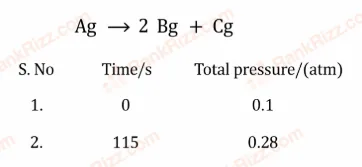
The rate constant of the reaction is ______ (nearest integer)
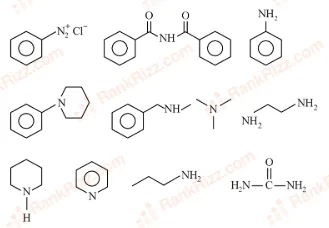
Number of compounds which give reaction with Hinsberg's reagent is ______.
The number of tripeptides formed by three different amino acids using each amino acid once is ______.