The 30 Chemistry questions of JEE Main 31 Jan 2023, Shift 1, numbered across the whole paper. Pick an answer on any question to check it against the key. Free to read, nothing to download.
Chemistry
Q31Hydrogen spectrum and spectral seriesTRANSCRIBED
Which transition in the hydrogen spectrum would have the same wavelength as the Balmer type transition from n = 4 to n = 2 of He+ spectrum
Q33VSEPR theory and shapes of molecules and ionsTRANSCRIBED
Match List I with List II List I List II A. XeF4 I. See-saw B. SF4 II. Square planar C. NH4+ III. Bent T-shaped D. BrF3 IV. Tetrahedral Choose the correct answer from the options given below:
Q39Concentration of ores, calcination and roastingTRANSCRIBED
The methods NOT involved in concentration of ore are (A) Liquation (B) Leaching (C) Electrolysis (D) Hydraulic washing (E) Froth floatation Choose the correct answer from the options given below:
Q41Other important compounds of transition metalsTRANSCRIBED
When Cu2+ ion is treated with KI, a white precipitate, X appears in solution. The solution is titrated with sodium thiosulphate, the compound Y is formed. X and Y respectively are
Cobalt chloride when dissolved in water forms pink colored complex X which has octahedral geometry. This solution on treating with conc HCl forms deep blue complex, Y which has a Z geometry. X, Y and Z, respectively, are
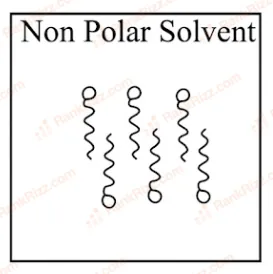
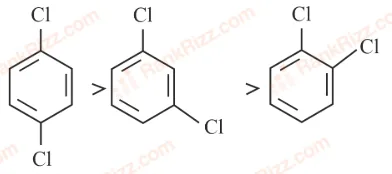
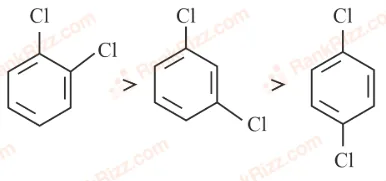
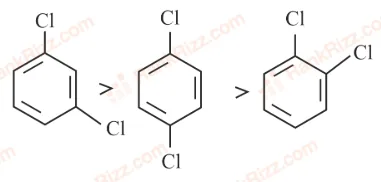
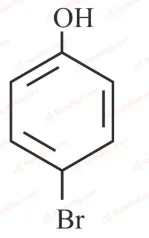
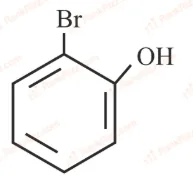
An organic compound 'A' with empirical formula C6H6O gives sooty flame on burning. Its reaction with bromine solution in low polarity solvent results in high yield of B. B is
Zinc reacts with hydrochloric acid to give hydrogen and zinc chloride. The volume of hydrogen gas produced at STP from the reaction of 11.5 g of zinc with excess HCl is L (Nearest integer) (Given: Molar mass of Zn is 65.4 g mol−1 and Molar volume of H2 at STP = 22.7 L)
Q53Enthalpies of reaction and Hess's lawTRANSCRIBED
The enthalpy change for the conversion of 21Cl2(g) to Cl−(aq) is (-) ______ kJmol−1 (Nearest integer) Given: ΔdisHCl2(g)0=240 kJmol−1 ΔegHCl(g)o=−350 kJmol−1 ΔhydHCl−(g)o=−380 kJmol−1
Q54Law of mass action and equilibrium constants Kc and KpTRANSCRIBED
For reaction: SO2(g)+21O2(g)⇌SO3(g)KP=2×10¹² at 27°C and 1 atm pressure. The Kc for the same reaction is ______ ×1013. (Nearest integer) (Given R=0.082 L atm K−1 mol−1)
The total pressure of a mixture of non-reacting gases X(0.6 g) and Y(0.45 g) in a vessel is 740 mm of Hg. The partial pressure of the gas X is mm of Hg. (Nearest Integer) (Given: molar mass X = 20 and Y = 45 g mol−1)
At 27°C, a solution containing 2.5 g of solute in 250.0 mL of solution exerts an osmotic pressure of 400 Pa. The molar mass of the solute is g mol−1 (Nearest integer) (Given: R = 0.083 L bar−1 mol−1)
Q57Electrode potentials, electrochemical series and cell EMFTRANSCRIBED
The logarithm of equilibrium constant for the reaction Pd2++4Cl−⇌PdCl42− is (Nearest integer) Given: F2.303RT=0.06 V Pd(aq)2++2e−⇌Pd(s)Eo=0.83 V PdCl42−(aq)+2e−⇌Pd(s)+4Cl−(aq)<br/>E^o = 0.65$$ V
Q58Arrhenius equation and activation energyTRANSCRIBED
A→B The rate constants of the above reaction at 200 K and 300 K are 0.03 min−1 and 0.05 min−1 respectively. The activation energy for the reaction is J (Nearest integer) (Given: ln 10 = 2.3, R = 8.3 J K−1 mol−1, log 5 = 0.70, log 3 = 0.48, log 2 = 0.30)