The 30 Chemistry questions of JEE Main 13 Apr 2023, Shift 1, numbered across the whole paper. Pick an answer on any question to check it against the key. Free to read, nothing to download.
Chemistry
Q31Bohr model of hydrogen-like speciesTRANSCRIBED
The energy of an electron in the first Bohr orbit of hydrogen atom is −2.18×10⁻¹⁸ J. Its energy in the third Bohr orbit is _____.
Q32Valency, oxidation states and nature of oxidesTRANSCRIBED
Which of the following statements are not correct? A. The electron gain enthalpy of F is more negative than that of Cl. B. Ionization enthalpy decreases in a group of periodic table. C. The electronegativity of an atom depends upon the atoms bonded to it. D. Al2O3 and NO are examples of amphoteric oxides. Choose the most appropriate answer from the options given below:
Given below are two statements: Statement I: Permutit process is more efficient compared to the synthetic resin method for the softening of water. Statement II: Synthetic resin method results in the formation of soluble sodium salts. In the light of the above statements, choose the most appropriate answer from the options given below:
A
Both the statements I and II are incorrect
B
Statement I is incorrect but statement II is correct
C
Both the statements I and II are correct
D
Statement I is correct but statement II is incorrect
Q44Stability and applications of coordination compoundsTRANSCRIBED
The mismatched combinations are A. Chlorophyll − Co B. Water hardness − EDTA C. Photography − [Ag(CN)2]− D. Wilkinson catalyst − [(Ph3P)3RhCl] E. Chelating ligand − D − Penicillamine Choose the correct answer from the options given below.
Q45Nucleophilic substitution (SN1 and SN2)TRANSCRIBED
2-Methyl propyl bromide reacts with C2H5O− and gives 'A' whereas on reaction with C2H5OH it gives 'B'. The mechanism followed in these reactions and the products 'A' and 'B' respectively are:
A
SN2, A = iso-butyl ethyl ether; SN1, B = tert-butyl ethyl ether
B
SN1, A = tert-butyl ethyl ether; SN1, B = 2-butyl ethyl ether
C
SN2, A = 2-butyl ethyl ether; SN2, B = iso-butyl ethyl ether
D
SN1, A = tert-butyl ethyl ether; SN2, B = iso-butyl ethyl ether
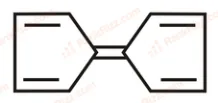
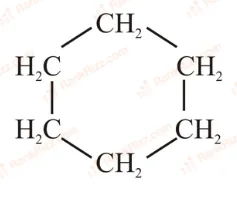
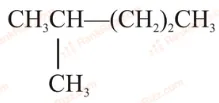
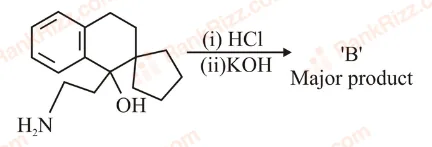
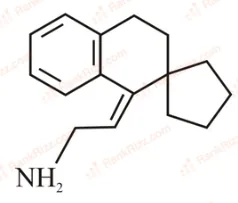
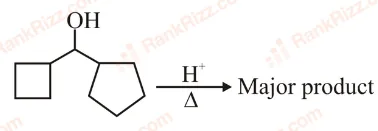
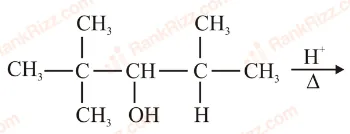
In the above reaction, left hand side and right hand side rings are named as 'A' and 'B' respectively. They undergo ring expansion. The correct statement for this process is:
A
Ring expansion can go upto seven membered rings
B
Finally both rings will become six membered each.
C
Finally both rings will become five membered each.
Q51Stoichiometry, limiting reagent and percentage yieldTRANSCRIBED
An organic compound gives 0.220 g of CO2 and 0.126 g of H2O on complete combustion. If the % of carbon is 24 then the % of hydrogen is _____ ×10−1. (Nearest integer)
Q52Real gases, compressibility factor and van der Waals equationTRANSCRIBED
A certain quantity of real gas occupies a volume of 0.15 dm3 at 100 atm and 500 K when its compressibility factor is 1.07. Its volume at 300 atm and 300 K (When its compressibility factor is 1.4) is _____ ×10−4 dm3 (Nearest integer)
Q53Enthalpies of reaction and Hess's lawTRANSCRIBED
A2 + B2→ 2AB. ΔHf=−200 kJ mol−1 AB, A2 and B2 are diatomic molecules. If the bond enthalpies of A2, B2 and AB are in the ratio 1 : 0.5 : 1, then the bond enthalpy of A2 is _____ kJ mol−1 (Nearest integer)
KMnO4 is titrated with ferrous ammonium sulphate hexahydrate in presence of dilute H2SO4. Number of water molecules produced for 2 molecules of KMnO4 is _____.
Q56Concentration terms and their interconversionTRANSCRIBED
20 mL of calcium hydroxide was consumed when it was reacted with 10 mL of unknown solution of H2SO4. Also 20 mL standard solution of 0.5 M HCl containing 2 drops of phenolphthalein was titrated with calcium hydroxide, the mixture showed pink colour when burette displayed the value of 35.5 mL whereas the burette showed 25.5 mL initially. The concentration of H2SO4 is _____ M. (Nearest integer)
Q57Abnormal molar mass and van't Hoff factorTRANSCRIBED
Solution of 12 g of non-electrolyte (A) prepared by dissolving it in 1000 mL of water exerts the same osmotic pressure as that of 0.05 M glucose solution at the same temperature. The empirical formula of A is CH2O. The molecular mass of A is _____ g. (Nearest integer)
Q58Conductance, conductivity and molar conductivityTRANSCRIBED
A metal surface of 100 cm2 area has to be coated with nickel layer of thickness 0.001 mm. A current of 2A was passed through a solution of Ni(NO3)2 for 'x' seconds to coat the desired layer. The value of x is _____. (Nearest integer) (ρNi (density of Nickel) is 10 g mL−1, Molar mass of Nickel is 60 g mol−1, F =96500 C mol−1)
Q59Integrated rate laws and half-life (zero and first order)TRANSCRIBED
t87.5 is the time required for the reaction to undergo 87.5% completion and t50 is the time required for the reaction to undergo 50% completion. The relation between t87.5 and t50 for a first order reaction is t87.5 = x × t50 The value of x is _____. (Nearest integer)