RankRizz

JEE Main 27 Jun 2022, Shift 1: Chemistry

The 30 Chemistry questions of JEE Main 27 Jun 2022, Shift 1, numbered across the whole paper. Pick an answer on any question to check it against the key. Free to read, nothing to download.

Chemistry

Q31Atomic and ionic radiiTRANSCRIBED

Given below are two statements : one is labelled as Assertion and the other is labelled as Reason.
Assertion: The ionic radii of O2−O^{2-} and Mg2+Mg^{2+} are same.
Reason: Both O2−O^{2-} and Mg2+Mg^{2+} are isoelectronic species.

  1. A

    Both Assertion and Reason are true and Reason is the correct explanation of Assertion.

  2. B

    Both Assertion and Reason are true but Reason is not the correct explanation of Assertion.

  3. C

    Assertion is true but Reason is false.

  4. D

    Assertion is false but Reason is true.
Q32VSEPR theory and shapes of molecules and ionsTRANSCRIBED

Based upon VSEPR theory, match the shape (geometry) of the molecules in List-I with the molecules in List-II

List-I (Shape)List-II (Molecules)
A T-shapedI. XeF4XeF_4
B Trigonal planarII. SF4SF_4
C Square planarIII. ClF3ClF_3
D See-sawIV. BF3BF_3
  1. A

    A-(I), B-(II), C-(III), D-(IV)

  2. B

    A-(IV), B-(I), C-(II), D-(III)

  3. C

    A-(II), B-(I), C-(IV), D-(III)

  4. D

    A-(III), B-(IV), C-(I), D-(II)

Q33Heat capacity and calorimetryTRANSCRIBED

Match List - I with List - II.

List-IList-II
(A) Spontaneous process(I) ΔH<0\Delta H < 0
(B) Process with ΔP=0,ΔT=0\Delta P = 0, \Delta T = 0(II) ΔGT,P<0\Delta G_{T,P} < 0
(C) ΔHreaction\Delta H_{reaction}(III) Isothermal and isobaric process
(D) Exothermic Process(IV) [Bond energies in reactants] - [Bond energies in products]

Choose the correct answer from the options given below

  1. A

    A-(III), B-(II), C-(IV), D-(I)

  2. B

    A-(II), B-(III), C-(IV), D-(I)

  3. C

    A-(II), B-(III), C-(I), D-(IV)

  4. D

    A-(II), B-(I), C-(III), D-(IV)

Q34Hydrogen peroxideTRANSCRIBED

Addition of H2SO4H_2SO_4 to BaO2BaO_2 produces

  1. A

    BaO, SO2SO_2 and H2OH_2O

  2. B

    BaHSO4BaHSO_4 and O2O_2

  3. C

    BaSO4,H2BaSO_4, H_2 and O2O_2

  4. D

    BaSO4BaSO_4 and H2O2H_2O_2

Q35Compounds of alkaline earth metalsTRANSCRIBED

BeCl2BeCl_2 reacts with LiAlH4LiAlH_4 to give

  1. A

    Be+Li[AlCl4]+H2Be + Li[AlCl_4] + H_2

  2. B

    Be+AlH3+LiCl+HClBe + AlH_3 + LiCl + HCl

  3. C

    BeH2+LiCl+AlCl3BeH_2 + LiCl + AlCl_3

  4. D

    BeH2+Li[AlCl4]BeH_2 + Li[AlCl_4]

Q36Group 14: trends and carbon allotropesTRANSCRIBED

Match List - I with List - II.

List-I (Si-Compounds)List-II (Si-Polymeric/Other Products)
A (CH3)4Si(CH_3)_4SiI Chain Silicone
B (CH3)Si(OH)3(CH_3)Si(OH)_3II Dimeric Silicone
C (CH3)2Si(OH)2(CH_3)_2Si(OH)_2III Silane
D (CH3)3Si(OH)(CH_3)_3Si(OH)IV 2D-Silicone

Choose the correct answer from the options given below

  1. A

    A-(III), B-(II), C-(I), D-(IV)

  2. B

    A-(IV), B-(I), C-(II), D-(III)

  3. C

    A-(II), B-(I), C-(IV), D-(III)

  4. D

    A-(III), B-(IV), C-(I), D-(II)

Q37Carbohydrates: classification and monosaccharidesTRANSCRIBED

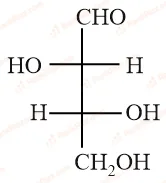
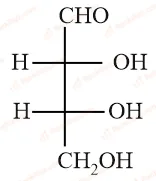
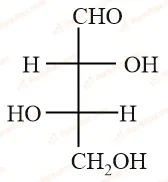
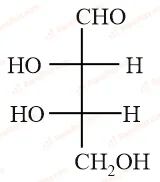
L-isomer of a compound 'A'(C4H8O4C_4H_8O_4) gives a positive test with [Ag(NH3)2]+[Ag(NH_3)_2]^+. Treatment of 'A' with acetic anhydride yields triacetate derivative. Compound 'A' produces an optically active compound (B) and an optically inactive compound (C) on treatment with bromine water and HNO3HNO_3 respectively. Compound (A) is :

  1. A
    Figure for JEE Main 2022 Chemistry question on Carbohydrates: classification and monosaccharides
  2. B
    Figure for JEE Main 2022 Chemistry question on Carbohydrates: classification and monosaccharides
  3. C
    Figure for JEE Main 2022 Chemistry question on Carbohydrates: classification and monosaccharides
  4. D
    Figure for JEE Main 2022 Chemistry question on Carbohydrates: classification and monosaccharides
Q38Air pollution: tropospheric pollutants, smog, acid rain and greenhouse effectTRANSCRIBED

Given below are two Statements :
Statement I : Classical smog occurs in cool humid climate. It is a reducing mixture of smoke, fog and sulphur dioxide.
Statement II : Photochemical smog has components, ozone, nitric oxide, acrolein, formaldehyde, PAN etc.
In the light of the above statements, choose the most appropriate answer from the options given below.

  1. A

    Both Statement I and Statement II are correct.

  2. B

    Both Statement I and Statement II are incorrect.

  3. C

    Statement I is incorrect but Statement II is correct.

  4. D

    Statement I is correct but Statement II is incorrect.

Q39Depression in freezing pointTRANSCRIBED

Given below are two statements : one is labelled as Assertion and the other is labelled as Reason.
Assertion: At 10°10°C, the density of a 55 M solution of KCl [atomic masses of K & Cl are 3939 & 35.535.5 g mol−1^{-1} respectively], is 'x' g mL−1^{-1}. The solution is cooled to −21°-21°C. The molality of the solution will remain unchanged.
Reason: The molality of a solution does not change with temperature as mass remains unaffected with temperature.
In the light of the above statements, choose the most appropriate answer from the options given below.

  1. A

    Assertion is true but Reason is false.

  2. B

    Assertion is false but Reason is true.
  3. C

    Both Assertion and Reason are true and Reason is the correct explanation of Assertion.

  4. D

    Both Assertion and Reason are true but Reason is not the correct explanation of Assertion.

Q40Properties of colloids and coagulationTRANSCRIBED

Match List - I with List - II.

List-IList-II
A Lyophilic colloidI Liquid-liquid colloid
B EmulsionII Protective colloid
C Positively charged colloidIII FeCl3+NaOHFeCl_3 + NaOH
D Negatively charged colloidIV FeCl3FeCl_3 + hot water

Choose the correct answer from the options given below

  1. A

    A-(II), B-(I), C-(IV), D-(III)

  2. B

    A-(III), B-(I), C-(IV), D-(II)

  3. C

    A-(II), B-(I), C-(III), D-(IV)

  4. D

    A-(III), B-(II), C-(I), D-(IV)

Q41Concentration of ores, calcination and roastingTRANSCRIBED

Match List - I with List - II.

List-IList-II
A Concentration of gold oreI Aniline
B Leaching of aluminaII NaOH
C Froth stabiliserIII SO2SO_2
D Blister copperIV NaCN

Choose the correct answer from the options given below

  1. A

    A-(IV), B-(III), C-(II), D-(I)

  2. B

    A-(IV), B-(II), C-(I), D-(III)

  3. C

    A-(III), B-(II), C-(I), D-(IV)

  4. D

    A-(II), B-(IV), C-(III), D-(I)

Q42Group 15: trends and hydridesTRANSCRIBED

Heating white phosphorus with conc. NaOH solution gives mainly

  1. A

    Na3PNa_3P and H2OH_2O

  2. B

    H3POH_3PO and NaH

  3. C

    P(OH)3P(OH)_3 and NaH2PO4NaH_2PO_4

  4. D

    PH3PH_3 and NaH2PO2NaH_2PO_2

Q43Colour and magnetic behaviour of complexes from CFTTRANSCRIBED

Which of the following will have maximum stabilization due to crystal field?

  1. A

    [Ti(H2O)6]3+[Ti(H_2O)_6]^{3+}

  2. B

    [Co(H2O)6]2+[Co(H_2O)_6]^{2+}

  3. C

    [Co(CN)6]3−[Co(CN)_6]^{3-}

  4. D

    [Cu(NH3)4]2+[Cu(NH_3)_4]^{2+}

Q45Oxidation and reduction of carbonyl compoundsTRANSCRIBED

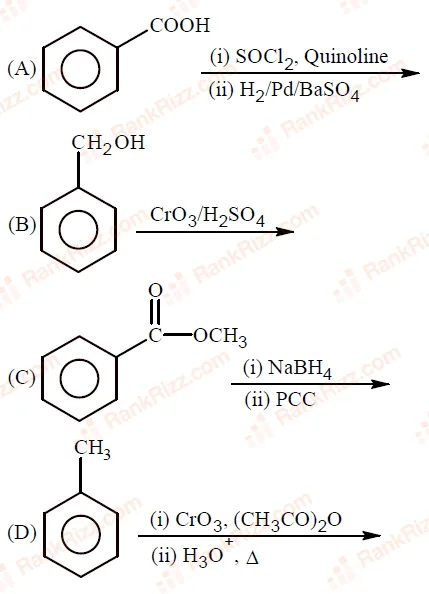
Which of the following reactions will yield benzaldehyde as a product?

Figure for JEE Main 2022 Chemistry question on Oxidation and reduction of carbonyl compounds
  1. A

    B & C

  2. B

    C & D

  3. C

    A & D

  4. D

    A & C

Q46Preparation of aldehydes and ketonesTRANSCRIBED

'A' and 'B' respectively are
A →(2)Zn−H2O(1)O3\xrightarrow[(2) Zn-H_2O]{(1) O_3 \atop} Ethane-1,2-dicarbaldehyde + Glyoxal/Oxaldehyde
B →(2)Zn−H2O(1)O3\xrightarrow[(2) Zn-H_2O]{(1) O_3 \atop} 5-oxohexanal

  1. A

    1-methylcyclohex-1,3-diene & cyclopentene

  2. B

    Cyclohex-1,3-diene & cyclopentene

  3. C

    Cyclohex-1,3-diene & 1-methylcyclopent-1-ene

  4. D

    1-methylcyclohex-1,4-diene & 1-methylcyclopent-1-ene

Q47Reactions and tests of aminesTRANSCRIBED

Given below are two statements :
Statement - I : In Hofmann degradation reaction, the migration of only an alkyl group takes place from carbonyl carbon of the amide to the nitrogen atom.
Statement - II : The group is migrated in Hofmann degradation reaction to electron deficient atom.
In the light of the above statements, choose the most appropriate answer from the options given below

  1. A

    Both Statement I and Statement II are correct.

  2. B

    Both Statement I and Statement II are incorrect.

  3. C

    Statement I is correct but Statement II is incorrect.

  4. D

    Statement I is incorrect but Statement II is correct.

Q48Important polymers and their monomersTRANSCRIBED

Match List - I with List - II.

List-I (Polymer)List-II (Used in)
A BakeliteI Radio and television cabinets
B GlyptalII Electrical switches
C PVCIII Paints and Lacquers
D PolystyreneIV Water pipes
  1. A

    A-(II), B-(III), C-(I), D-(IV)

  2. B

    A-(II), B-(III), C-(IV), D-(I)

  3. C

    A-(I), B-(II), C-(III), D-(IV)

  4. D

    A-(IV), B-(III), C-(II), D-(I)

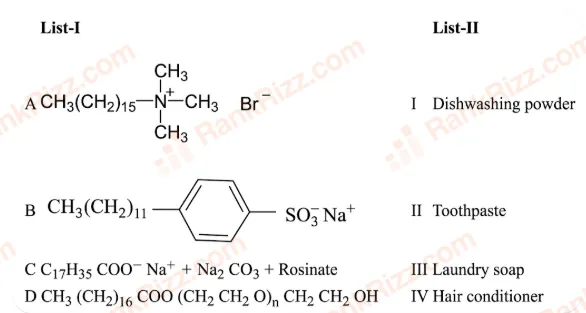
Q49Soaps and detergentsTRANSCRIBED

Match List - I with List - II.

Figure for JEE Main 2022 Chemistry question on Soaps and detergents

Choose the correct answer from the options given below

  1. A

    A-(IV), B-(II), C-(III), D-(I)

  2. B

    A-(III), B-(II), C-(IV), D-(I)

  3. C

    A-(IV), B-(III), C-(II), D-(I)

  4. D

    A-(II), B-(IV), C-(I), D-(II)

Q50Methods of purification of organic compoundsTRANSCRIBED

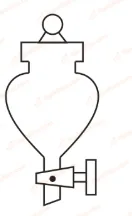
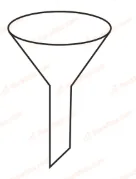
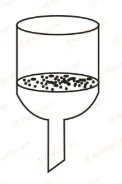
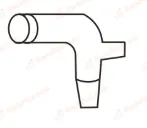
Which of the following is structure of a separating funnel?

  1. A
    Figure for JEE Main 2022 Chemistry question on Methods of purification of organic compounds
  2. B
    Figure for JEE Main 2022 Chemistry question on Methods of purification of organic compounds
  3. C
    Figure for JEE Main 2022 Chemistry question on Methods of purification of organic compounds
  4. D
    Figure for JEE Main 2022 Chemistry question on Methods of purification of organic compounds
Q51de Broglie wavelength and Heisenberg uncertainty principleTRANSCRIBED

If the uncertainty in velocity and position of a minute particle in space are, 2.4×10−262.4 \times 10^{-26} (ms−1^{-1}) and 10−710^{-7} (m) respectively. The mass of the particle in g is ______ (Nearest integer)
(Given : h=6.626×10⁻³⁴h = 6.626 \times 10^{-34} Js)

Q52Law of mass action and equilibrium constants Kc and KpTRANSCRIBED

2NOCl(g)⇌2NO(g)+Cl2(g)2NOCl(g) \rightleftharpoons 2NO(g) + Cl_2(g)
In an experiment, 2.02.0 moles of NOCl was placed in a one-litre flask and the concentration of NO after equilibrium established, was found to be 0.40.4 mol/L. The equilibrium constant at 30°30°C is ______ ×10−4\times 10^{-4}.

Q53Structural isomerismTRANSCRIBED

Total number of possible stereoisomers of dimethyl cyclopentane is ______

Q54Defects in solidsTRANSCRIBED

Metal deficiency defect is shown by Fe0.93OFe_{0.93}O. In the crystal, some Fe2+Fe^{2+} cations are missing and loss of positive charge is compensated by the presence of Fe3+Fe^{3+} ions. The percentage of Fe2+Fe^{2+} ions in the Fe0.93OFe_{0.93}O crystals is ______ (Nearest integer)

Q55Mole concept, atomic and molar massTRANSCRIBED

Two elements A and B which form 0.150.15 moles of A2BA_2B and AB3AB_3 type compounds. If both A2BA_2B and AB3AB_3 weigh equally, then the atomic weight of A is ______ times of atomic weight of B.

Q56Elevation in boiling pointTRANSCRIBED

22 g of a non-volatile non-electrolyte solute is dissolved in 200200 g of two different solvents A and B whose ebullioscopic constants are in the ratio of 1:81 : 8. The elevation in boiling points of A and B are in the ratio xy\frac{x}{y} (x:yx : y). The value of yy is ______ (Nearest Integer)

Q57Conductance, conductivity and molar conductivityTRANSCRIBED

The limiting molar conductivities of NaI, NaNO3NaNO_3 and AgNO3AgNO_3 are 12.7,12.012.7, 12.0 and 13.313.3 mS m2^2 mol−1^{-1}, respectively (all at 25°25°C). The limiting molar conductivity of AgI at this temperature is ______ mS m2^2 mol−1^{-1}.

Q58Arrhenius equation and activation energyTRANSCRIBED

The rate constant for a first order reaction is given by the following equation :
ln⁡k=33.24−2.0×10⁴KT\ln k = 33.24 - \frac{2.0 \times 10^4 K}{T}
The Activation energy for the reaction is given by ______ kJ mol−1^{-1}. (In Nearest integer) (Given : R=8.3R = 8.3 J K−1^{-1} mol−1^{-1})

Q59Other important compounds of transition metalsTRANSCRIBED

The number of statement(s) correct from the following for Copper is/are
(A) Cu(II) complexes are always paramagnetic
(B) Cu(I) complexes are generally colourless
(C) Cu(I) is easily oxidized
(D) In Fehling solution, the active reagent has Cu(I)

Q60Valence bond theory of complexesTRANSCRIBED

Acidified potassium permanganate solution oxidises oxalic acid. The spin-only magnetic moment of the mangenese product formed from the above reaction is ______ B.M. (Nearest Integer)

NEXT IN THIS PAPER →Maths, Q61 onwards