JEE Main 2022 Chemistry question — Oxidation and reduction of carbonyl compounds
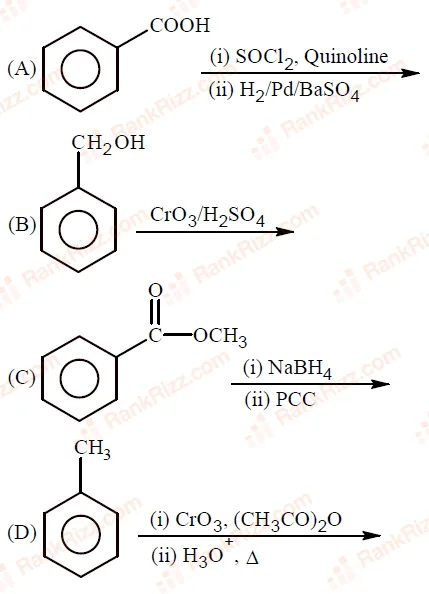
Which of the following reactions will yield benzaldehyde as a product?
SOLUTION
To determine which reactions produce benzaldehyde, the reagents and reaction conditions must be analysed.
In reaction , benzoic acid first reacts with to form benzoyl chloride.
Subsequent treatment with performs the:
which selectively converts the acid chloride into benzaldehyde.
Hence, reaction gives benzaldehyde.
In reaction , benzyl alcohol reacts with (Jones reagent).
This strong oxidising agent converts the primary alcohol completely into benzoic acid.
Hence, benzaldehyde is not obtained.
In reaction , methyl benzoate is treated with .
is too mild to reduce esters.
Therefore, no aldehyde is formed and PCC has no effect.
Hence, benzaldehyde is not obtained.
In reaction , toluene reacts with to form a protected gem-diacetate intermediate.
Acid hydrolysis using converts this intermediate into benzaldehyde.
Hence, reaction gives benzaldehyde.
Therefore, the reactions producing benzaldehyde are:
Thus, the right option is C.
Tagged Oxidation and reduction of carbonyl compounds. Machine-assigned, so read it as a strong shortlist rather than a verdict.