Q26Mole concept, atomic and molar massTRANSCRIBED
The average molar mass of chlorine is . The ratio of to in naturally occurring chlorine is close to:
- A
4 : 1
- B
3 : 1
- C
2 : 1
- D
1 : 1
The 25 Chemistry questions of JEE Main 06 Sep 2020, Shift 2, numbered across the whole paper. Pick an answer on any question to check it against the key. Free to read, nothing to download.
The average molar mass of chlorine is . The ratio of to in naturally occurring chlorine is close to:
4 : 1
3 : 1
2 : 1
1 : 1
For a reaction . The free energy change is plotted as a function of temperature. The temperature below which the oxide is stable could be inferred from the plot as the point at which:
the slope change from negative to positive
the free energy change show a change from negative to positive value
the slope changes from positive to negative
the slope changes from positive to zero
The value of is 64 at 800 K for the reaction
The value of for the following reaction is:
1/64
8
1/4
1/8
Dihydrogen of high purity (> 99.95%) is obtained through:
The reaction of Zn with dilute HCl
The electrolysis of acidified water using Pt electrodes
The electrolysis of brine solution
The electrolysis of warm solution using Ni electrodes
Match the following compounds (Column-I) with their uses (Column-II):
S. No. Column-I S.No. Column-II
(I) - (A) casts of statues
(II) NaCl - (B) white wash
(III) - (C) antacid
(IV) - (D) washing soda preparation
(I)-(D), (II)-(A), (III)-(C), (IV)-(B)
(I)-(B), (II)-(D), (III)-(A), (IV)-(C)
(I)-(B), (II)-(C), (III)-(D), (IV)-(A)
(I)-(D), (II)-(C), (III)-(B), (IV)-(A)
Match the following:
Test/Method Reagent
(i) Lucas Test (a) / aq. KOH
(ii) Dumas method (b) /
(iii) Kjeldahl's method (c) CuO /
(iv) Hinsberg Test (d) Conc. HCl and
(e)
(i)-(d), (ii)-(c), (iii)-(b), (iv)-(e)
(i)-(b), (ii)-(d), (iii)-(e), (iv)-(a)
(i)-(d), (ii)-(c), (iii)-(e), (iv)-(a)
(i)-(b), (ii)-(a), (iii)-(c), (iv)-(d)
The IUPAC name of the following compound is:
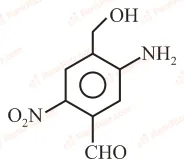
2-nitro-4-hydroxymethyl-5-amino benzaldehyde
3-amino-4-hydroxymethyl-5-nitrogenzaldehyde
5-amino-4-hydroxymethyl-2-nitrobenzaldehyde
4-amino-2-formyl-5-hydroxymethyl nitrogenzene
A crystal is made up of metal ions 'M1' and 'M2' and oxide ions. Oxide ions form a ccp lattice structure. The cation 'M1' occupies 50% of octahedral voids and the cation 'M2' occupies 12.5% of tetrahedral voids of oxide lattice. The oxidation numbers of 'M1' and 'M2' are respectively:
+2, +4
+1, +3
+3, +1
+4, +2
A set of solutions is prepared using 180 g of water as a solvent and 10 g of different non-volatile solutes A, B and C. The relative lowering of vapour pressure in the presence of these solutes are in the order [Given, molar mass of ; ; ]
For the given cell;
change in Gibbs energy is negative, it:
The element that can be refined by distillation is:
nickel
zinc
tin
gallium
The reaction of NO with at 250 K gives:
Reaction of an inorganic sulphite X with dilute generated compound Y. Reaction of Y with NaOH gives X. Further, the reaction of X with Y and water affords compound Z. Y and X, respectively, are:
and
and
and
S and
Mischmetal is an alloy consisting mainly of:
Lanthanoid metals
actinoid and transition metals
lanthanoid and actinoid metals
actinoid metals
For a metal ion in an octahedral field, the correct electronic configuration is:
when
when
when
when
The increasing order of the boiling points of the major products A, B and C of the following reactions will be:
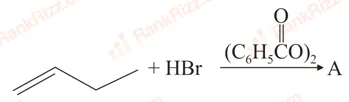
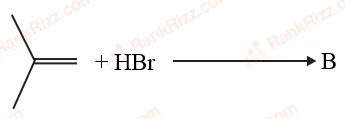
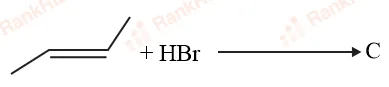
The correct match between Item-I (starting material) and Item-II (reagent) for the preparation of benzaldehyde is:
Item-I Item-II
(I) Benzene (P) HCl and ,
(II) Benzonitrile (Q) , , S and quinoline
(III) Benzoyl Chloride (R) Co, HCl and
(I)-(Q), (II)-(R) and (III)-(P)
(I)-(P), (II)-(Q) and (III)-(R)
(I)-(R), (II)-(P) and (III)-(Q)
(I)-(R), (II)-(Q) and (III)-(P)
Which of the following compounds can be prepared in good yield by Gabriel phthalimide synthesis?
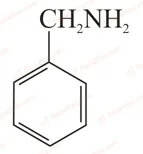
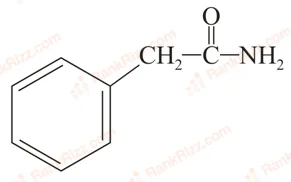
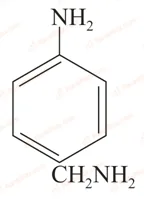
The correct match between item-I and item-II is:
Item-I Item-II
(a) Natural rubber (I) 1,3-butadiene + styrene
(b) Neoprene (II) 1,3-butadiene
(c) Buna-N (III) chloroprene
(d) Buna-S (IV) Isoprene
(a)-(III), (b)-(IV), (c)-(I), (d)-(II)
(a)-(III), (b)-(IV), (c)-(II), (d)-(I)
(a)-(IV), (b)-(III), (c)-(II), (d)-(I)
(a)-(IV), (b)-(III), (c)-(I), (d)-(II)
Which one of the following statement is not true?
Lactose contains -glycosidic linkage between of galactose and of glucose
Lactose is a reducing sugar and it gives Fehling's test
Lactose is a disaccharide and it contains 8 hydroxyl groups
On acid hydrolysis, lactose gives one molecule of D(+)-glucose and one molecule of D(+)-galactose
The atomic number of Unnilunium is______.
If the solubility product of is , then the solubility of in pure water is ______ [Assuming that neither kind of ion reacts with water]
The rate of a reaction decreased by 3.555 times when the temperature was changed from to . The activation energy (in ) of the reaction is______.
For Freundlich adsorption isotherm, a plot of (y-axis) and (x-axis) gives a straight line, the intercept and slope for the line is 0.4771 and 2, respectively. The mass of gas, adsorbed per gram of adsorbent if the initial pressure is 0.04 atm is ______ .
A solution of phenol in chloroform when treated with aqueous NaOH gives compound P as a major product. The mass percentage of carbon in P is______.