RankRizz

JEE Main 08 Apr 2019, Shift 2: Chemistry

The 30 Chemistry questions of JEE Main 08 Apr 2019, Shift 2, numbered across the whole paper. Pick an answer on any question to check it against the key. Free to read, nothing to download.

Chemistry

Q31Stoichiometry, limiting reagent and percentage yieldTRANSCRIBED

The percentage composition of carbon by mole in methane is:

  1. A

    75 %

  2. B

    20 %

  3. C

    80 %

  4. D

    25 %

Q32Mole concept, atomic and molar massTRANSCRIBED

0.27 g of a long chain fatty acid was dissolved in 100 cm3^3 of hexane. 10 mL of this solution was added dropwise to the surface of water in a round watch glass. Hexane evaporates and a monolayer is formed. The distance from edge to centre of the watch glass is 10 cm. What is the height of the monolayer?
[Density of fatty acid = 0.9 g cm−3^{-3}; π=3\pi = 3]

  1. A

    10−410^{-4} m

  2. B

    10−610^{-6} m

  3. C

    10−810^{-8} m

  4. D

    10−210^{-2} m

Q33Electromagnetic radiation, Planck's quantum theory and photoelectric effectTRANSCRIBED

If p is the momentum of the fastest electron ejected from a metal surface after the irradiation of light having wavelength λ\lambda, then for 1.5 p momentum of the photoelectron, the wavelength of the light should be: (Assume kinetic energy of ejected photoelectron to be very high in comparison to work function)

  1. A

    49λ\frac{4}{9}\lambda

  2. B

    34λ\frac{3}{4}\lambda

  3. C

    23λ\frac{2}{3}\lambda

  4. D

    12λ\frac{1}{2}\lambda

Q34Modern periodic table and classification of elementsTRANSCRIBED

The IUPAC symbol for the element with atomic number 119 would be:

  1. A

    Unh

  2. B

    Uun

  3. C

    Une

  4. D

    Uue

Q35Molecular orbital theory of diatomic speciesTRANSCRIBED

Among the following molecules/ions, C22−C_2^{2-}, N22−N_2^{2-}, O22−O_2^{2-}, O2O_2, which one is diamagnetic and has the shortest bond length?

  1. A

    N22−N_2^{2-}

  2. B

    O22−O_2^{2-}

  3. C

    O2O_2

  4. D

    C22−C_2^{2-}

Q36First law: work, heat and internal energyTRANSCRIBED

5 moles of an ideal gas at 100 K are allowed to undergo reversible compression till its temperature becomes 200 K. If CV=28C_V = 28 J K−1^{-1}, calculate ΔU\Delta U and ΔpV\Delta pV for the process. (R = 8.0 J K−1^{-1} mol−1^{-1})

  1. A

    ΔU=14\Delta U = 14 J; ΔpV=0.8\Delta pV = 0.8 J

  2. B

    ΔU=14\Delta U = 14 kJ; ΔpV=18\Delta pV = 18 kJ

  3. C

    ΔU=14\Delta U = 14 kJ; ΔpV=4\Delta pV = 4 kJ

  4. D

    ΔU=2.8\Delta U = 2.8 kJ; ΔpV=0.8\Delta pV = 0.8 kJ

Q37Law of mass action and equilibrium constants Kc and KpTRANSCRIBED

For the following reaction, equilibrium constants are given:
S(s)+O2(g)⇌SO2(g);K1=1052S(s) + O_2(g) \rightleftharpoons SO_2(g); \quad K_1 = 10^{52}
2S(s)+3O2(g)⇌2SO3(g);K2=101292S(s) + 3O_2(g) \rightleftharpoons 2SO_3(g); \quad K_2 = 10^{129}
The equilibrium constant for the reaction, 2SO2(g)+O2(g)⇌2SO3(g)2SO_2(g) + O_2(g) \rightleftharpoons 2SO_3(g) is:

  1. A

    1015410^{154}

  2. B

    102510^{25}

  3. C

    1018110^{181}

  4. D

    107710^{77}

Q38Hydrogen peroxideTRANSCRIBED

The strength of 11.2 volume solution of H2_2O2_2 is:
[Given that, the molar mass of H = 1 g mol−1^{-1} and O = 16 g mol−1^{-1}]

  1. A

    1.7 %

  2. B

    13.6 %

  3. C

    34 %

  4. D

    3.4 %

Q39Fajans' rules, polarisation and covalent characterTRANSCRIBED

The covalent alkaline earth metal halide X = Cl, Br, I is:

  1. A

    CaX2_2

  2. B

    MgX2_2

  3. C

    SrX2_2

  4. D

    BeX2_2

Q40Structural isomerismTRANSCRIBED

Which of the following compounds will show the maximum 'enol' content?

  1. A

    CH3_3COCH2_2CONH2_2

  2. B

    CH3_3COCH2_2COCH3_3

  3. C

    CH3_3COCH2_2COOC2_2H5_5

  4. D

    CH3_3COCH3_3

Q41Electrophilic aromatic substitutionTRANSCRIBED

Polysubstitution is a major drawback in:

  1. A

    Reimer Tiemann reaction

  2. B

    Friedel Craft's alkylation

  3. C

    Acetylation of aniline

  4. D

    Friedel Craft's acylation

Q42Nucleophilic substitution (SN1 and SN2)TRANSCRIBED

Which one of the following alkenes when treated with HCl yields majorly an anti Markovnikov product?

  1. A

    CH3_3O - CH = CH2_2

  2. B

    Cl - CH = CH2_2

  3. C

    H2_2N - CH = CH2_2

  4. D

    F3_3C - CH = CH2_2

Q43Water pollutionTRANSCRIBED

The maximum prescribed concentration of copper in drinking water is:

  1. A

    3 ppm

  2. B

    5 ppm

  3. C

    0.5 ppm

  4. D

    0.05 ppm

Q44Crystal lattices, unit cells and densityTRANSCRIBED

Consider the bcc unit cells of the solids 1 and 2 with the position of atoms as shown below. The radius of atom B is twice that of atom A. The unit cell edge length is 50% more in solid 2 than in 1. What is the approximate packing efficiency in solid 2?
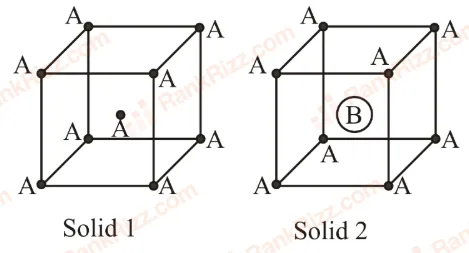
Figure for JEE Main 2019 Chemistry question on Crystal lattices, unit cells and density
  1. A

    90 %

  2. B

    45 %

  3. C

    75 %

  4. D

    65 %

Q45Solubility of gases and Henry's lawTRANSCRIBED

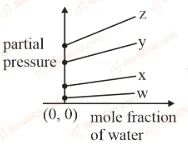
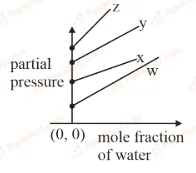
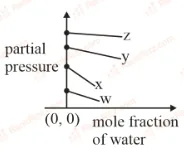
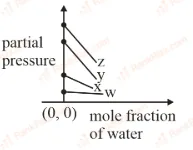
For the solution of the gases w, x, y and z in water at 298 K, the Henry's law constants (KH_H) are 0.5, 2, 35 and 40 kbar, respectively. The correct plot for the given data is:
  1. A
    Figure for JEE Main 2019 Chemistry question on Solubility of gases and Henry's law
  2. B
    Figure for JEE Main 2019 Chemistry question on Solubility of gases and Henry's law
  3. C
    Figure for JEE Main 2019 Chemistry question on Solubility of gases and Henry's law
  4. D
    Figure for JEE Main 2019 Chemistry question on Solubility of gases and Henry's law
Q46Electrode potentials, electrochemical series and cell EMFTRANSCRIBED

Calculate the standard cell potential (in V) of the cell in which the following reaction takes place:
Fe2+^{2+}(aq) + Ag+^+(aq) →\rightarrow Fe3+^{3+}(aq) + Ag(s)
Given that EAg+/Ag0=xE^{0}_{Ag^+/Ag} = x V, EFe2+/Fe0=yE^{0}_{Fe^{2+}/Fe} = y V, EFe3+/Fe0=zE^{0}_{Fe^{3+}/Fe} = z V

  1. A

    x+2y−3zx + 2y - 3z

  2. B

    x−yx - y

  3. C

    x−zx - z

  4. D

    x+y−zx + y - z

Q47Parallel, consecutive and reversible reactionsTRANSCRIBED

For a reaction scheme A →k1\xrightarrow{k_1} B →k2\xrightarrow{k_2} C, if the net rate of formation of B is set to be zero then the concentration of B is given by:

  1. A

    k1+k2[A]k_1 + k_2[A]

  2. B

    k1k2[A]k_1 k_2[A]

  3. C

    k1k2[A]\frac{k_1}{k_2}[A]

  4. D

    k1−k2[A]k_1 - k_2[A]

Q48Refining of metalsTRANSCRIBED

The Mond process is used for the:

  1. A

    Purification of Zr and Ti

  2. B

    Purification of Ni

  3. C

    Extraction of Zn

  4. D

    Extraction of Mo

Q49VSEPR theory and shapes of molecules and ionsTRANSCRIBED

The ion that has sp3^3d2^2 hybridization for the central atom is:

  1. A

    BrF2−_2^{-}

  2. B

    ICl4−_4^{-}

  3. C

    IF6−_6^{-}

  4. D

    ICl2−_2^{-}

Q50VSEPR theory and shapes of molecules and ionsTRANSCRIBED

The correct statement about ICl5_5 and ICl4−_4^{-} is:

  1. A

    ICl5_5 is trigonal bipyramidal and ICl4−_4^{-} is tetrahedral.

  2. B

    Both are isostructural.

  3. C

    ICl5_5 is square pyramidal and ICl4−_4^{-} is tetrahedral.

  4. D

    ICl5_5 is square pyramidal and ICl4−_4^{-} is square planar.

Q51General properties of transition elementsTRANSCRIBED

The statement that is INCORRECT about the interstitial compounds is:

  1. A

    They have high melting points.

  2. B

    They are very hard.

  3. C

    They are chemically reactive.

  4. D

    They have metallic conductivity.

Q52Stability and applications of coordination compoundsTRANSCRIBED

The compound that inhibits the growth of tumors is:

  1. A

    trans-[PtCl2_2(NH3_3)2_2]

  2. B

    cis-[PtCl2_2(NH3_3)2_2]

  3. C

    cis-[PdCl2_2(NH3_3)2_2]

  4. D

    trans-[PdCl2_2(NH3_3)2_2]

Q53Valence bond theory of complexesTRANSCRIBED

The calculated spin-only magnetic moments BM of the anionic and cationic species of FeH2_2O6+2_6^{+2} and Fe(CN)64−_6^{4-} respectively, are:

  1. A

    0 and 4.9

  2. B

    2.84 and 5.92

  3. C

    4.9 and 0

  4. D

    0 and 5.92

Q54Nucleophilic substitution (SN1 and SN2)TRANSCRIBED

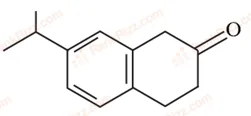
The major product of the following reaction is:
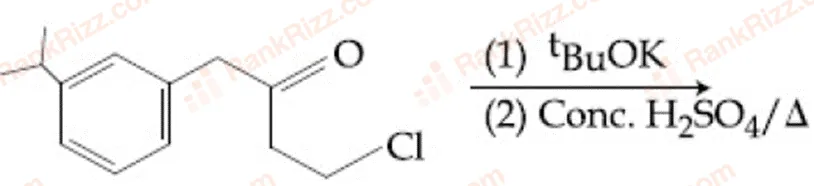
Figure for JEE Main 2019 Chemistry question on Nucleophilic substitution (SN1 and SN2)
  1. A
    Figure for JEE Main 2019 Chemistry question on Nucleophilic substitution (SN1 and SN2)
  2. B
    Figure for JEE Main 2019 Chemistry question on Nucleophilic substitution (SN1 and SN2)
  3. C
    Figure for JEE Main 2019 Chemistry question on Nucleophilic substitution (SN1 and SN2)
  4. D
    Figure for JEE Main 2019 Chemistry question on Nucleophilic substitution (SN1 and SN2)
Q56Diazonium saltsTRANSCRIBED

The major product obtained in the following reaction is:
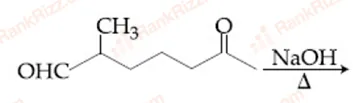
Figure for JEE Main 2019 Chemistry question on Diazonium salts


NaOH, Δ\Delta

  1. A
    Figure for JEE Main 2019 Chemistry question on Diazonium salts
  2. B
    Figure for JEE Main 2019 Chemistry question on Diazonium salts
  3. C
    Figure for JEE Main 2019 Chemistry question on Diazonium salts
  4. D
    Figure for JEE Main 2019 Chemistry question on Diazonium salts
Q57Nucleophilic addition reactions of carbonyl compoundsTRANSCRIBED

The major product obtained in the following reaction is:
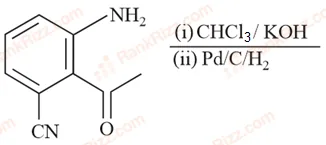
Figure for JEE Main 2019 Chemistry question on Nucleophilic addition reactions of carbonyl compounds
  1. A
    Figure for JEE Main 2019 Chemistry question on Nucleophilic addition reactions of carbonyl compounds
  2. B
    Figure for JEE Main 2019 Chemistry question on Nucleophilic addition reactions of carbonyl compounds
  3. C
    Figure for JEE Main 2019 Chemistry question on Nucleophilic addition reactions of carbonyl compounds
  4. D
    Figure for JEE Main 2019 Chemistry question on Nucleophilic addition reactions of carbonyl compounds
Q58Electrophilic substitution of anilineTRANSCRIBED

The major product in the following reaction is:
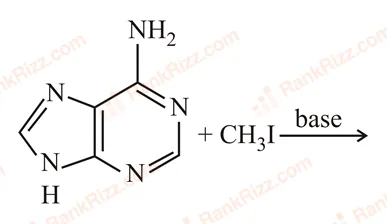
Figure for JEE Main 2019 Chemistry question on Electrophilic substitution of aniline
  1. A
    Figure for JEE Main 2019 Chemistry question on Electrophilic substitution of aniline
  2. B
    Figure for JEE Main 2019 Chemistry question on Electrophilic substitution of aniline
  3. C
    Figure for JEE Main 2019 Chemistry question on Electrophilic substitution of aniline
  4. D
    Figure for JEE Main 2019 Chemistry question on Electrophilic substitution of aniline
Q60Carbohydrates: classification and monosaccharidesTRANSCRIBED

Fructose and glucose can be distinguished by:

  1. A

    Fehling's test

  2. B

    Benedict's test

  3. C

    Barfoed's test

  4. D

    Seliwanoff's test

NEXT IN THIS PAPER →Maths, Q61 onwards