RankRizz

JEE Main 10 Apr 2019, Shift 1: Maths

The 30 Maths questions of JEE Main 10 Apr 2019, Shift 1, numbered across the whole paper. Pick an answer on any question to check it against the key. Free to read, nothing to download.

Maths

Q61Relation between roots and coefficientsTRANSCRIBED

If α\alpha and β\beta are the roots of the quadratic equation x2+xsin⁡θ−2sin⁡θ=0x^2 + x\sin\theta - 2\sin\theta = 0, θ∈(0,π2)\theta \in \left(0, \frac{\pi}{2}\right), then α12+β12(α−12+β−12)⋅(α−β)24\frac{\alpha^{12} + \beta^{12}}{(\alpha^{-12} + \beta^{-12})\cdot(\alpha - \beta)^{24}} is equal to:

  1. A

    26(sin⁡θ+8)12\frac{2^6}{(\sin\theta + 8)^{12}}

  2. B

    212(sin⁡θ−4)12\frac{2^{12}}{(\sin\theta - 4)^{12}}

  3. C

    212(sin⁡θ+8)12\frac{2^{12}}{(\sin\theta + 8)^{12}}

  4. D

    212(sin⁡θ−8)6\frac{2^{12}}{(\sin\theta - 8)^6}

Q62Modulus and conjugateTRANSCRIBED

If a>0a > 0 and z=(1+i)2a−iz = \frac{(1+i)^2}{a-i}, has magnitude 25\sqrt{\frac{2}{5}}, then zˉ\bar{z} is equal to:

  1. A

    −15−35i-\frac{1}{5} - \frac{3}{5}i

  2. B

    −35−15i-\frac{3}{5} - \frac{1}{5}i

  3. C

    15−35i\frac{1}{5} - \frac{3}{5}i

  4. D

    −15+35i-\frac{1}{5} + \frac{3}{5}i

Q63Arrangements with restrictionsTRANSCRIBED

The number of 6 digit numbers that can be formed using the digits 0, 1, 2, 5, 7 and 9 which are divisible by 11 and no digit is repeated is:

  1. A

    36

  2. B

    60

  3. C

    72

  4. D

    48

Q64Arithmetic progressionTRANSCRIBED

If a1,a2,a3,…,ana_1, a_2, a_3, \ldots, a_n are in A.P. and a1+a4+a7+…+a16=114a_1 + a_4 + a_7 + \ldots + a_{16} = 114, then a1+a6+a11+a16a_1 + a_6 + a_{11} + a_{16} is equal to:

  1. A

    64

  2. B

    98

  3. C

    38

  4. D

    76

Q65Sums of natural numbers, squares and cubesTRANSCRIBED

The sum 3×1312+5×(13+23)12+22+7×(13+23+33)12+22+32+…\frac{3 \times 1^3}{1^2} + \frac{5 \times (1^3 + 2^3)}{1^2 + 2^2} + \frac{7 \times (1^3 + 2^3 + 3^3)}{1^2 + 2^2 + 3^2} + \ldots upto 10th^{th} term is

  1. A

    660

  2. B

    600

  3. C

    620

  4. D

    680

Q66Sums of binomial coefficientsTRANSCRIBED

If the coefficients of x2x^2 and x3x^3 are both zero, in the expansion of the expression (1+ax+bx2)(1−3x)15(1 + ax + bx^2)(1 - 3x)^{15}, in powers of x, then the ordered pair (a, b) is equal to

  1. A

    (28, 315)

  2. B

    (-21, 714)

  3. C

    (28, 861)

  4. D

    (-54, 315)

Q67Equations with parameters and trigonometric inequalitiesTRANSCRIBED

All the pairs (x, y), that satisfy the inequality 2sin⁡2x−2sin⁡x+5⋅14sin⁡2y≤12^{\sqrt{\sin^2 x - 2\sin x + 5}} \cdot \frac{1}{4^{\sin^2 y}} \leq 1 also satisfy the equation:

  1. A

    2sin⁡x=sin⁡y2\sin x = \sin y

  2. B

    sin⁡x=2sin⁡y\sin x = 2\sin y

  3. C

    ∣sin⁡x∣=∣sin⁡y∣|\sin x| = |\sin y|

  4. D

    2∣sin⁡x∣=3sin⁡y2|\sin x| = 3\sin y

Q68Tangents and normals to a circleTRANSCRIBED

The line x=yx = y touches a circle at the point (1, 1). If the circle also passes through the point (1, -3), then its radius is

  1. A

    323\sqrt{2}

  2. B

    3

  3. C

    2

  4. D

    222\sqrt{2}

Q69Position of two circles and common tangentsTRANSCRIBED

If the circles x2+y2+5Kx+2y+K=0x^2 + y^2 + 5Kx + 2y + K = 0 and 2(x2+y2)+2Kx+3y−1=02(x^2 + y^2) + 2Kx + 3y - 1 = 0, (K ∈ R), intersect at the points P and Q, then the line 4x+5y−K=04x + 5y - K = 0, passes through P and Q, for:

  1. A

    exactly two values of K

  2. B

    no value of K

  3. C

    exactly one value of K

  4. D

    infinitely many values of K

Q70Tangents to an ellipseTRANSCRIBED

If the line x−2y=12x - 2y = 12 is a tangent to the ellipse x2a2+y2b2=1\frac{x^2}{a^2} + \frac{y^2}{b^2} = 1 at the point (3,−92)\left(3, -\frac{9}{2}\right), then the length of the latus rectum of the ellipse is

  1. A

    5 units

  2. B

    12212\sqrt{2} units

  3. C

    9 units

  4. D

    838\sqrt{3} units

Q71Standard hyperbola and basic propertiesTRANSCRIBED

If a directrix of a hyperbola centered at the origin and passing through the point (4,−23)(4, -2\sqrt{3}) is 5x=455x = 4\sqrt{5} and its eccentricity is e, then:

  1. A

    4e4+8e2−35=04e^4 + 8e^2 - 35 = 0

  2. B

    4e4−24e2+35=04e^4 - 24e^2 + 35 = 0

  3. C

    4e4−24e2+27=04e^4 - 24e^2 + 27 = 0

  4. D

    4e4−12e2−27=04e^4 - 12e^2 - 27 = 0

Q72Limits of algebraic functionsTRANSCRIBED

If lim⁡x→1x4−1x−1=lim⁡x→kx3−k3x2−k2\lim_{x \to 1}\frac{x^4 - 1}{x - 1} = \lim_{x \to k}\frac{x^3 - k^3}{x^2 - k^2}, then k is

  1. A

    32\frac{3}{2}

  2. B

    43\frac{4}{3}

  3. C

    38\frac{3}{8}

  4. D

    83\frac{8}{3}

Q73Logical connectives, truth tables and tautologiesTRANSCRIBED

Which one of the following Boolean expression is a tautology?

  1. A

    (p∨q)∧(∼p∨∼q)(p \vee q) \wedge (\sim p \vee \sim q)

  2. B

    (p∧q)∨(p∧∼q)(p \wedge q) \vee (p \wedge \sim q)

  3. C

    (p∨q)∧(p∨∼q)(p \vee q) \wedge (p \vee \sim q)

  4. D

    (p∨q)∨(∼p∨∼q)(p \vee q) \vee (\sim p \vee \sim q)

Q74Mean, median and modeTRANSCRIBED

If for some x∈x \in R, the frequency distribution of the marks obtained by 20 students in a test is:

Figure for JEE Main 2019 Mathematics question on Mean, median and mode

Then the mean of the marks is:

  1. A

    3.0

  2. B

    2.5

  3. C

    3.2

  4. D

    2.8

Q75Heights and distancesTRANSCRIBED

ABC is a triangular park with AB = AC = 100 metres. A vertical tower is situated at the mid-point of BC. If the angles of elevation of the top of the tower at A and B are cot⁡−1(32)\cot^{-1}(3\sqrt{2}) and cosec−1(22)\text{cosec}^{-1}(2\sqrt{2}) respectively, then the height of the tower (in metres) is

  1. A

    10033\frac{100}{3\sqrt{3}}

  2. B

    20

  3. C

    25

  4. D

    10510\sqrt{5}

Q76Systems of linear equationsTRANSCRIBED

If the system of linear equations x+y+z=5x + y + z = 5, x+2y+2z=6x + 2y + 2z = 6, x+3y+λz=μx + 3y + \lambda z = \mu, (λ,μ∈\lambda, \mu \in R), has infinitely many solutions, then the value of λ+μ\lambda + \mu is:

  1. A

    7

  2. B

    10

  3. C

    12

  4. D

    9

Q77Evaluation of determinantsTRANSCRIBED

If Δ1=∣xsin⁡θcos⁡θ−sin⁡θ−x1cos⁡θ1x∣\Delta_1 = \begin{vmatrix} x & \sin\theta & \cos\theta \\ -\sin\theta & -x & 1 \\ \cos\theta & 1 & x \end{vmatrix} and Δ2=∣xsin⁡2θcos⁡2θ−sin⁡2θ−x1cos⁡2θ1x∣\Delta_2 = \begin{vmatrix} x & \sin 2\theta & \cos 2\theta \\ -\sin 2\theta & -x & 1 \\ \cos 2\theta & 1 & x \end{vmatrix}, x≠0x \neq 0; then for all θ∈(0,π2)\theta \in \left(0, \frac{\pi}{2}\right):

  1. A

    Δ1+Δ2=−2(x3+x−1)\Delta_1 + \Delta_2 = -2(x^3 + x - 1)

  2. B

    Δ1−Δ2=x(cos⁡2θ−cos⁡4θ)\Delta_1 - \Delta_2 = x(\cos 2\theta - \cos 4\theta)

  3. C

    Δ1+Δ2=−2x3\Delta_1 + \Delta_2 = -2x^3

  4. D

    Δ1−Δ2=−2x3\Delta_1 - \Delta_2 = -2x^3

Q78Composite functionsTRANSCRIBED

Let f(x)=x2f(x) = x^2, x∈Rx \in R. For any A⊆RA \subseteq R, define g(A)={x∈R:f(x)∈A}g(A) = \{x \in R : f(x) \in A\}. If S=[0,4]S = [0, 4], then which one of the following statements is not true?

  1. A

    g(f(S))≠Sg(f(S)) \neq S

  2. B

    f(g(S))≠f(S)f(g(S)) \neq f(S)

  3. C

    f(g(S))=Sf(g(S)) = S

  4. D

    g(f(S))=g(S)g(f(S)) = g(S)

Q79Differentiability at a pointTRANSCRIBED

Let f:R→Rf : R \to R be differentiable at c∈Rc \in R and f(c)=0f(c) = 0. If g(x)=∣f(x)∣g(x) = |f(x)|, then at x=cx = c, g is:

  1. A

    not differentiable

  2. B

    not differentiable if f′(c)=0f'(c) = 0

  3. C

    differentiable if f′(c)=0f'(c) = 0

  4. D

    differentiable if f′(c)≠0f'(c) \neq 0

Q80Continuity at a pointTRANSCRIBED

If f(x)={sin⁡(p+1)x+sin⁡xx,x<0q,x=0x+x2−xx3/2,x>0f(x) = \begin{cases} \frac{\sin(p+1)x + \sin x}{x}, & x < 0 \\ q, & x = 0 \\ \frac{\sqrt{x + x^2} - \sqrt{x}}{x^{3/2}}, & x > 0 \end{cases} is continuous at x=0x = 0, then the ordered pair (p, q) is equal to:

  1. A

    (−32,12)\left(-\frac{3}{2}, \frac{1}{2}\right)

  2. B

    (−12,32)\left(-\frac{1}{2}, \frac{3}{2}\right)

  3. C

    (52,12)\left(\frac{5}{2}, \frac{1}{2}\right)

  4. D

    (−12,12)\left(-\frac{1}{2}, \frac{1}{2}\right)

Q81Composite functionsTRANSCRIBED

Let f(x)=ex−xf(x) = e^x - x and g(x)=x2−xg(x) = x^2 - x, ∀\forall x ∈ R. Then the set of all x ∈ R, where the function h(x)=(f∘g)(x)h(x) = (f \circ g)(x) is increasing, is:

  1. A

    [−1,−12]∪[12,∞)\left[-1, -\frac{1}{2}\right] \cup \left[\frac{1}{2}, \infty\right)

  2. B

    [0,∞)[0, \infty)

  3. C

    [0,12]∪[1,∞)\left[0, \frac{1}{2}\right] \cup [1, \infty)

  4. D

    [−12,0]∪[1,∞)\left[-\frac{1}{2}, 0\right] \cup [1, \infty)

Q82Integration by substitutionTRANSCRIBED

If ∫dx(x2−2x+10)2=A(tan⁡−1(x−13)+f(x)x2−2x+10)+C\int \frac{dx}{(x^2 - 2x + 10)^2} = A\left(\tan^{-1}\left(\frac{x-1}{3}\right) + \frac{f(x)}{x^2 - 2x + 10}\right) + C, then (where C is a constant of integration)

  1. A

    A=127A = \frac{1}{27} and f(x)=9(x−1)f(x) = 9(x - 1)

  2. B

    A=181A = \frac{1}{81} and f(x)=3(x−1)f(x) = 3(x - 1)

  3. C

    A=154A = \frac{1}{54} and f(x)=9(x−1)2f(x) = 9(x - 1)^2

  4. D

    A=154A = \frac{1}{54} and f(x)=3(x−1)f(x) = 3(x - 1)

Q83Definite integrals: properties and King's ruleTRANSCRIBED

The value of ∫02π[sin⁡2x(1+cos⁡3x)]dx\int_0^{2\pi} [\sin 2x(1 + \cos 3x)]dx, where [t] denotes the greatest integer function is

  1. A

    π\pi

  2. B

    2π2\pi

  3. C

    −π-\pi

  4. D

    −2π-2\pi

Q84Definite integral as limit of a sumTRANSCRIBED

lim⁡n→∞((n+1)1/3n4/3+(n+2)1/3n4/3+…+(2n)1/3n4/3)\lim_{n \to \infty}\left(\frac{(n+1)^{1/3}}{n^{4/3}} + \frac{(n+2)^{1/3}}{n^{4/3}} + \ldots + \frac{(2n)^{1/3}}{n^{4/3}}\right) is equal to

  1. A

    34(2)4/3−34\frac{3}{4}(2)^{4/3} - \frac{3}{4}

  2. B

    43(2)3/4\frac{4}{3}(2)^{3/4}

  3. C

    43(2)4/3\frac{4}{3}(2)^{4/3}

  4. D

    34(2)4/3−43\frac{3}{4}(2)^{4/3} - \frac{4}{3}

Q85Equations of a line in various formsTRANSCRIBED

The region represented by ∣x−y∣≤2|x - y| \leq 2 and ∣x+y∣≤2|x + y| \leq 2 is bounded by a

  1. A

    rhombus of area 828\sqrt{2} sq. units

  2. B

    rhombus of side length 2 units

  3. C

    square of area 16 sq. units

  4. D

    square of side length 222\sqrt{2} units

Q86Linear first-order differential equationsTRANSCRIBED

If y=y(x)y = y(x) is the solution of the differential equation dydx=(tan⁡x−y)sec⁡2x\frac{dy}{dx} = (\tan x - y)\sec^2 x, x∈(−π2,π2)x \in \left(-\frac{\pi}{2}, \frac{\pi}{2}\right), such that y(0)=0y(0) = 0, then y(−π4)y\left(-\frac{\pi}{4}\right) is equal to:

  1. A

    1e−2\frac{1}{e} - 2

  2. B

    2+1e2 + \frac{1}{e}

  3. C

    e−2e - 2

  4. D

    12−e\frac{1}{2} - e

Q87Scalar (dot) productTRANSCRIBED

Let A(3, 0, -1), B(2, 10, 6) and C(1, 2, 1) be the vertices of a triangle and M be the mid-point of AC. If G divides BM in the ratio, 2 : 1, then cos⁡(∠GOA)\cos(\angle GOA) (O being the origin) is equal to

  1. A

    130\frac{1}{\sqrt{30}}

  2. B

    1610\frac{1}{6\sqrt{10}}

  3. C

    115\frac{1}{\sqrt{15}}

  4. D

    1215\frac{1}{2\sqrt{15}}

Q88Foot of perpendicular, image and distance from a lineTRANSCRIBED

If the length of the perpendicular from the point (β,0,β)(\beta, 0, \beta), (β≠0\beta \neq 0) to the line, x1=y−10=z+1−1\frac{x}{1} = \frac{y-1}{0} = \frac{z+1}{-1} is 32\sqrt{\frac{3}{2}}, then β\beta is equal to

  1. A

    2

  2. B

    -1

  3. C

    -2

  4. D

    1

Q89Distance, foot and image with respect to a planeTRANSCRIBED

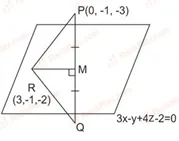
If Q(0, -1, -3) is the image of the point P in the plane 3x−y+4z=23x - y + 4z = 2 and R is the point (3, -1, -2), then the area (in sq. units) of △PQR\triangle PQR is

Figure for JEE Main 2019 Mathematics question on Distance, foot and image with respect to a plane
  1. A

    914\frac{\sqrt{91}}{4}

  2. B

    912\frac{\sqrt{91}}{2}

  3. C

    2132\sqrt{13}

  4. D

    652\frac{\sqrt{65}}{2}

Q90Conditional probability and multiplication theoremTRANSCRIBED

Assume that each born child is equally likely to be a boy or girl. If two families have two children each, then the conditional probability that all children are girls given that at least two are girls is:

  1. A

    112\frac{1}{12}

  2. B

    110\frac{1}{10}

  3. C

    111\frac{1}{11}

  4. D

    117\frac{1}{17}