Q31Stoichiometry, limiting reagent and percentage yieldTRANSCRIBED
At 300 K and 1 atm, 15 mL of a gaseous hydrocarbon requires 375 mL air containing 20% O2 by volume, for complete combustion. After combustion, the gases occupy 345 mL. Assuming that the water formed is in liquid form and the volumes were measured at the same temperature and pressure, the formula of the hydrocarbon is: (Assume complete combustion of reactant)
- A
- B
- C
- D
Q32de Broglie wavelength and Heisenberg uncertainty principleTRANSCRIBED
A stream of electrons from a heat filament was passed between two charge plates kept at a potential difference V esu. If e and m are charge and mass of an electron, respectively, then the value of λh (where λ is wavelength associated with the electron wave) is given by:
- A
- B
- C
- D
Q33Ionisation enthalpyTRANSCRIBED
Which of the following atoms has the highest first ionization energy?
- A
- B
- C
- D
Q34VSEPR theory and shapes of molecules and ionsTRANSCRIBED
The species in which the N atom is in a state of sp hybridization is:
- A
- B
- C
- D
Q35Gas laws and ideal gas equationTRANSCRIBED
Two closed bulbs of equal volume (V) containing an ideal gas initially at pressure pi and temperature T1 are connected through a narrow tube of negligible volume, as shown in the figure below. The temperature of one of the bulbs is then raised to T2. The final pressure Pf is:
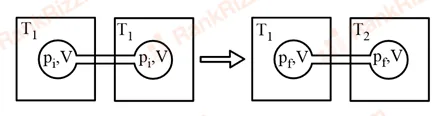
- A
2pi(T1+T2T2)
- B
2pi(T1+T2T1T2)
- C
pi(T1+T2T1T2)
- D
2pi(T1+T2T1)
Q36Enthalpies of reaction and Hess's lawTRANSCRIBED
The heats of combustion of carbon and carbon monoxide are −393.5 and −283.5 kJ mol−1, respectively. The heat of formation (in kJ) of carbon monoxide per mole is:
- A
- B
- C
- D
Q37Law of mass action and equilibrium constants Kc and KpTRANSCRIBED
The equilibrium constant at 298 K for a reaction A+B⇌C+D is 100. If the initial concentration of all the four species were 1 M each, then the equilibrium concentration of D (in mol L−1) will be:
- A
- B
- C
- D
Q38Water and heavy waterTRANSCRIBED
Which of the following statements about water is FALSE?
- A
There is extensive intramolecular hydrogen bonding in the condensed phase.
- B
Ice formed by heavy water sinks in normal water.
- C
Water is oxidized to oxygen during photosynthesis
- D
Water can act both as an acid and as a base
Q39Alkali metals: properties and trendsTRANSCRIBED
The main oxides formed on combustion of Li, Na and K in excess of air are respectively:
- A
Li2O2, Na2O2 and KO2
- B
Li2O, Na2O2 and KO2
- C
Li2O, Na2O and KO2
- D
LiO2, Na2O2 and K2O
Q40Structural isomerismTRANSCRIBED
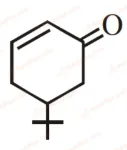
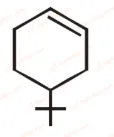
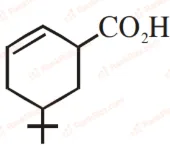
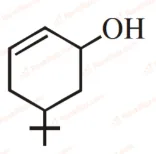
The absolute configuration of

is:
- A
- B
- C
- D
Q41Methods of purification of organic compoundsTRANSCRIBED
The distillation technique most suited for separating glycerol from spent - lye in the soap industry is:
- A
- B
Distillation under reduced pressure
- C
- D
Q42Electrophilic addition to alkenesTRANSCRIBED
The reaction of propene with HOCl (Cl2+H2O) proceeds through the intermediate:
- A
CH3−CH(OH)−CH2+
- B
CH3−CHCl−CH2+
- C
CH3−CH+−CH2−OH
- D
CH3−CH+−CH2−Cl
Q43Water pollutionTRANSCRIBED
The concentration of fluoride, lead, nitrate and iron in a water sample from an underground lake was found to be 1000 ppb, 40 ppb, 100 ppm and 0.2 ppm, respectively. This water is unsuitable for drinking due to high concentration of:
- A
- B
- C
- D
Q44Relative lowering of vapour pressureTRANSCRIBED
18 g glucose (C6H12O6) is added to 178.2 g water. The vapour pressure of water (in torr) for this aqueous solution is:
- A
- B
- C
- D
Q45Batteries, fuel cells and corrosionTRANSCRIBED
Galvanization is applying a coating of:
- A
- B
- C
- D
Q46Integrated rate laws and half-life (zero and first order)TRANSCRIBED
Decomposition of H2O2 follows a first order reaction. In fifty minutes the concentration of H2O2 decreases from 0.5 to 0.125 M in one such decomposition. When the concentration of H2O2 reaches 0.05 M, the rate of formation of O2 will be:
- A
2.66 L min−1 at STP
- B
1.34×10⁻² mol min−1
- C
6.93×10⁻² mol min−1
- D
6.93×10⁻⁴ mol min−1
Q47Adsorption and adsorption isothermsTRANSCRIBED
For a linear plot of log (mx) versus log p in a Freundlich adsorption isotherm, which of the following statements is correct? (k and n are constants)
- A
Only n1 appears as the slope.
- B
log(n1) appears as the intercept.
- C
Both k and n1 appear in the slope term.
- D
n1 appears as the intercept.
Q48Alkali metals: properties and trendsTRANSCRIBED
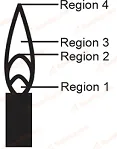
The hottest region of Bunsen flame shown in the figure below is:
- A
- B
- C
- D
Q49Concentration of ores, calcination and roastingTRANSCRIBED
Which one of the following ores is best concentrated by froth flotation method?
- A
- B
- C
- D
Q50Group 15: trends and hydridesTRANSCRIBED
The pair in which phosphorous atoms have a formal oxidation state of +3 is:
- A
Orthophosphorous and hypophospheric acids
- B
Pyrophosphorous and pyrophosphoric acids
- C
Orthophosphorous and pyrophosphorous acids
- D
Pyrophosphorous and hypophosphoric acids
Q51Dinitrogen, ammonia, nitric acid and oxides of nitrogenTRANSCRIBED
The reaction of zinc with dilute and concentrated nitric acid, respectively, produces:
- A
- B
NO2 and N2O
- C
N2O and NO2
- D
Q52General properties of transition elementsTRANSCRIBED
Find the metallic and ferromagnetic substance.
- A
- B
- C
- D
Q53Structural isomerism in complexesTRANSCRIBED
Which one of the following complexes shows optical isomerism? (en=ethylenediamine)
- A
trans [Co(en)2Cl2] Cl
- B
[Co(NH3)4Cl2] Cl
- C
[Co(NH3)3Cl3]
- D
cis [Co(en)2Cl2] Cl
Q54Valence bond theory of complexesTRANSCRIBED
The pair having the same magnetic moment is: [At. No.: Cr = 24, Mn = 25, Fe = 26, Co = 27]
- A
[Mn(H2O)6]2+ and [Cr(H2O)6]2+
- B
[CoCl4]2− and [Fe(H2O)6]2+
- C
[Cr(H2O)6]2+ and [CoCl4]2−
- D
[Cr(H2O)6]2+ and [Fe(H2O)6]2+
Q55Reactions of phenolsTRANSCRIBED
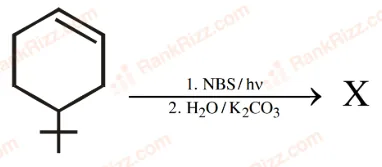
The product of the reaction given below is:
- A
- B
- C
- D
Q56Properties and reactions of alcoholsTRANSCRIBED
2-chloro-2-methylpentane on reaction with sodium methoxide in methanol yields:
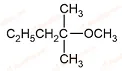
(i)
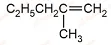
(ii)
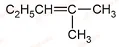
(iii)
- A
- B
- C
- D
Q57Reactions and tests of aminesTRANSCRIBED
In the Hoffmann bromamide degradation reaction, the number of moles of NaOH and Br2 used per mole of amine produced are:
- A
Two moles of NaOH and two moles of Br2
- B
Four moles of NaOH and one mole of Br2
- C
One mole of NaOH and one mole of Br2
- D
Four moles of NaOH and two moles of Br2
Q58Important polymers and their monomersTRANSCRIBED
Which of the following statements about low density polythene is FALSE?
- A
Its synthesis required dioxygen or a peroxide initiator as a catalyst
- B
It is used in the manufacture of buckets, dust-bins etc.
- C
Its synthesis requires high pressure
- D
It is a poor conductor of electricity
Q59Soaps and detergentsTRANSCRIBED
Which of the following is an anionic detergent?
- A
Cetyltrimethyl ammonium bromide
- B
- C
hexadecyltrimethyl ammonium bromide
- D
Q60Proteins and enzymesTRANSCRIBED
Thiol group is present in:
- A
- B
- C
- D