RankRizz

JEE Main 04 Apr 2015, Offline: Chemistry

The 30 Chemistry questions of JEE Main 04 Apr 2015, Offline, numbered across the whole paper. Pick an answer on any question to check it against the key. Free to read, nothing to download.

Chemistry

Q31Mole concept, atomic and molar massTRANSCRIBED

The molecular formula of a commercial resin used for exchanging ions in water softening is C8H7SO3NaC_8H_7SO_3Na (molecular weight = 206). What would be the maximum uptake of Ca2+Ca^{2+} ions by the resin if expressed in mol per gm?

  1. A

    1412\frac{1}{412}

  2. B

    1103\frac{1}{103}

  3. C

    1206\frac{1}{206}

  4. D

    2309\frac{2}{309}

Q32Bohr model of hydrogen-like speciesTRANSCRIBED

Which of the following is the energy of a possible excited state of hydrogen?

  1. A

    +6.8 eV

  2. B

    +13.6 eV

  3. C

    -6.8 eV

  4. D

    -3.4 eV

Q33Atomic and ionic radiiTRANSCRIBED

The ionic radii (in A˚\mathring{A}) of N3−N^{3-}, O2−O^{2-} and F−F^{-} are respectively:

  1. A

    1.71, 1.36 and 1.40

  2. B

    1.36, 1.40 and 1.71

  3. C

    1.36, 1.71 and 1.40

  4. D

    1.71, 1.40 and 1.36

Q34Hydrogen bonding and intermolecular forcesTRANSCRIBED

The intermolecular interaction that is dependent on the inverse cube of distance between the molecules is:

  1. A

    Hydrogen bond

  2. B

    Ion-ion interaction

  3. C

    Ion-dipole interaction

  4. D

    London force

Q35Gibbs energy and spontaneityTRANSCRIBED

The following reaction is performed at 298 K.
2NO(g)+O2(g)⇌2NO2(g)2NO(g) + O_2(g) \rightleftharpoons 2NO_2(g)
The standard free energy of the formation of NO(g)NO(g) is 86.6 kJ mol−1^{-1} at 298 K. What is the standard free energy of the formation of NO2(g)NO_2(g) at 298 K? (KP=1.6×10¹²)(K_P = 1.6 \times 10^{12})

  1. A

    0.5[2×86,600−R(298)ln⁡(1.6×10¹²)]0.5[2 \times 86,600 - R(298)\ln(1.6 \times 10^{12})]

  2. B

    R(298)ln⁡(1.6×10¹²)−86,600R(298)\ln(1.6 \times 10^{12}) - 86,600

  3. C

    86,600+R(298)ln⁡(1.6×10¹²)86,600 + R(298)\ln(1.6 \times 10^{12})

  4. D

    86,600−ln⁡(1.6×10¹²)R(298)86,600 - \frac{\ln(1.6 \times 10^{12})}{R(298)}

Q36Law of mass action and equilibrium constants Kc and KpTRANSCRIBED

The standard Gibbs energy change at 300 K for the reaction 2A⇌B+C2A \rightleftharpoons B + C is 2494.2 J. At a given time, the composition of the reaction mixture is [A]=12[A] = \frac{1}{2}, [B]=2[B] = 2 and [C]=12[C] = \frac{1}{2}. The reaction proceeds in the:
[R = 8.314 J/K-mol, e = 2.718] {Given antilog (-0.44) = 0.36}

  1. A

    Reverse direction because Q<KCQ < K_C

  2. B

    Forward direction because Q>KCQ > K_C

  3. C

    Reverse direction because Q>KCQ > K_C

  4. D

    Forward direction because Q<KCQ < K_C

Q37Hydrogen peroxideTRANSCRIBED

From the following statements, choose the incorrect statement regarding H2O2H_2O_2.

  1. A

    It has to be kept away from dust.

  2. B

    It can act only as an oxidising agent.

  3. C

    It decomposes on exposure to light.

  4. D

    It has to be stored in plastic or wax-lined glass bottles in the dark.

Q38Alkaline earth metals: properties and trendsTRANSCRIBED

Which one of the following alkaline earth metal sulphates has its hydration enthalpy greater than its lattice enthalpy?

  1. A

    SrSO4SrSO_4

  2. B

    CaSO4CaSO_4

  3. C

    BeSO4BeSO_4

  4. D

    BaSO4BaSO_4

Q39Methods of purification of organic compoundsTRANSCRIBED

In Carius method of estimation of halogens, 250 mg of an organic compound gave 141 mg AgBr. What is the percentage of bromine in the compound (atomic mass of Ag = 108 and atomic number of Br = 80)?

  1. A

    60

  2. B

    24

  3. C

    36

  4. D

    48

Q40Optical isomerism and chiralityTRANSCRIBED

Which of the following compounds will exhibit geometrical isomerism?

  1. A

    1, 1 - Diphenyl - 1 - propane

  2. B

    1 - Phenyl - 2 - butene

  3. C

    3 - Phenyl - 1 - butene

  4. D

    2 - Phenyl - 1 - butene

Q41Group 16: trends, dioxygen, ozone and oxidesTRANSCRIBED

Assertion: Nitrogen and Oxygen are the main components in the atmosphere but these do not react to form oxides of nitrogen.
Reason: The reaction between nitrogen and oxygen requires high temperature.

  1. A

    Both the Assertion and Reason are incorrect.

  2. B

    Both Assertion and Reason are correct and the Reason is the correct explanation for the Assertion.

  3. C

    Both Assertion and Reason are correct, but the Reason is not the correct explanation for the Assertion.

  4. D

    The Assertion is incorrect but the Reason is correct.

Q42Crystal lattices, unit cells and densityTRANSCRIBED

Sodium metal crystallizes in a body centred cubic lattice with a unit cell edge of 4.29 A˚\mathring{A}. The radius of sodium atom is approximately:

  1. A

    0.93 A˚\mathring{A}

  2. B

    1.86 A˚\mathring{A}

  3. C

    3.22 A˚\mathring{A}

  4. D

    5.72 A˚\mathring{A}

Q43Relative lowering of vapour pressureTRANSCRIBED

The vapour pressure of acetone at 20∘^\circC is 185 torr. When 1.2 g of a non-volatile substance was dissolved in 100 g of acetone at 20∘^\circC, its vapour pressure was 183 torr. The molar mass (g mol−1^{-1}) of the substance is:

  1. A

    488

  2. B

    32

  3. C

    64

  4. D

    128

Q44Conductance, conductivity and molar conductivityTRANSCRIBED

Two Faraday of electricity is passed through a solution of CuSO4CuSO_4. The mass of copper deposited at the cathode is: (Atomic mass of Cu = 63.5 amu)

  1. A

    127 g

  2. B

    0 g

  3. C

    63.5 g

  4. D

    2 g

Q45Integrated rate laws and half-life (zero and first order)TRANSCRIBED

Higher order (>3) reactions are rare due to:

  1. A

    Loss of active species on collision.

  2. B

    Low probability of simultaneous collision of all the reacting species.

  3. C

    Increase in entropy and activation energy as more molecules are involved.

  4. D

    Shifting of equilibrium towards reactants due to elastic collisions.

Q46Adsorption and adsorption isothermsTRANSCRIBED

3 g of activated charcoal was added to 50 mL of acetic acid solution (0.06 N) in a flask. After an hour, it was filtered and the strength of the filtrate was found to be 0.042 N. The amount of acetic acid adsorbed (per gram of charcoal) is:
  1. A

    54 mg

  2. B

    18 mg

  3. C

    36 mg

  4. D

    42 mg

Q47Refining of metalsTRANSCRIBED

In the context of the Hall-Heroult process for the extraction of Al, which of the following statements is false?

  1. A

    Na3AlF6Na_3AlF_6 serves as the electrolyte.

  2. B

    CO and CO2CO_2 are produced in this process.

  3. C

    Al2O3Al_2O_3 is mixed with CaF2CaF_2 which lowers the melting point of the mixture and brings conductivity.

  4. D

    Al3+Al^{3+} is reduced at the cathode to form Al.

Q48Group 17: halogens and hydrogen halidesTRANSCRIBED

Which among the following is the most reactive?

  1. A

    ICl

  2. B

    Cl2Cl_2

  3. C

    Br2Br_2

  4. D

    I2I_2

Q49Group 18: noble gases and xenon compoundsTRANSCRIBED

Which one has the highest boiling point?

  1. A

    Xe

  2. B

    He

  3. C

    Ne

  4. D

    Kr

Q50General properties of transition elementsTRANSCRIBED

Match the catalysts to the correct process.

Catalyst     Process
A. TiCl3TiCl_3     i. Wacker process
B. PdCl2PdCl_2     ii. Ziegler-Natta polymerisation
C. CuCl2CuCl_2     iii. Contact process
D. V2O5V_2O_5     iv. Deacon's process

  1. A

    A →\rightarrow iii, B →\rightarrow i, C →\rightarrow ii, D →\rightarrow iv

  2. B

    A →\rightarrow iii, B →\rightarrow ii, C →\rightarrow iv, D →\rightarrow i

  3. C

    A →\rightarrow ii, B →\rightarrow i, C →\rightarrow iv, D →\rightarrow iii

  4. D

    A →\rightarrow ii, B →\rightarrow iii, C →\rightarrow iv, D →\rightarrow i

Q51Colour and magnetic behaviour of complexes from CFTTRANSCRIBED

Which one of the following compounds is not a yellow colored compound?

  1. A

    BaCrO4BaCrO_4

  2. B

    Zn2[Fe(CN)6]Zn_2[Fe(CN)_6]

  3. C

    K3[Co(NO2)6]K_3[Co(NO_2)_6]

  4. D

    (NH4)3[As(Mo3O10)4](NH_4)_3[As(Mo_3O_{10})_4]

Q52Potassium dichromate and potassium permanganateTRANSCRIBED

The colour of KMnO4KMnO_4 is due to: [where M →\rightarrow metal, L →\rightarrow ligand]

  1. A

    σ−σ∗\sigma - \sigma^* transition

  2. B

    M →\rightarrow L charge transfer transition

  3. C

    d - d transition

  4. D

    L →\rightarrow M charge transfer transition

Q53Structural isomerism in complexesTRANSCRIBED

The number of geometric isomers that can exist for square planar [Pt(Cl)(py)(NH3)(NH2OH)]+[Pt(Cl)(py)(NH_3)(NH_2OH)]^+ is (py = pyridine):

  1. A

    6

  2. B

    2

  3. C

    3

  4. D

    4

Q54Nucleophilic substitution (SN1 and SN2)TRANSCRIBED

The synthesis of alkyl fluorides is best accomplished by:

  1. A

    Swarts reaction

  2. B

    Free radical fluorination

  3. C

    Sandmeyer's reaction

  4. D

    Finkelstein reaction

Q55Preparation of aldehydes and ketonesTRANSCRIBED

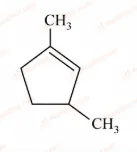
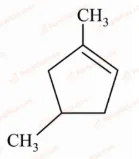
Which compound would give 5-keto-2-methyl hexanal upon ozonolysis?

  1. A
    Figure for JEE Main 2015 Chemistry question on Preparation of aldehydes and ketones
  2. B
    Figure for JEE Main 2015 Chemistry question on Preparation of aldehydes and ketones
  3. C
    Figure for JEE Main 2015 Chemistry question on Preparation of aldehydes and ketones
  4. D
    Figure for JEE Main 2015 Chemistry question on Preparation of aldehydes and ketones
Q56Preparation of aldehydes and ketonesTRANSCRIBED

In the following sequence of reactions:
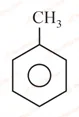
Toluene →KMnO4\xrightarrow{KMnO_4} A →SOCl2\xrightarrow{SOCl_2} B →BaSO4H2/Pd\xrightarrow[ BaSO_4]{H_2/Pd} C
The Product C is:

  1. A

    C6H5CHOC_6H_5CHO

  2. B

    C6H5COOHC_6H_5COOH

  3. C

    C6H5CH3C_6H_5CH_3

  4. D

    C6H5CH2OHC_6H_5CH_2OH

Q58Important polymers and their monomersTRANSCRIBED

Which polymer is used in the manufacture of paints and lacquers?

  1. A

    Poly vinyl chloride

  2. B

    Bakelite

  3. C

    Glyptal

  4. D

    Polypropene

Q59Drugs and medicinesTRANSCRIBED

Which of the following compounds is not an antacid?

  1. A

    Ranitidine

  2. B

    Aluminium hydroxide

  3. C

    Cimetidine

  4. D

    Phenelzine

Q60Vitamins and hormonesTRANSCRIBED

Which of the vitamins given below is water soluble?

  1. A

    Vitamin K

  2. B

    Vitamin C

  3. C

    Vitamin D

  4. D

    Vitamin E

NEXT IN THIS PAPER →Maths, Q61 onwards