JEE ADVANCED 2008 · PAPER 2HARDTRANSCRIBED
JEE Advanced 2008 Chemistry question — Properties and reactions of alcohols
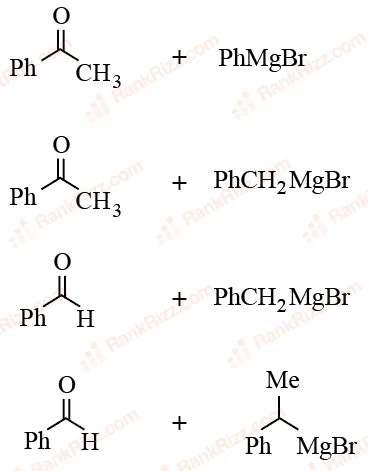
Compound H is formed by the reaction of
SOLUTION
Key idea: Work backwards from the ozonolysis products.
Passage facts (2008 paper): tertiary alcohol H → (acid, −H₂O) → alkene I → ozonolysis → J + K. J with KOH gives benzyl alcohol + L, so J is PhCHO (Cannizzaro). K with KOH gives only M, so K is an enolisable ketone, PhCOCH₃ (self-aldol).
- J = PhCHO and K = PhCOCH₃, so I must be .
- I comes from dehydrating a tertiary alcohol with the OH on the carbon that carries and Ph: H = .
- Grignard disconnection at the carbinol carbon:
- The other combinations give the wrong skeleton or a secondary alcohol: Figure 1 gives , and Figures 3 and 4 use PhCHO, which gives secondary alcohols.
Answer: (B) Figure 2 (acetophenone + PhCH₂MgBr)
Tagged Properties and reactions of alcohols. Machine-assigned, so read it as a strong shortlist rather than a verdict.