Q17Analysis of anionsTRANSCRIBED
During sodium nitroprusside test of sulphide ion in an aqueous solution, one of the ligands coordinated to the metal ion is converted to
- A
NOS
- B
SCN
- C
SNO
- D
NCS
The 16 Chemistry questions of JEE Advanced 2025 Paper 2, numbered across the whole paper. Pick an answer on any question to check it against the key. Free to read, nothing to download.
During sodium nitroprusside test of sulphide ion in an aqueous solution, one of the ligands coordinated to the metal ion is converted to
NOS
SCN
SNO
NCS
The complete hydrolysis of ICl, ClF and BrF, respectively, gives
IO, ClO and BrO
IO, ClO and BrO
IO, ClO and BrO
IO, ClO and BrO
Monocyclic compounds P, Q, R and S are the major products formed in the reaction sequences given below.
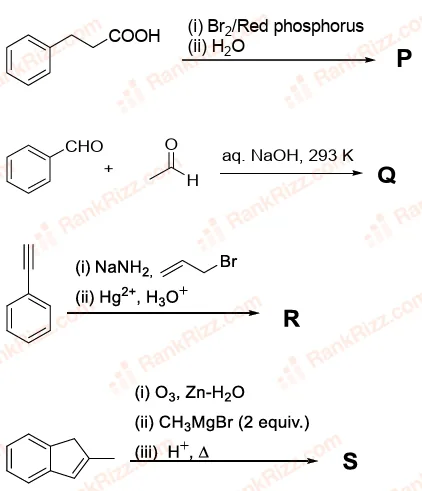
The product having the highest number of unsaturated carbon atom(s) is
P
Q
R
S
The correct reaction/reaction sequence that would produce a dicarboxylic acid as the major product is
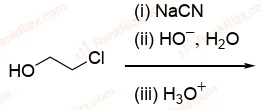
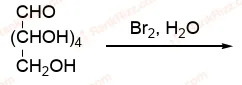
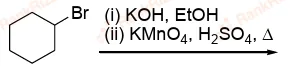
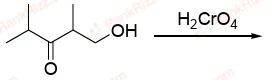
The correct statement(s) about intermolecular forces is(are)
The potential energy between two point charges approaches zero more rapidly than the potential energy between a point dipole and a point charge as the distance between them approaches infinity.
The average potential energy of two rotating polar molecules that are separated by a distance has dependence.
The dipole-induced dipole average interaction energy is independent of temperature.
Nonpolar molecules attract one another even though neither has a permanent dipole moment.
The compound(s) with P-H bond(s) is(are)
HPO
HPO
HPO
HPO
For the reaction sequence given below, the correct statement(s) is(are)

Both X and Y are oxygen containing compounds.
Y on heating with CHCl/KOH forms isocyanide.
Z reacts with Hinsberg's reagent.
Z is an aromatic primary amine.
For the reaction sequence given below, the correct statement(s) is(are)
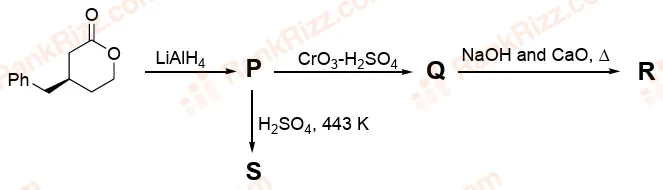
P is optically active.
S gives Bayer's test.
Q gives effervescence with aq. NaHCO.
R is an alkyne.
The density (in g cm) of the metal which forms a cubic close packed (ccp) lattice with an axial distance (edge length) equal to 400 pm is ______.
Use: Atomic mass of metal = 105.6 amu and Avogadro's constant = mol
The solubility of barium iodate in an aqueous solution prepared by mixing 200 mL of 0.010 M barium nitrate with 100 mL of 0.10 M sodium iodate is mol dm. The value of is ______.
Use: Solubility product constant () of barium iodate =
Adsorption of phenol from its aqueous solution on to fly ash obeys Freundlich isotherm. At a given temperature, from 10 mg g and 16 mg g aqueous phenol solutions, the concentrations of adsorbed phenol are measured to be 4 mg g and 10 mg g, respectively. At this temperature, the concentration (in mg g) of adsorbed phenol from 20 mg g aqueous solution of phenol will be ______.
Use:
Consider a reaction . The rate of this reaction is measured to be . At the start of the reaction, the concentration of , , is 10-times the concentration of , . The reaction can be considered to be a pseudo first order reaction with assumption that is constant. Due to this assumption, the relative error (in %) in the rate when this reaction is 40% complete, is ______.
[ and represent corresponding rate constants]
At 300 K, an ideal dilute solution of a macromolecule exerts osmotic pressure that is expressed in terms of the height (h) of the solution (density = 1.00 g cm) where h is equal to 2.00 cm. If the concentration of the dilute solution of the macromolecule is 2.00 g dm, the molar mass of the macromolecule is g mol. The value of is ______.
Use: Universal gas constant (R) = 8.3 J K mol and acceleration due to gravity (g) = 10 m s
An electrochemical cell is fueled by the combustion of butane at 1 bar and 298 K. Its cell potential is volts, where is the Faraday constant. The value of is ______.
Use: Standard Gibbs energies of formation at 298 K are: kJ mol; kJ mol; kJ mol
The sum of the spin only magnetic moment values (in B.M.) of [Mn(Br)] and [Mn(CN)] is ______.
A linear octasaccharide (molar mass = 1024 g mol) on complete hydrolysis produces three monosaccharides: ribose, 2-deoxyribose and glucose. The amount of 2-deoxyribose formed is 58.26% (w/w) of the total amount of the monosaccharides produced in the hydrolyzed products. The number of ribose unit(s) present in one molecule of octasaccharide is ______.
Use: Molar mass (in g mol): ribose = 150, 2-deoxyribose = 134, glucose = 180; Atomic mass (in amu): H = 1, O = 16