JEE Advanced 2025 Chemistry question — Properties and reactions of alcohols
For the reaction sequence given below, the correct statement(s) is(are)
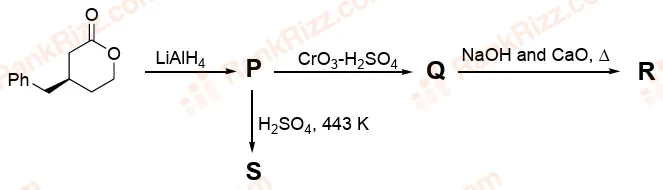
SOLUTION
The first step is the addition of a Grignard reagent to an aldehyde.
Propanal, , is treated with followed by hydrolysis.
The product P is -butanol. The carbon bearing the group is attached to four different groups , so it is chiral. Hence P is optically active. Therefore, statement A is correct.
Next, P is oxidised with a mild oxidising agent such as PCC (or ) to give compound Q.
Q is 2-butanone, a neutral ketone. Ketones do not react with aqueous , so Q will not produce effervescence of . Hence statement C is wrong.
The ketone Q is then completely reduced (Clemmensen or Wolff-Kishner reduction) to give compound R.
CH_3COCH_2CH_3 \;\xrightarrow{\text{Zn-Hg/HCl or N\!NH_2/KOH}}\; CH_3CH_2CH_2CH_3
R is n-butane, a saturated hydrocarbon containing no triple bond; therefore R is not an alkyne. Statement D is wrong.
Finally, R undergoes free-radical bromination with to give a mixture of bromoalkanes collectively represented as compound S.
Because all these bromoalkanes are fully saturated, they contain neither nor bonds. Saturated halides do not decolourise alkaline (Baeyer’s test), so S gives a negative Baeyer’s test. Statement B is wrong.
Thus, among the given statements only A is correct.
Option A which is: P is optically active.
Tagged Properties and reactions of alcohols. Machine-assigned, so read it as a strong shortlist rather than a verdict.