RankRizz

JEE Advanced 2022 Paper 1: Chemistry

The 18 Chemistry questions of JEE Advanced 2022 Paper 1, numbered across the whole paper. Pick an answer on any question to check it against the key. Free to read, nothing to download.

Chemistry

Q19Enthalpies of reaction and Hess's lawTRANSCRIBED

2 mol of Hg(g) is combusted in a fixed volume bomb calorimeter with excess of O2O_2 at 298 K and 1 atm into HgO(s). During the reaction, temperature increases from 298.0 K to 312.8 K. If heat capacity of the bomb calorimeter and enthalpy of formation of Hg(g) are 20.00 kJ K−1^{-1} and 61.32 kJ mol−1^{-1} at 298 K, respectively, the calculated standard molar enthalpy of formation of HgO(s) at 298 K is X kJ mol−1^{-1}. The value of |X| is ______.

[Given : Gas constant R = 8.3 J K−1^{-1} mol−1^{-1}]

Q20Electrode potentials, electrochemical series and cell EMFTRANSCRIBED

The reduction potential (E0E^0, in V) of MnO4−MnO_4^-(aq)/Mn(s) is ______.

[Given : EMnO4−(aq)/MnO2(s)0=1.68E^0_{MnO_4^-(aq)/MnO_2(s)} = 1.68 V ; EMnO2(s)/Mn2+(aq)0=1.21E^0_{MnO_2(s)/Mn^{2+}(aq)} = 1.21 V ; EMn2+(aq)/Mn(s)0=−1.03E^0_{Mn^{2+}(aq)/Mn(s)} = -1.03 V]

Q21pH of acids, bases and their mixturesTRANSCRIBED

A solution is prepared by mixing 0.01 mol each of H2CO3H_2CO_3, NaHCO3_3, Na2_2CO3_3, and NaOH in 100 mL of water. pH of the resulting solution is ______.

[Given : pKa1pK_{a1} and pKa2pK_{a2} of H2CO3H_2CO_3 are 6.37 and 10.32, respectively ; log 2 = 0.30]

Q22Stoichiometry, limiting reagent and percentage yieldTRANSCRIBED

The treatment of an aqueous solution of 3.74 g of Cu(NO3_3)2_2 with excess KI results in a brown solution along with the formation of a precipitate. Passing H2_2S through this brown solution gives another precipitate X. The amount of X (in g) is ______.

[Given : Atomic mass of H = 1, N = 14, O = 16, S = 32, K = 39, Cu = 63, I = 127]

Q23Group 15: trends and hydridesTRANSCRIBED

Dissolving 1.24 g of white phosphorous in boiling NaOH solution in an inert atmosphere gives a gas Q. The amount of CuSO4_4 (in g) required to completely consume the gas Q is ______.

[Given : Atomic mass of H = 1, O = 16, Na = 23, P = 31, S = 32, Cu = 63]

Q24Quantitative estimation of elementsTRANSCRIBED

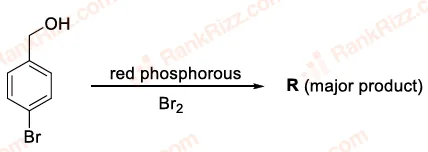
Consider the following reaction.

Figure for JEE Advanced 2022 Chemistry question on Quantitative estimation of elements

On estimation of bromine in 1.00 g of R using Carius method, the amount of AgBr formed (in g) is ______.

[Given : Atomic mass of H = 1, C = 12, O = 16, P = 31, Br = 80, Ag = 108]

Q25Stoichiometry, limiting reagent and percentage yieldTRANSCRIBED

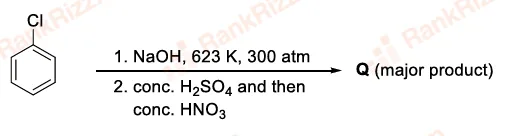
The weight percentage of hydrogen in Q, formed in the following reaction sequence, is ______.

Figure for JEE Advanced 2022 Chemistry question on Stoichiometry, limiting reagent and percentage yield

[Given : Atomic mass of H = 1, C = 12, N = 14, O = 16, S = 32, Cl = 35]

Q26Benzene and aromatic hydrocarbons: structure and preparationTRANSCRIBED

If the reaction sequence given below is carried out with 15 moles of acetylene, the amount of product D formed (in g) is ______.

Figure for JEE Advanced 2022 Chemistry question on Benzene and aromatic hydrocarbons: structure and preparation

The yields of A, B, C and D are given in parentheses.

[Given : Atomic mass of H = 1, C = 12, O = 16, Cl = 35]

Q27Molecular orbital theory of diatomic speciesTRANSCRIBED

For diatomic molecules, the correct statement(s) about the molecular orbitals formed by the overlap of two 2pzp_z orbitals is(are)

  1. A

    σ\sigma orbital has a total of two nodal planes.

  2. B

    σ∗\sigma^* orbital has one node in the xzxz-plane containing the molecular axis.

  3. C

    π\pi orbital has one node in the plane which is perpendicular to the molecular axis and goes through the center of the molecule.

  4. D

    π∗\pi^* orbital has one node in the xyxy-plane containing the molecular axis.

Q28Adsorption and adsorption isothermsTRANSCRIBED

The correct option(s) related to adsorption processes is(are)

  1. A

    Chemisorption results in a unimolecular layer.

  2. B

    The enthalpy change during physisorption is in the range of 100 to 140 kJ mol−1^{-1}.

  3. C

    Chemisorption is an endothermic process.

  4. D

    Lowering the temperature favors physisorption processes.

Q29Extraction of Fe, Cu, Zn, Al, Ag and AuTRANSCRIBED

The electrochemical extraction of aluminum from bauxite ore involves

  1. A

    the reaction of Al2_2O3_3 with coke (C) at a temperature > 2500°C.

  2. B

    the neutralization of aluminate solution by passing CO2_2 gas to precipitate hydrated alumina (Al2_2O3_3.3H2_2O)

  3. C

    the dissolution of Al2_2O3_3 in hot aqueous NaOH.

  4. D

    the electrolysis of Al2_2O3_3 mixed with Na3_3AlF6_6 to give Al and CO2_2.

Q30Group 15: trends and hydridesTRANSCRIBED

The treatment of galena with HNO3_3 produces a gas that is

  1. A

    paramagnetic

  2. B

    bent in geometry

  3. C

    an acidic oxide

  4. D

    colorless

Q31Reactions of carboxylic acidsTRANSCRIBED

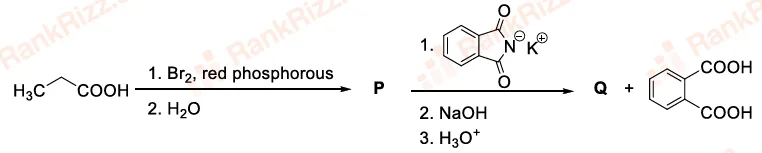
Considering the reaction sequence given below, the correct statement(s) is(are)

Figure for JEE Advanced 2022 Chemistry question on Reactions of carboxylic acids
  1. A

    P can be reduced to a primary alcohol using NaBH4_4.

  2. B

    Treating P with conc. NH4_4OH solution followed by acidification gives Q.

  3. C

    Treating Q with a solution of NaNO2_2 in aq. HCl liberates N2_2.

  4. D

    P is more acidic than CH3_3CH2_2COOH.

Q32Diazonium saltsTRANSCRIBED

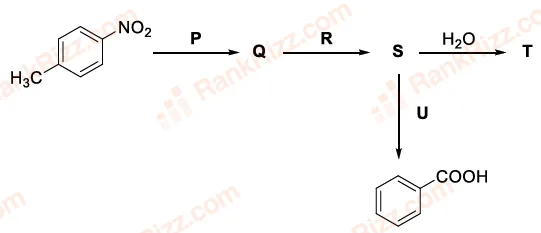
Consider the following reaction sequence,

Figure for JEE Advanced 2022 Chemistry question on Diazonium salts

the correct option(s) is(are)

  1. A
    Figure for JEE Advanced 2022 Chemistry question on Diazonium salts
  2. B
    Figure for JEE Advanced 2022 Chemistry question on Diazonium salts
  3. C
    Figure for JEE Advanced 2022 Chemistry question on Diazonium salts
  4. D
    Figure for JEE Advanced 2022 Chemistry question on Diazonium salts
Q33Rate law, order and molecularityTRANSCRIBED

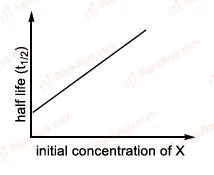
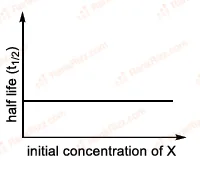
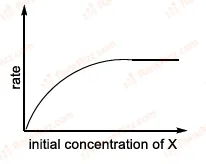
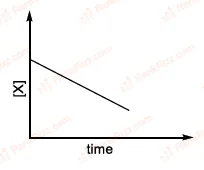
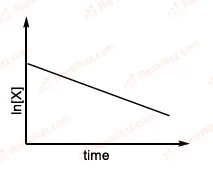
Match the rate expressions in LIST-I for the decomposition of X with the corresponding profiles provided in LIST-II. XsX_s and k constants having appropriate units.

LIST-ILIST-II
(I) rate = k[X]Xs+[X]\frac{k[X]}{X_s + [X]}, under all possible initial concentration of X(P) Figure for JEE Advanced 2022 Chemistry question on Rate law, order and molecularity
(II) rate = k[X]Xs+[X]\frac{k[X]}{X_s + [X]}, where initial concentration of X are much less than XsX_s(Q) Figure for JEE Advanced 2022 Chemistry question on Rate law, order and molecularity
(III) rate = k[X]Xs+[X]\frac{k[X]}{X_s + [X]}, where initial concentration of X are much higher than XsX_s(R) Figure for JEE Advanced 2022 Chemistry question on Rate law, order and molecularity
(IV) rate = k[X]2Xs+[X]\frac{k[X]^2}{X_s + [X]}, where initial concentration of X is much higher than XsX_s(S)Figure for JEE Advanced 2022 Chemistry question on Rate law, order and molecularity
(T) Figure for JEE Advanced 2022 Chemistry question on Rate law, order and molecularity
  1. A

    I →\to P; II →\to Q; III →\to S; IV →\to T

  2. B

    I →\to R; II →\to S; III →\to S; IV →\to T

  3. C

    I →\to P; II →\to Q; III →\to Q; IV →\to R

  4. D

    I →\to R; II →\to S; III →\to Q; IV →\to R

Q34Hydrogen peroxideTRANSCRIBED

LIST-I contains compounds and LIST-II contains reaction

LIST-ILIST-II
(I) H2_2O2_2(P) Mg(HCO3_3)2_2 + Ca(OH)2_2 →\to
(II) Mg(OH)2_2(Q) BaO2_2 + H2_2SO4_4 →\to
(III) BaCl2_2(R) Ca(OH)2_2 + MgCl2_2 →\to
(IV) CaCO3_3(S) BaO2_2 + HCl →\to
(T) Ca(HCO3_3)2_2 + Ca(OH)2_2 →\to

Match each compound in LIST-I with its formation reaction(s) in LIST-II, and choose the correct option

  1. A

    I →\to Q; II →\to P; III →\to S; IV →\to R

  2. B

    I →\to T; II →\to P; III →\to Q; IV →\to R

  3. C

    I →\to T; II →\to R; III →\to Q; IV →\to P

  4. D

    I →\to Q; II →\to R; III →\to S; IV →\to P

Q35Colour and magnetic behaviour of complexes from CFTTRANSCRIBED

LIST-I contains metal species and LIST-II contains their properties.

LIST-ILIST-II
(I) [Cr(CN)6]4−[Cr(CN)_6]^{4-}(P) t2gt_{2g} orbitals contain 4 electrons
(II) [RuCl6]2−[RuCl_6]^{2-}(Q) μ\mu(spin-only) = 4.9 BM
(III) [Cr(H2O)6]2+[Cr(H_2O)_6]^{2+}(R) low spin complex ion
(IV) [Fe(H2O)6]2+[Fe(H_2O)_6]^{2+}(S) metal ion in 4+ oxidation state
(T) d4d^4 species

[Given : Atomic number of Cr = 24, Ru = 44, Fe = 26]

Match each metal species in LIST-I with their properties in LIST-II, and choose the correct option

  1. A

    I →\to R, T; II →\to P, S; III →\to Q, T; IV →\to P, Q

  2. B

    I →\to R, S; II →\to P, T; III →\to P, Q; IV →\to Q, T

  3. C

    I →\to P, R; II →\to R, S; III →\to R, T; IV →\to P, T

  4. D

    I →\to Q, T; II →\to S, T; III →\to P, T; IV →\to Q, R

Q36Quantitative estimation of elementsTRANSCRIBED

Match the compounds in LIST-I with the observation in LIST-II, and choose the correct option.

LIST-ILIST-II
(I) Aniline(P) Sodium fusion extract of the compound on boiling with FeSO4_4, followed by acidification with conc. H2_2SO4_4, gives Prussian blue color.
(II) o-Cresol(Q) Sodium fusion extract of the compound on treatment with sodium nitroprusside gives blood red color.
(III) Cysteine(R) Addition of the compound to a saturated solution of NaHCO3_3 results in effervescence.
(IV) Caprolactam(S) The compound reacts with bromine water to give a white precipitate.
(T) Treating the compound with neutral FeCl3_3 solution produces violet color.
  1. A

    I →\to P, Q; II →\to S; III →\to Q, R; IV →\to P

  2. B

    I →\to P; II →\to R, S; III →\to R; IV →\to Q, S

  3. C

    I →\to Q, S; II →\to P, T; III →\to P; IV →\to S

  4. D

    I →\to P, S; II →\to T; III →\to Q, R; IV →\to P

NEXT IN THIS PAPER →Maths, Q37 onwards