JEE ADVANCED 2022 · PAPER 1+4 / −2MEDIUMTRANSCRIBED
JEE Advanced 2022 Chemistry question — Diazonium salts
Consider the following reaction sequence,
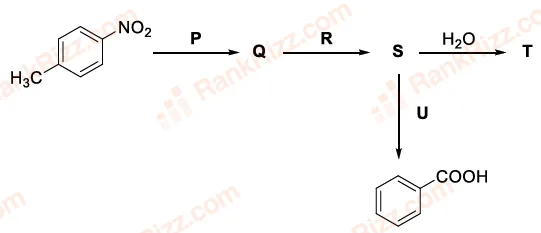
the correct option(s) is(are)
SOLUTION
Key idea: Reduce to , diazotise, then either hydrolyse (giving a phenol) or deaminate and oxidise the side chain (giving benzoic acid).
- P reduces p-nitrotoluene to p-toluidine (Q). Either or works.
- R (, i.e. at 0–5 °C) diazotises Q, giving S = p-methylbenzenediazonium chloride.
- p-cresol, so T = p-cresol.
- U must first replace by H (using or ethanol) to give toluene. –KOH with heat then oxidises to (after acidification), giving benzoic acid.
Checking each option:
- (A) P = , R = , U = then . Correct.
- (B) P = Sn/HCl, R = , S = p-tolyl diazonium chloride. Correct.
- (C) S = diazonium salt, T = p-cresol, U = then . Correct.
- (D) If Q were p-nitrobenzoic acid, T would be p-hydroxybenzoic acid, not p-cresol. Incorrect.
Answer: (A), (B), (C)
Tagged Diazonium salts. Machine-assigned, so read it as a strong shortlist rather than a verdict.