RankRizz

JEE Advanced 2008 Paper 1: Maths

The 23 Maths questions of JEE Advanced 2008 Paper 1, numbered across the whole paper. Pick an answer on any question to check it against the key. Free to read, nothing to download.

Maths

Q47Common tangents involving a parabolaTRANSCRIBED

Consider the two curves
C1:y2=4xC_1 : y^2 = 4x
C2:x2+y2−6x+1=0C_2 : x^2 + y^2 - 6x + 1 = 0
Then,

  1. A

    C1C_1 and C2C_2 touch each other only at one point

  2. B

    C1C_1 and C2C_2 touch each other exactly at two points

  3. C

    C1C_1 and C2C_2 intersect (but do not touch) at exactly two points

  4. D

    C1C_1 and C2C_2 neither intersect nor touch each other
Q48Properties and simplification of inverse trigonometric functionsTRANSCRIBED

If 0<x<10 < x < 1, then
1+x2[{xcos⁡(cot⁡−1x)+sin⁡(cot⁡−1x)}2−1]12=\sqrt{1 + x^2}[\left\{x \cos (\cot^{-1} x) + \sin(\cot^{-1} x)\right\}^2 - 1]^{\frac{1}{2}}=

  1. A

    x1+x2\frac{x}{\sqrt{1 + x^2}}

  2. B

    xx

  3. C

    x1+x2x\sqrt{1 + x^2}

  4. D

    1+x2\sqrt{1 + x^2}

Q49Scalar triple product and coplanarityTRANSCRIBED

The edges of a parallelopiped are of unit length andare parallel to non-coplanar unit vectors a^,b^,c^\hat{a}, \hat{b}, \hat{c} such that
a^.b^=b^.c^=c^.a^=12\hat{a} . \hat{b} = \hat{b} . \hat{c} = \hat{c} . \hat{a} = \frac{1}{2}.
Then, the volume of the parallelopiped is

  1. A

    12\frac{1}{\sqrt{2}}

  2. B

    122\frac{1}{2\sqrt{2}}

  3. C

    32\frac{\sqrt{3}}{2}

  4. D

    13\frac{1}{\sqrt{3}}

Q50Pair of straight linesTRANSCRIBED

Let a and b be non-zero real numbers. Then, the equation
(ax2+by2+c)(x2−5xy+6y2)=0(ax^2 + by^2 + c)(x^2 - 5xy + 6y^2) = 0
represents

  1. A

    four straight lines, when c = 0 and a, b are of the same sign

  2. B

    two straight lines and a circle, when a = b, and c is of sign opposite to that of a

  3. C

    two straight lines and a hyperbola, when a and b are of the same sign and c is of sign opposite to that of a

  4. D

    a circle and an ellipse, when a and b are of the same sign and is of sign opposite to that of a

Q51Differentiability at a pointTRANSCRIBED

Let
g(x)=(x−1)nlog⁡cos⁡m(x−1);0<x<2g(x) = \frac{(x - 1)^n}{\log \cos^m (x - 1)};0 < x < 2, m and n are integers, m≠0,n>0m \neq 0, n > 0, and let p be the left hand derivative of ∣x−1∣\mid x - 1 \mid at x=1.
If lim⁡x→1+g(x)=p\lim_{x \rightarrow 1+}g(x) = p, then

  1. A

    n = 1, m = 1

  2. B

    n = 1, m = -1

  3. C

    n = 2, m = 2

  4. D

    n > 2, m = n

Q52Optimization word and geometry problemsTRANSCRIBED

The total number of local maxima and local minima of the function
f(x)={(2+x)3,−3<x≤−1x23−1<x<2f(x) = \begin{cases}(2 + x)^3, & -3<x \leq -1\\x^{\frac{2}{3}} & -1 < x < 2\end{cases} is

  1. A

    0

  2. B

    1

  3. C

    2

  4. D

    3

Q53Equation of a circle in various formsTRANSCRIBED

A straight line through the vertex P of a triangle PQR intersects the side QR at the point S and the circumcircle of the triangle PQR at the point T. If S is not the centre of the circumcircle, then

  1. A

    1PS+1ST<2QS+SR\frac{1}{PS} + \frac{1}{ST} < \frac{2}{\sqrt{QS+SR}}

  2. B

    1PS+1ST>2QS+SR\frac{1}{PS} + \frac{1}{ST} > \frac{2}{\sqrt{QS+SR}}

  3. C

    1PS+1ST<4QR\frac{1}{PS} + \frac{1}{ST} < \frac{4}{QR}

  4. D

    1PS+1ST>4QR\frac{1}{PS} + \frac{1}{ST} > \frac{4}{QR}

Q54Chords, position of a point and locus on ellipseTRANSCRIBED

Let P(x1,y1)P(x_1, y_1) and Q(x2,y2),y1<0,y2<0Q(x_2, y_2), y_1 < 0, y_2 < 0, be the end of the latus rectum of the ellipse x2+4y2=4x^2 + 4y^2 = 4. The equations of parabolas with latus rectum PQ are

  1. A

    x2+23y=3+3x^2 + 2\sqrt{3} y = 3+\sqrt{3}

  2. B

    x2−23y=3+3x^2 - 2\sqrt{3} y = 3+\sqrt{3}

  3. C

    x2+23y=3−3x^2 + 2\sqrt{3} y = 3-\sqrt{3}

  4. D

    x2−23y=3−3x^2 - 2\sqrt{3} y = 3-\sqrt{3}

Q55Sums of natural numbers, squares and cubesTRANSCRIBED

Let
Sn=∑k=1nnn2+kn+k2S_n = \sum_{k=1}^{n}\frac{n}{n^2 + kn + k^2} and Tn=∑k=0n−1nn2+kn+k2T_n = \sum_{k=0}^{n-1}\frac{n}{n^2 + kn + k^2}, for n=1,2,3,...,n = 1, 2, 3, ..., Then,

  1. A

    Sn<π33S_n < \frac{\pi}{3\sqrt{3}}

  2. B

    Sn>π33S_n > \frac{\pi}{3\sqrt{3}}

  3. C

    Tn<π33T_n < \frac{\pi}{3\sqrt{3}}

  4. D

    Tn>π33T_n > \frac{\pi}{3\sqrt{3}}

Q56Differentiability at a pointTRANSCRIBED

Let f(x) be a non-constant twice differentiable function defined on (−∞,∞)(-\infty, \infty) such that f(x) = f(1 - x) and f′(14)=0f'\left(\frac{1}{4}\right) = 0. Then,

  1. A

    f′′(x)f''(x) vanishes at least twice on [0, 1]

  2. B

    f′(12)=0f'\left(\frac{1}{2}\right) = 0

  3. C

    ∫−1212f(x+12)sin⁡xdx=0\int_{-\frac{1}{2}}^{\frac{1}{2}}f\left(x + \frac{1}{2}\right)\sin x dx = 0

  4. D

    ∫012f(t)esin⁡πtdt=∫121f(1−t)esin⁡πtdt\int_{0}^{\frac{1}{2}}f(t)e^{\sin \pi t} dt = \int_{\frac{1}{2}}^{1}f(1 - t)e^{\sin \pi t} dt

Q57Higher order derivativesTRANSCRIBED

Let f and g be real valued functions defined on interval (-1, 1) such that g′′(x)g''(x) is continuous, g(0)≠0,g′(0)=0,g′′(0)≠0g(0) \neq 0, g'(0) = 0, g''(0) \neq 0, and f(x)=g(x)sin⁡xf(x) = g(x)\sin x.
STATEMENT-1: lim⁡x→0[g(x)cot⁡x−g(0)cosec⁡x]=f′′(0).\lim_{x \rightarrow 0}[g(x)\cot x - g(0) \cosec x] =f''(0).
STATEMENT-2: f′(0)=g(0)f'(0) = g(0).

  1. A

    STATEMENT-1 is True, STATEMENT-2 is True; STATEMENT-2 is a correct explanation for STATEMENT-1

  2. B

    STATEMENT-1 is True, STATEMENT-2 is True; STATEMENT-2 is NOT a correct explanation for STATEMENT-1

  3. C

    STATEMENT-1 is True, STATEMENT-2 is False

  4. D

    STATEMENT-1 is False, STATEMENT-2 is True

Q58Equation of a planeTRANSCRIBED

Consider three planes
P1:x−y+z=1P_1 : x - y + z = 1
P2:x+y−z=−1P_2 : x + y - z = -1
P3:x−3y+3z=2P_3 : x - 3y + 3z = 2.
Let L1,L2,L3L_1, L_2, L_3 be the lines of interaction of the planes P2P_2 and P3,P3P_3, P_3 and P1,P_1, and P1P_1 and P2P_2, respectively.
STATEMENT-1: At least two of the lines L1,L2L_1, L_2, and L3L_3 are non-parallel.
and
STATEMENT-2: The three planes do not have a common point.

  1. A

    STATEMENT-1 is True, STATEMENT-2 is True; STATEMENT-2 is a correct explanation for STATEMENT-1

  2. B

    STATEMENT-1 is True, STATEMENT-2 is True; STATEMENT-2 is NOT a correct explanation for STATEMENT-1

  3. C

    STATEMENT-1 is True, STATEMENT-2 is False

  4. D

    STATEMENT-1 is False, STATEMENT-2 is True

Q59Systems of linear equationsTRANSCRIBED

Consider the system of equations
x−2y+3z=−1x - 2y + 3z = -1
−x+y−2z=k-x + y - 2z = k
x−3y+4z=1x - 3y + 4z = 1.
STATEMENT-1: The system of equations has no solution for k≠3k \neq 3.
and
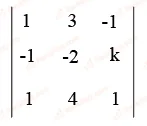
STATEMENT-2: The determinant

Figure for JEE Advanced 2008 Mathematics question on Systems of linear equations

≠0\neq 0, for k≠3k \neq 3.

  1. A

    STATEMENT-1 is True, STATEMENT-2 is True; STATEMENT-2 is a correct explanation for STATEMENT-1

  2. B

    STATEMENT-1 is True, STATEMENT-2 is True; STATEMENT-2 is NOT a correct explanation for STATEMENT-1

  3. C

    STATEMENT-1 is True, STATEMENT-2 is False

  4. D

    STATEMENT-1 is False, STATEMENT-2 is True

Q60Addition theorem and algebra of eventsTRANSCRIBED

Consider the system of equations
ax+by=0,cx+dy=0ax + by = 0,cx + dy = 0, where a,b,c,d∈{0,1}a, b, c, d \in \left\{0, 1\right\}.
STATEMENT-1: The probability that the system of equations has a unique solution is 38\frac{3}{8}
and
STATEMENT-2: The probability that the system of equations hasa solution is 1.

  1. A

    STATEMENT-1 is True, STATEMENT-2 is True; STATEMENT-2 is a correct explanation for STATEMENT-1

  2. B

    STATEMENT-1 is True, STATEMENT-2 is True; STATEMENT-2 is NOT a correct explanation for STATEMENT-1

  3. C

    STATEMENT-1 is True, STATEMENT-2 is False

  4. D

    STATEMENT-1 is False, STATEMENT-2 is True

Q61Tangents and normals to a circleTRANSCRIBED

The equation of circle C is

  1. A

    (x−23)2+(y−1)2=1(x - 2\sqrt{3})^2+(y-1)^2 = 1

  2. B

    (x−23)2+(y+12)2=1(x - 2\sqrt{3})^2+\left(y+\frac{1}{2}\right)^2 = 1

  3. C

    (x−3)2+(y+1)2=1(x - \sqrt{3})^2+(y+1)^2 = 1

  4. D

    (x−3)2+(y−1)2=1(x - \sqrt{3})^2+(y-1)^2 = 1

Q62Tangents and normals to a circleTRANSCRIBED

Points E and F are given by

  1. A

    (32,32),(3,0)\left(\frac{\sqrt{3}}{2}, \frac{3}{2}\right), \left(\sqrt{3}, 0\right)

  2. B

    (32,12),(3,0)\left(\frac{\sqrt{3}}{2}, \frac{1}{2}\right), \left(\sqrt{3}, 0\right)

  3. C

    (32,32),(32,12)\left(\frac{\sqrt{3}}{2}, \frac{3}{2}\right), \left(\frac{\sqrt{3}}{2}, \frac{1}{2}\right)

  4. D

    (32,32),(32,12)\left(\frac{3}{2}, \frac{\sqrt{3}}{2}\right), \left(\frac{\sqrt{3}}{2}, \frac{1}{2}\right)

Q63Tangents and normals to a circleTRANSCRIBED

Equations of the sides QR, RP are

  1. A

    y=23x+1,y=−23x−1y = \frac{2}{\sqrt{3}}x + 1, y = -\frac{2}{\sqrt{3}}x - 1

  2. B

    y=13x,y=0y = \frac{1}{\sqrt{3}}x, y = 0

  3. C

    y=32x+1,y=−32x−1y = \frac{\sqrt{3}}{2}x + 1, y = -\frac{\sqrt{3}}{2}x - 1

  4. D

    y=3x,y=0y = \sqrt{3}x, y = 0

Q64Implicit and parametric differentiationTRANSCRIBED

If f(−102)=22f(-10\sqrt{2}) = 2\sqrt{2}, then f′′(−102)=f''(-10\sqrt{2}) =

  1. A

    427332\frac{4\sqrt{2}}{7^33^2}

  2. B

    −427332-\frac{4\sqrt{2}}{7^33^2}

  3. C

    \frac{4\sqrt{2}}{7^3 3

  4. D

    −42733-\frac{4\sqrt{2}}{7^3 3}

Q65Area between curvesTRANSCRIBED

The area of the region bounded by the curve y = f(x), the x-axis, and the lines x = a and x = b, where −∞<a<b<−2-\infty < a < b < -2, is

  1. A

    ∫abx3((f(x))2−1)dx+bf(b)−af(a)\int_{a}^{b} \frac{x}{3\left((f(x))^2 - 1\right)}dx + bf(b) - af(a)

  2. B

    −∫abx3((f(x))2−1)dx+bf(b)−af(a)-\int_{a}^{b} \frac{x}{3\left((f(x))^2 - 1\right)}dx + bf(b) - af(a)

  3. C

    ∫abx3((f(x))2−1)dx−bf(b)+af(a)\int_{a}^{b} \frac{x}{3\left((f(x))^2 - 1\right)}dx - bf(b) + af(a)

  4. D

    −∫abx3((f(x))2−1)dx−bf(b)+af(a)-\int_{a}^{b} \frac{x}{3\left((f(x))^2 - 1\right)}dx - bf(b) + af(a)

Q66Leibniz rule for differentiating integralsTRANSCRIBED

∫−11g′(x)dx=\int_{-1}^{1} g'(x)dx =

  1. A

    2g(-1)

  2. B

    0

  3. C

    -2g(1)

  4. D

    2g(1)

Q67Locus and regions in the Argand planeTRANSCRIBED

The number of elements in the set A⋂B⋂CA \bigcap B \bigcap C is

  1. A

    0

  2. B

    1

  3. C

    2

  4. D

    ∞\infty

Q68Locus and regions in the Argand planeTRANSCRIBED

Let z be any point in A⋂B⋂CA \bigcap B \bigcap C. Then, ∣z+1−i∣2+∣z−5−i∣2\mid z + 1 - i \mid^2 + \mid z - 5 - i \mid^2 lies between

  1. A

    25 and 29

  2. B

    30 ad 34

  3. C

    35 and 39

  4. D

    40 and 44

Q69Locus and regions in the Argand planeTRANSCRIBED

Let z be any point in A⋂B⋂CA \bigcap B \bigcap C and let w be any point satisfying ∣w−2−i∣<3\mid w - 2 - i \mid < 3. Then, ∣z∣−∣w∣+3\mid z \mid - \mid w \mid + 3 lies between

  1. A

    -6 and 3

  2. B

    -3 and 6

  3. C

    -6 and 6

  4. D

    -3 and 9